Author Archives: michaelwhitworth

#31songs (13): ‘Weightless’, by the Blue Aeroplanes

#31songs (13): A song about other worlds

‘Weightless’, by The Blue Aeroplanes, from Swagger

The ‘song about’ formula doesn’t suit The Blue Aeroplanes, as, like a lot of symbolist and modernist poetry, Gerard Langley’s lyrics resist reduction to a theme or a message.  How we interpret the lyrics to ‘Weightless’ depends a lot on the music, and if I say these are lyrics about ‘other worlds’, it’s because of various references to space-flight, and particularly the line repeated regretfully and yet self-deprecatingly after the song has subsided from its climax: ‘I liked being weightless best’.  The lyrics manage to articulate the listener’s own regret that the song will soon be over, and a feeling that its intensity can never be regained.

YouTube video

The song starts gently; the melodic guitar line has a folky flavour that I can’t help but think of as Scottish; perhaps because of the hammer-on from B to D, perhaps because of the way that the interval of G to D dominates.  (Compare the instrumental ‘For Tim Collins’ on Friendloverplane 2, which has a similar electric guitar sound in it, or the opening of ‘Autumn Journal XXIV‘, which I hope to come back to in a later post.) The bass comes in with a descending line, interplaying delicately with the other guitars. The first 25 seconds are perfection; then there’s heavily reverbed drum part that sounded just fine in 1990 but is now the one thing in the whole song that feels dated. But it can be forgiven. The whole pace suggests a band utterly confident in themselves: they can create an atmosphere that leads us into the core of the song and they’re sure we won’t grow impatient; each new bar, or at least each return to the start of the sequence of chords, brings something new.

In contrast with the attention-grabbing opening of ‘Jacket Hangs’, the vocals here begin in an understated way, as if picking up a conversation that had already been underway.  The expressive variety in this song makes it one of Gerard Langley’s greatest performances. What the ‘it’ of the opening verse might be we can only infer: it could be some unarticulated disagreement that’s destroying a relationship from within; with the phrase about drink that follows, we seem to be in the same lyrical territory as some of the Spitting Out Miracles songs.  But what is ‘the guide’?  In being ‘shuttle-bound’ are they on their way to an airport shuttle-bus, moving on without having really resolved things, or on their way to the space shuttle?  I don’t think of Langley as a writer of science-fiction lyrics, but this one is titled ‘Weightless’, so it’s not impossible to think of it as set in outer space.  That too would make sense of ‘half the world’s / floating in space’: one side of the globe, seen from space.  (According to Richard Bell’s blog, the song was part of the live set in the October-November 1988 tour, and it was around this time that Space Shuttle flights resumed following the Challenger disaster of January 1986. In that context, being ‘shuttle-bound’ has connotations of defiant determination.)

One of my biggest problems in interpreting this lyric is a crucial difference between the printed text and what Gerard performs on the record.  It comes as the song rises to a climax and the vocals come back in after an instrumental break.  The sleeve notes have people ‘swaying and guinea-wormed’, but in the performance it sounds more like ‘swaying and scrubland‘ or maybe ‘swaying and scrubbed-out‘.  The guinea-worm makes sense of much else in the lyric, especially the something ‘growing inside’ and ‘when it’s out it’ll just / poison the bloody water again’, and ‘working down the body slowly’ might be a reference to the worm coming out of a limb.  The guinea-worm could be the ‘it’ of the opening verse.  Whatever the ‘it’ might be, it’s parasitic and destructive, but the fifth and sixth verses propose something even more complex — ‘That what’s living / inside comes from a shared necessity’ — which might also explain the ‘sinister babies’: they’ve made this things together, and can never get rid of it.

The coda to the song, ‘Ok, we can go for a quick drink after work’, manages an astonishing though abrupt transition of tone, as if the speaker were trying to cover up the passionate confrontation (sinister parasites, spaceflight, and so on) with socially conventional compromises. Musically, too, the band manage a wonderful transition of atmosphere, from the powerful middle section to something that resembles the opening in its quiet reflective tone, but isn’t exactly the same.  I especially like the descending chromatic sequence of notes on one of the guitars (A, G#, G, F#), which brings a tone of foreboding to the conclusion, as if the whatever poisoned the bloody water is already preparing to come back.  And of course on the album, they start to fade in the echoing notes that introduce ‘… And Stones’.


LYRICS

If we can’t destroy it straight,
we could at least murder it,
burn it out as we crash the guide.
But no, we’re shuttle-bound
and poker-faced, we talk it
under the table, thinking hearts

And dry flowers played against us
crook the bloody circumstance.
That said, violence is like drink.
One’s too many and a hundred’s
not enough. Or one’s too many
and a hundred brooks no argument.

The sound of violins drowned in
gunfire. It’s the water of life.
At the edge of our sight, half
the world’s floating in space
like diagrams with consequence,
and how much falls to anyone else?

Walking down this hillside
to clear water, there’s something
breathing, growing inside like
sinister babies, the trees
pollarded like love gone awry.
Now swaying and guinea-wormed,

people in the way of crowds grown
aimless and bitter crack the ground.
The skies light with satellites,
the windows light with booby-traps.
Working down the body slowly,
hit on this! That what’s living

inside comes from a shared necessity
and when it’s out it’ll just
poison the bloody water again.
Ok, we can go for a quick drink
after work, it’s a way of life, sure
but I liked being weightless best …
Virginia Woolf’s Orlando and the country house

My blog post on Woolf’s Orlando is now available on the OUP blog:

http://blog.oup.com/2014/12/virginia-woolf-orlando-country-house/

The source for the quotations from Angela Carter is a YouTube video of Tom Paulin’s notorious J’accuse programme about Woolf. The two parts available are labelled as parts 2 and 3, but I’ve not been able to find part 1 anywhere:

https://www.youtube.com/watch?v=sBxbrk_g_Bs

https://www.youtube.com/watch?v=yYL2GTXR7MY

Angela Carter’s contribution comes just after 1m 27s in “part 2”; I’d first come across the ‘slobbering valentine’ bit in a newspaper review of the programme.  I must admit I’ve not watched both parts: the arguments are so tendentious that it’s hard to take seriously: for example, Clarissa Dalloway’s patriotic statement in The Voyage Out is offered as if it reflects its author’s views (which it obviously does not); the error in the reading is acknowledged, and then Paulin ploughs on regardless, treating a piece of unpleasantness in the diaries as if it rescued his argument about Clarissa.

#31songs (12): Jacket Hangs, by the Blue Aeroplanes

#31songs (12): Best opening

‘Jacket Hangs’, by the Blue Aeroplanes, from Swagger (1990)

There’s an official video for this one, or alternatively a YouTube version.

If there’s a single song on Swagger that earns the album its title, it’s the opening one.  There’s a confidence about the performances that hadn’t come through on the previous albums, and it all starts with Gerard’s opening line of ‘Jacket Hangs’: ‘Pick a card, any card … Wrong!’  But the swagger is there in the music as well, and especially on this track, which builds on the heave-ho sea shanty rhythm that I mentioned in ‘Bury Your Love Like Treasure’.  You can hear it coming through in ‘Warhol’s Fifteen’, a song the band first recorded on Tolerance, but which they later reworked; the characteristic rhythm is much stronger in the version that was collected on Friendloverplane.

Warhol’s Fifteen (YouTube of the Tolerance version)

Warhol’s Fifteen (Spotify of the Friendloverplane version)

It’s never exactly the same rhythm in any of these songs, but there’s a family resemblance.  There’s more swaggering in ‘Jacket Hangs’ in the lead guitar line, sometimes striding up and down the fretboard, sometimes cascading down it.  The guitar solo, when it comes, is actually nothing special, but it doesn’t need to be: there’s so much going on elsewhere.  After the solo the song strips down (around 2.25) and then after eight bars builds up again: another guitar comes in playing quickly strummed small chords (just the high strings), as if it wants to butt into the conversation, and then another guitar playing high chiming notes.

There’s a lot going on in the lyrics, too, some of the most insistently punning lyrics on any of the Aeroplanes’ albums; puns have a place in a certain kind of witty pop song (Andy Partridge is fond of them), but that kind of ostentatious wit isn’t usually Gerard Langley’s mode.  We ‘press and suit’; ‘Just so’ for ‘just sew’.  ‘Jacket Hangs’ is about surface and depths, appearance and identity, about the costumes we might wear in order to press a suit (to become a suitor?), to get from outside to inside in an emotional and sexual way.

LYRICS

Pick a card, any card.  Wrong. Pick nineteenth-century
twin-set pearls in a new clasp, brass neck, collar me
right. We need a suit, we press a suit

so collar me. Collar me siamese cat drapes,
roughneck honey.  [Quite the test for the unused boy.
Jacket hangs just so and you’re inside.]*

I believe in what passes for a centre, collar me
in spite of dress, your boyfriend link, crooked arm.
I want to see inside our most difficult act.

We press a suit, we swan about, from rack shop
to hanger blade, that line around your eyes means
you can see, see better than I can, than I see you.

Then I make contact. Swing, loosen up. Let those arms
Rotate like helicopter blades, lift. Little jump and skip
The rest. Like coral or groves the cards are marked

Your eyes are mine, coloured anew and set in train.
I passed the test, I think I passed, I think I’m fine.
Yes, jacket hangs just so and you’re inside.

*Lyrics in the liner notes that aren’t in the recorded version.

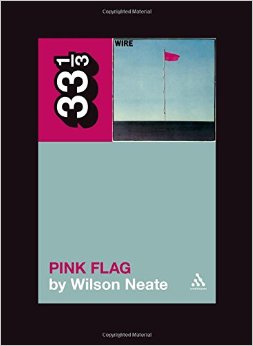
Pink Flag, by Wilson Neate

Pink Flag, by Wilson Neate

There’s a lot to like and a lot to admire about Wilson Neate’s Pink Flag (2008) in the 33 1/3rd series, and if in the end I have my reservations, they’re primarily reservations about the album, and reservations about the book only because Neate didn’t anticipate me as its reader.

Neate Pink Flag

Neate opens personally, narrating over two and a half pages how he first heard Wire, but the book really begins with the second chapter.  Here Neate introduces us to the band, member-by-member.  Doing this also enables him to establish some of the main reference points: the bands they were listening to in the 1960s and early 1970s; art school and Brian Eno. Here, as throughout the book, Neate draws on extensive new interviews with the band members.  Chapter three traces how they fitted into the punk scene, which they were part of, but which was settling into cliché by the time of their first performance. They were significantly older than many punk bands (the oldest, Bruce Gilbert, turned 30 in 1976), and their experience and their art-school background gave them some critical distance from the scene.  Chapter four gives us both an analysis of the main concepts at play in the structures of Wire’s songs, in particular, ideas about framing and subtraction.  And it also extracts the maximum comedic potential from the presence, personality, and removal of George Gill, one of the band’s guitarists in its early phase:

Gill was Keith Richards played by a Yorkshireman, a blunt, acerbic blues-rock purist …. flatmate Slim Smith remembers: “He was the college’s main rabble-rouser, always causing trouble in class and drinking heavily, which occasionally resulted in getting into fights.” Gilbert goes further, commenting that Gill often “looked like he was about to break into a fight with himself.” (p.59)

 The fifth chapter turns to the recording of the album. Neate points to there being disagreement about how important producer Mike Thorne was in creating Wire’s distinctive aesthetic and sound: the release in 2006 of their 1977 gig at the Roxy seems to have demonstrated that the band had nailed it before the producer became involved; on the other hand, the interviews with Thorne that Neate draws on throughout the book create a very sympathetic impression of him, both as regards the technicalities of production and the management of a band who were new to the studio environment and somewhat overawed by it.  There’s also a fabulous anecdote of Bruce Gilbert overindulging in Thorne’s herbal cigarettes on the first day to the extent that he thought they’d completed the recording and could pack up and go home.  (In fact the recording took about three weeks, with another three needed for mixing.)

The chapter of track-by-track analyses draws out the more general ideas in relation to particular songs, and sets further ideas in motion, placing songs on a spectrum of orthodox to experimental.  As there are twenty-one tracks on the album, each analysis is necessarily brief, some of them not more than a page, and in consequence, and by contrast to what went before, the chapter somewhat disjointed.  The final chapter, a mere six pages, considers the afterlife of the album, particularly as regards the revision of songwriting credits.  Neate takes what could is potentially a dry and technical question and uses it to reopen the larger conceptual issues underpinning Wire’s work — above all, what is a song — but it’s still not the conclusion I’d hope for in a really great book.

But I may not be Neate’s ideal reader.  I came to Wire relatively late, via their On Returning compilation CD, and have mixed feelings about them. On the one hand, they were capable of writing the most insanely catchy high-tempo guitar songs —  ‘Dot Dash’ in particular never fails to delight — but in spite of the energy and the at times snarly vocals, there’s something dry and cerebral about their work that means it feels one dimensional.  In this respect they’re like several other late 1970s bands: Talking Heads, another band with an art-school background, similarly accentuate the cerebral.  Likewise with them, I’m always pleased to hear their music, but in some way it doesn’t stay with me.

Neate’s book makes me admire Pink Flag more, but it doesn’t make me love it.  He does acknowledge that the band were sometimes ‘seen as too intellectual’ (p.40) and as ‘sterile’ (p.43), but his book isn’t designed to engage with those sorts of criticism: discussing Wire’s work in terms of framing keeps them at the cerebral level.  It’s much harder to devise a critical vocabulary that will allow the reader to recognise a flicker of an emotional reaction to a band and then to nurture that reaction into some kind of love for them. I wonder if, by interviewing the band and the producer, and building his book around those interviews, Neate got a narrow perspective, as any historian might if working with a limited set of sources.  There’s relatively little by way of quotation from contemporary reviews: how might the book have read if Neate had taken negative reviews as his starting point and worked outward from there?  Having said that, I’ve enjoyed Neate’s writing and analysis, and am tempted to read his later book, Read & Burn: A Book about Wire (2013).

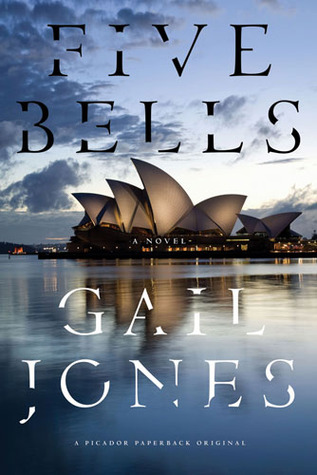
Five Bells, by Gail Jones

Five Bells, by Gail Jones

Five Bells, Gail Jones’s 2011 novel of four characters in one day in Sydney, first came to my attention through Jem Poster’s review for The Guardian, which made much of its similarities to Mrs Dalloway. My 2005 Authors in Context book on Virginia Woolf had included a chapter on the ways in which Woolf’s work is recontextualized by film adaptation and by the kinds of rewriting we find in Michael Cunningham’s The Hours and Robin Lippincott’s Mr Dalloway, so I was naturally interested to hear of another what might be another such work.  More recently I’ve been working on a reader’s guide to criticism of Mrs Dalloway, and thinking about what creative adaptations (principally The Hours) mean for our understanding of the original novel.  Critical articles that purport to be about both Mrs Dalloway and The Hours are often really only about the latter; they’re uninterested in how Cunningham’s adaptation might make us see the 1925 novel in a new light, or might simply remind us of its strengths.  (Seymour Chatman’s 2005 narratological comparison of the two is the most impressive exception to this rule.)

Jones Gail Five Bells

The novel concerns four characters on a January day in Sydney, all converging on the Circular Quay, from which the Sydney Opera House is visible. Two, Ellie and James, are Australian born (though James’s Italian ancestry is something he is particularly conscious of), and they were friends and lovers as teenagers. Now in their thirties (I think it’s set in 2010 or 2011), they have come to Circular Quay to meet again after many years; it slowly emerges that James, who for many years has been in poor mental health, has recently been involved in a tragic incident and wishes to tell Ellie about it.  The other two characters are Pei Xing, a Chinese-born woman who has settled in Australia, and Catherine, a young Irish woman who is there on holiday.  Each is preoccupied by memories: Pei Xing by her family’s persecution in the Chinese Cultural Revolution, and by her father’s work as a translator of Boris Pasternak’s Dr Zhivago; Catherine by  the death of her sparky, iconoclastic brother; James by a succession of traumatic incidents; Ellie, by less conspicuously painful memories of her teenage years.  In among these, several of them remember other bits and pieces, phrases from poems and novel and songs, so that when ‘No direction home’ turns up (p.174), you don’t doubt that ‘Like a Rolling Stone’ is being invoked.  (I can’t think of another novel that’s as relaxed as this one about popular song being part of the fabric of people’s emotional lives.)  Thematically, Five Bells is about the way we hold memories and that memories hold us; it’s about healthy and unhealthy relationships with the past; it’s about the value of re-engaging with the past, but also the value of detachment and disengagement.

On a first reading, prompted by Jem Poster’s comparison to Mrs Dalloway, it seems as if James is going to be an equivalent to Septimus Warren Smith, but this isn’t The Hours, and Jones isn’t attempting any straightforward mapping of Woolf’s characters on to her own.  Most importantly, there isn’t a Clarissa, no sane truth to set alongside James’s insane truth, no upper middle-class woman whose power contrasts with that of the lower middle-class male, no hostess of parties who might be seen (rightly or wrongly) as a redemptive figure. James is mentally unwell and taking medication, but his illness is nothing like as severe as Septimus’s.  Ellie is predisposed to happiness (I’m paraphrasing), but that attitude is significantly different from Clarissa’s more self-conscious and artificial celebratory trait.

Poster’s comparison is more relevant to what the characters (and Jones’s prose) register as they wander round central Sydney.  Five Bells is particularly good at noticing the urban soundscape:

[Ellie] was filled with corny delight and ordinary elation. Behind her, raddled train-noise reverberated up high, and the didgeridoo, now barely audible, continued its low soft moaning.  A child sounded a squeal. A ferry churned away.  From another came the clang of a falling gang-plank and the sound of passengers embarking (pp.3-4)

There’s an echo here of one of the passages early in Mrs Dalloway that defines Clarissa’s outlook:

In people’s eyes, in the swing, tramp, and trudge; in the bellow and the uproar; the carriages, motor cars, omnibuses, vans, sandwich men shuffling and swinging; brass bands; barrel organs; in the triumph and the jingle and the strange high singing of some aeroplane overhead was what she loved; life; London; this moment of June.

But it doesn’t feel like Jones is following Woolf slavishly; more that she’s selected the same palate, but modernised it and transposed it to contemporary Australia.  (The next thing we hear in the passage from Five Bells is ‘Jumping Jack Flash’.)

It’s modernised too in that eventually, but with an impressive inevitability, CCTV and contemporary surveillance culture comes into play.  Quite how Jones hints that this will be so, I’ve not determined, having read it only once, but halfway through I found myself wondering who or what was watching the four characters, and then, in the sixth and final chapter, there it was: a CCTV image capturing two of them.  It may be these expectations came from a recollection of Woolf’s plans for Mrs Dalloway, in which sketchy version Septimus would attempt assassinate the Prime Minister; that led me to wondering what James or another character might do, and how quickly they’d be spotted in a modern city centre.  Perhaps also a hazy recollection of Barbara Vine’s King Solomon’s Carpet, in which I think there might have been a terrorist. But it might simply come from the opening account of the four characters passing through a train station, talk of glimpses and ‘blurred partial vision’, and from Ellie’s reflections in chapter two about this being an age of mediation, and ‘relentless repetition’ of generic images of death and grief in newspapers and on TV. (It’s great though, that alongside those relatively conventional accounts of surveillance culture we can have Ellie’s recollection of her father’s word for old-fashioned aimless people-watching: lollygagging.)

What Five Bells illuminates about Mrs Dalloway is the way that Woolf’s novel relates the extraordinary to the everyday, the epoch-making to the quotidian.  Woolf’s account of Septimus’s insanity is intensely sympathetic, but Five Bells leads to the reflection that there’s something unfortunate about the way that Septimus’s illness has to be yoked to and derived from the Great War; the fact that the novel hints at other aetiologies (above all, Septimus’s sexuality) doesn’t diminish the problem.  Five Bells never really commits to an explanation of James’s illness. There is an early incident involving the slaughter of a chicken, which seems to have become a traumatic memory in the sense of a memory that can’t be assimilated into the main life narrative.  (The grammar describing it is tellingly ambiguous: ‘all of them caught in this drama with the headless chicken that would not do the right thing and straightaway, as it should, just lie down and die’ [p.61].  Is it the memory or the chicken that refuses to die?) But there are other factors for James — his family history, his mother’s own mental illness, the recent tragic incident — and the novel doesn’t want to place them in any kind of hierarchy.  In Catherine’s life, the epoch-changing event is the murder of the Irish journalist Veronica Guerin, but when we eventually learn about the cause of her brother’s death, it has no meaning on a worldwide scale.  (It’s interesting that we’re told Catherine adored U2 from an early age, as their songs so revel in the epic and the epoch-making, whether Bloody Sunday or Martin Luther King, but haven’t found much space for the everyday.  That preference, and the repeated references to Guerin, leave us expecting a more significant death for her brother.)  Its not that Five Bells doesn’t include the Significant Events of History — most obviously it does so in Pei XIng’s experience of the Cultural Revolution — but rather that it refuses to subordinate the everyday to those events.  By contrast, Mrs Dalloway‘s focus on the everyday is always overshadowed by the Great War: the aeroplanes refers back to it; the car backfiring refers back to the trenches and the assassination of the Archduke.  Recently, Elyse Graham and Pericles Lewis have questioned whether Woolf really believes in the sacrificial-redemptive logic that might seem to be implied by Septimus’s suicide and Clarissa’s response to it, and Five Bells also seems to distance itself from that aspect of Woolf’s novel.

A novel as deeply committed to the everyday as Five Bells necessarily has some trouble reaching a conclusion, and the solution that Jones has found in the final chapter involves a modulation into a slightly different style of narrative, a more dramatic one that we aren’t fully prepared for.  (I don’t want to say too much, for the sake of those who haven’t read it yet.)  There’s a kind of Thomas Hardy-like bitter irony about the conclusion, where trivial causes and a failure to communicate have terrible consequences.

Podcast: An Introduction to Orlando (1928), by Virginia Woolf

Podcast: An Introduction to Orlando (1928), by Virginia Woolf

I’ve uploaded an MP3 of an introductory lecture on Virginia Woolf’s Orlando. I was invited to give the lecture by the producer of a theatrical adaptation of it at Keble College; as the audience was reckoned to consist mostly of school pupils (presumably sixth-form), the lecture tries not to assume much familiarity with Woolf or the novel.  I begin with biographical background about Virginia and Vita, go on to narrate their relationship, and mention Logan Pearsall Smith as background to Nick Greene / Sir Nicholas Greene;  I then talk about genre (biography and fantasy), discover I’ve left far too little time to talk about sexuality, and conclude by addressing Angela Carter’s accusation that it’s ‘an orgy of snobbery’, caught up in the ideological myth of the English country house.

I hadn’t had an opportunity to see the play — and sadly, due to other commitments, wasn’t able to — so it doesn’t discuss that at all.

It’s all largely improvised, and two-thirds through when I’m discussing Sally Potter’s film adaptation, I completely forget Tilda Swinton’s name.

#31songs (11): Severn Beach, by The Blue Aeroplanes

#31songs (11): A song with a number in the title (sort of)

‘Severn Beach’, by The Blue Aeroplanes, from Friendloverplane (1988)

I could have chosen ‘Days of 49’, of which there are versions on both Friendloverplane and Spitting Out Miracles, or ‘Warhol’s Fifteen’ or ’88 Out’ from Friendloverplane, but instead here’s one that doesn’t really have a number in its title, even if it sounds that way, the wonderfully catchy and straightforward ‘Severn Beach’:

There’s a raucous rockabilly garage-band feel to the song: it’s there in the big crude echo on the vocals, in the riff, and in the fuzzy and out-of-tune guitar solo. There’s a counting-song aspect to the lyrics, which takes us back to Manfred Mann’s ‘5-4-3-2-1’ via XTC’s ‘Senses Working Overtime’: my son loved this when he first heard it a few months ago, and he’s only just turned five.

If there’s a drawback to the garage-band feel, it’s that the lyrics are largely incomprehensible.  I have tried, but in the verses got nothing more definite than ‘… cardboard box to get out to Severn Beach’, ‘where the mud flats howl’, ‘like buried pots’, and ‘they got nothing to say but plenty to do before they die.’

Podcast: Science and Poetry in the 1920s and 1930s

Podcast: Science and Poetry in the 1920s and 1930s

The audio file of my seminar paper on science and poetry is now available on SoundCloud; I hope in due course to have it uploaded to iTunesU, at which point I might delete the SoundCloud version.

Will Abberley kindly made a video, so if you’d like hear the same thing but with additional hand gestures and a few powerpoint slides, here it is.

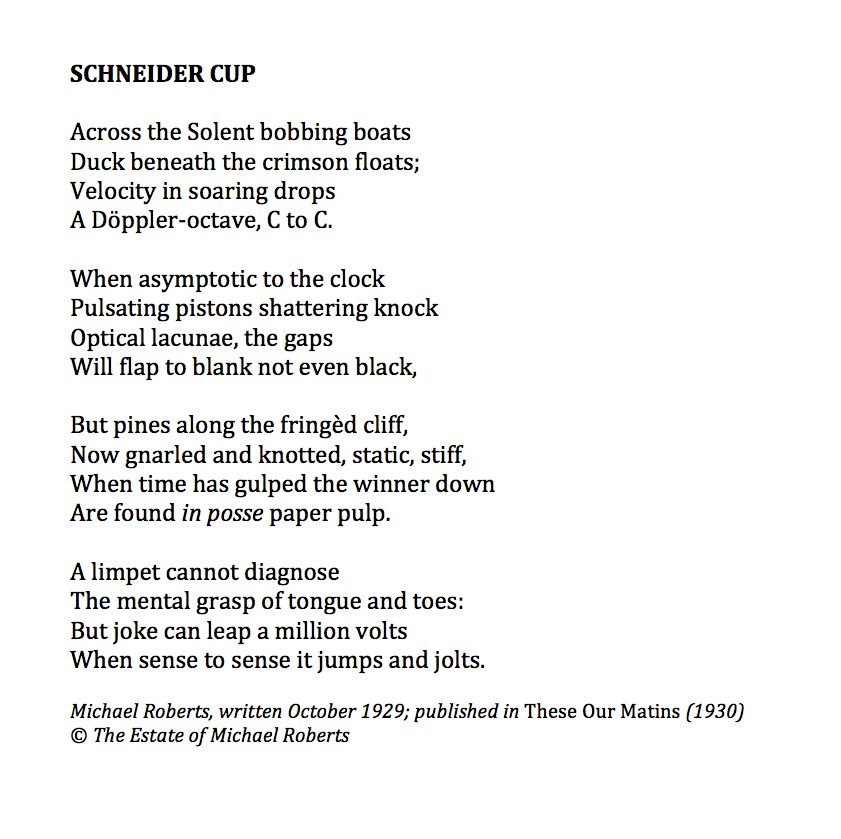
As in the first half I do a close reading of a poem, Michael Roberts’s ‘Schneider Cup’, I’ve reproduced the text here.

SCHNEIDER CUP

#31songs (10): Winter Sun, by The Blue Aeroplanes

#31 Songs (10): A Song About the Weather

‘Winter Sun’, by The Blue Aeroplanes, from Spitting Out Miracles

As many who’ve been involved in it will attest, The Blue Aeroplanes is Gerard Langley’s group.  But Langley doesn’t originate the music. Rather, according to Richard Bell:

Gerard taped everything on a portable cassette walkman, all the jamming. He’d come back to us with an isolated riff and say “repeat that bit 8 times”! He was very much the director of the music, making the music fit the poems he had prepared. Although he did not play an instrument he had a strong sense of musical innovation or cliche, and steered us towards the former.(*)

And although Langley is the director, there’s been a long and welcome tradition in the band of allowing other members to write and perform their own songs.  Having a sung vocal in the middle of a Blue Aeroplanes album makes a big difference; having lyrics with rhymes likewise.  The sung material takes less concentration and is often more straightforward lyrically.  It can serve as interlude, as prelude, and as a reminder of what’s so special about the other material.

An early example is ‘Winter Sun’ on Spitting Out Miracles, with lyrics written and sung by Nick Jacobs, guitarist in the band from Bop Art through to this album.  Unlike some of the later examples, especially those by Rodney Allen, Jacobs’s lyrics here are almost as oblique as Langley’s.  At the start you might think that the winter sun in literal, though you’d have to be unusually pale to catch the sun in the winter time. The idea that ‘every detail cast a long shadow’ suggests that it’s a metaphor: a winter sun makes even the tiniest of things take on giant proportions.  The winter sun here is the lover so dominating the that addressee was in danger of being lost in him or her.  (As with many Aeroplanes songs, both genders are possible.)

Musically it’s spiky and angular; though there’s a folk tinge to the vocals and other aspects of the arrangement, the basic guitar riff could be new wave riff from the late 70s.

LYRICS

BAs Winter SunCaught yourself in the winter sun,
The light was bright and the angle was acute.
Every detail cast a long shadow,
The truth irritating and hard to explain.

You’ve got an image that you want to project
But it’s no damn use if you can’t protect it.
Get out from under what’s holding you down,
If that’s your best friend, don’t stick around.

Shed a silent, private tear
Then you opened the door and left the room.
You feel guilty and you feel bad
But a measure of sadness is only natural.

Caught yourself in the winter sun,
The light was bright and the angle it was cruel.
You lost yourself in your lover, lost yourself and you lost another.
Hard to explain, naturally.