Author Archives: michaelwhitworth

#31songs (9): Bury Your Love Like Treasure, by The Blue Aeroplanes

#31songs (9): Best Ending

‘Bury Your Love Like Treasure’, by The Blue Aeroplanes, from Spitting Out Miracles

Endings are something the Blue Aeroplanes are good at. On several songs they synchronise the completion of the lyric with the closure of the music, which can give a final line an epigrammatic forcefulness even if the words don’t entirely merit it: that’s there as early as ‘Hard Objects’ by Art Objects, and later in ‘And Stones’ from Swagger.  It’s not quite the same as Wire’s aesthetic of ending the music when the words run out: what the Aeroplanes does feels less arbitrary, feels like a culmination.  In other songs though, the musicians are happy to jam around a theme long after Gerard has, so to speak, folded up his poetry book and left the stage; the effect isn’t quite as distinctive, but the sound that the band makes in full flight is magnificent: take the playout to ‘Talking on the Other Phone’ from Friendloverplane 2, for example.

‘Bury Your Love Like Treasure’ opens side two of the vinyl Spitting Out Miracles, and for that reason also deserves an honorary mention in the best opening category: John Stapleton, who at this stage in the band’s history was splicing samples into the band’s music, begins the song with ‘After a Smooooth Landing on Side Two’, taken from goodness-knows-where, and then with a spiky couple of chords we’re launched into the song:

The Album version

The Official Video (shorn of Stapleton’s sample)

There’s a force and simplicity about the music for verses: two strong emphases on the second and third beats, then a long run up and down the scale in the following bar.  (I have an idea that there’s a kind of sea-shanty origin for this: two strong beats for the pull on the rope, and the rest of the two bars to relax and recover.)  The lyrics are relatively forceful and direct too: a relationship in crisis, retaliations on both sides.  The big indecipherable irony lies in the chorus: if the addressee does bury her love, will the speaker’s finding it really be a success for the relationship?  Doesn’t his promise that he’ll ‘still find it’ sound more like a threat?

The main body of the song is done by 2.00, and it’s here that the music treats begin: interwoven backing vocals singing a sort of round, first calming the song down, and then gradually building it up again, working round an organ line that begins thin and simple and itself becomes busier.  There’s a strong folk feeling to it, but also a psychedelic quality. The vocal performances actually sound a bit shaky in places, as if some of the singers were at the edge of their ranges, but that’s part of its charm.

The folk influences on The Blue Aeroplanes are a curious matter, because if a defining feature of folk songs is the potential for anyone to join in with the singing, then Gerard Langley’s vocal performances are the opposite of folk: they’re spectacles to be heard and admired, but they’re not for joining in with. You can’t even sing the song to yourself when it’s over, though you can replay it in your head.  But the playout vocals on ‘Bury Your Love’ invite you to join in.

LYRICS

BAs Bury Your Love

I’m not at all sure it’s a good idea,
I think someone’s mistaken in this house.
Nobody could say your intentions were clear
But who in this place is going to work it all out?

You can bury your love like treasure,
Bury it so deep you can’t even measure it,
Bury your love like treasure,
I’ll still find it.

You can note all this down with a fine-point pen,
All these shared things, special intensities,
But none of it’s been true since way back when,
We can’t even be in the same city.
So tell me the difference between women and men,
You told it me once, tell me again.
Tell me that version, tell it me now,
Here in the morning, once more at noon.
I’ll never be certain I’m not staying here,
With this view of the sea from our white hotel room.

Bury your love like treasure,
Bury it so deep you can’t even measure it,
Bury your love like treasure,
But I’ll still find it.


Teaching Literature and Science (final blog)

Teaching Literature and Science: BSLS Symposium, 8 November 2014

(5) Building Courses Workshop

The fifth element of the BSLS symposium was a welcome change of format, a workshop on building courses led by Allyson Purcell Davies and Yasemin Erden.  I naively imagined that after 30 minutes brainstorming our group would have devised the perfect final-year module.  As it turned out, this was a big opportunity to talk about other issues that had arisen during the day, so we got a bit distracted, and I don’t think we were alone in that.  It was an enormously valuable session, but I’m not sure any courses were built at the end of it.  My group talked about our different institutional contexts, with Janine Rogers’s Canadian one being very different, and also about why some courses recruit well and others don’t.

(Most people attending the symposium seemed to have very positive experiences, whereas I’ve had an M.St. special option that recruited only one person and wasn’t viable, and a series of lectures on Literature and Science that dwindled to an audience of about two by its final week.  With hindsight, I think the M.St. option was too narrowly drawn — science and poetry in the early C20th — while the lecture series had the bad luck to be timetabled against a very popular series on key concepts in literary theory.)

We also talked about specific outcomes we might want to see: much that had been discussed under the heading of aims was fairly general and not specific to textual study, and I made a case for the importance of historically informed linguistic sensitivity to figurative language: something that might in part be developed through reading Lakoff and Johnson, but which only becomes historical by reading scientific source texts. We also talked about the different marketing strategies for a literature and science course: do you title it as ‘literature and science’ and place that at the very centre, or do you devise a different topic (e.g., ‘the body in the fin de siècle’) and work the science in as part of the content?

Other groups reported back on matters such as

  • the different approaches one needs to take in a class: the need to be ‘teachery’ for some texts, which I think meant provided formal exposition and specific guidelines, in recognition that absorbing historical science and history of sciences approaches can’t be done by extending existing literary-critical skills.
  • outcomes (in a large sense): understanding the ethical implications of literature and science knowledge.
  • institutional structures: liberal arts model of university, and question of what transferrable skills institutions want to see
  • collaboration: how best to enable it
  • the nature of funding for interdisciplinary research
  • what sort of students we want to produce
  • digital resources and how to use them productively
  • if one were offering an entirely MA course in literature and science, what would be core and what would be optional. (The interesting thought behind this is that the research consortium arrangements that have recently begun in the UK make such an MA a realistic possibility in terms of having sufficient lecturers with expertise.)
  • how to subdivide ones topics, e.g., historically or thematically?  One compromise solution suggested was to pick a theme (e.g. the body) and to historicise within it.
  • the question of validity in interpretation: what rules apply in literature and science, and how do they differ from those in the literary criticism the students have previously encountered.
  • What focus should one take?  Should one focus on authors, or on the culture and the readership?  Should one look at the history of forms of writing?

(6) Student perspectives

In the final session three current students reported back on their experience of taking literature and science courses.  (There were to have been two more, and the session probably needed more participants to really reach critical mass.)  It was interesting to hear their reasons for being drawn towards science and literature, and their reflections on the kinds of intellectual skills it develops.  Jonathan Craig from Mount Allison University is a major in Physics who had taken Janine Rogers’s Literature, Science and Technology course (English 1121), and his remarks on the differences in approach required — the more open-ended quality of literature — echoed what we had heard from Vic earlier in the day.  Daisy Edwards and Chloe Osborne had both taken Will Tattersdill’s module at Birmingham, and reflected on this motivations for choosing it — both to do with current non-literature friends and the choices they’d had to make (or had made for them) earlier in their school careers.  They also discussed teaching methods and structures: Daisy welcomed the lecture element on her course (one one-hour lecture per week and one two-hour seminar), while Chloe mentioned that she wished she had been able to develop relevant skills during her first and second year.  (Implicitly this takes us back to the start of the day, and Charlotte Sleigh’s remarks about the skills needed for literature and science being diverse and being a lot for students to absorb.)

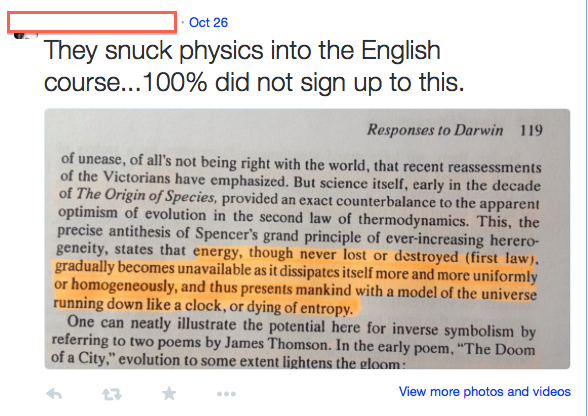
Like previous sessions on teaching at regular BSLS conferences, the symposium was enormously stimulating and empowering: I was almost left wishing I taught in an modularised institution where I could offer a third-year special module; in practice I’ll have to create some undergraduate lectures or classes.  It’s clear we don’t all agree on what to introduce to undergraduates and what to save for postgraduate study, and that our motivations have different emphases, but the differences were good to think with, and the atmosphere supportive.  One important warning note came from Josie Gill, who noted the tendency of a meeting like this to be self-confirming: what about the students who don’t choose literature and science?  Why don’t they, and what are they choosing instead?   A few weeks ago I came across a tweet from a current Oxford student (not Merton), whose tutor is, I guess, offering some literature and science context as part of the 1830-1910 first-year period paper.  It’s a rather negative note to sound in conclusion; but it’s a warning that not everyone finds the topic as engaging as we do:

anti-science tweet

Teaching Literature and Science (3, 4)

Teaching Literature and Science: BSLS Symposium, 8 November 2014

(3) Literature and Science for Science Students

Our third session was an unexpected pleasure: three tutors talking about the opportunities they’d had to teach creative skills and/or literature to science students in a British context. (In the afternoon we also heard from a science major who had taken Janine Rogers’s course at Mt Allison, Canada.)  My only disappointment about this session was that because the institutional structures that all three were working in were so unfamiliar, I felt I’d missed crucial details about exactly what they were offering and how it fitted in.

Vic Callaghan (Essex) was speaking on behalf of the Creative Science Foundation.  Vic had started his academic career in electronic engineering, before moving over into computer science and A.I., and gave a compelling account of how, right at the start, he had been inspired to do science by reading science fiction. The main theme of his talk was the increasing recognition that technological innovation requires creative imagination, and that science degrees tend to knock it out: scientists favour cautious approaches and ‘incremental thinking’ over imaginative leaps.  Engineering curricula are packed full with content; there’s little space for creativity. This has become a particular problem for chip manufacturers like Intel, for which the average duration between a new processor being imagined and its going into production is an astonishing seven years.  The problem is that the consumer side of the market innovates far more quickly: mobile phone designs are superseded every 18 months or so; the Intel chip designer has to imagine future uses for processors that haven’t yet been invented.  Intel’s approach was to try to wean their designers away from the scientific mindset they’d been trained in (in terms of there being right/wrong answers to any problem, etc.), by telling them that they could use fiction.  They used stories as a way of ‘wrapping up’ the technology and as a way of communicating the ideas.

Duncan Mackay, an astrophysicist from the University of Kent, contrasted himself to Vic, and picked up on Charlotte’s earlier question about what it is we do, by noting that his science is completely non-utilitarian.  His methods of engaging students with creative material were (i) to get them to paraphrase poems in terms of mathematical formulae (the symposium noticeboard had a weird rewriting of one of T. S. Eliot’s ‘Preludes’), and (ii) to get them to identify conceptual metaphors and ‘image schemata’ in scientific work.  This was intriguing stuff (I was interested to know how much theoretical grounding he gave them on the latter), and I would have liked to hear more details.

Matt Wraith comes from a literary-critical disciplinary background, and runs the Horizons programme at Imperial College, aiming to broaden the coverage available in a science institution.  He noted that the motivations of the institution, the students, and the tutors are not necessarily identical, though there wasn’t time for a more detailed analysis of whether the gaps between those motivations, and the tensions between them, are productive or limiting.

(4) Negotiating University Structures

After lunch we moved to the question of how literature and science does or doesn’t fit into institutional expectations and structures. In so far as other sessions had made reference to institutional traditions, outlooks, tendencies, limitations, etc., these weren’t entirely new questions, but it was valuable to foreground them. Emily Alder (Edinburgh Napier) has recently offered a module ‘Narratives of Nature’ which consists of literature and science with an eco-critical slant.  The background to her offering is the Scottish educational system which, relative to the English, requires students to cover a broader range of subjects up to university.  Joint Honours programmes are popular at Napier, and her module needed to recognise that; it also needed to work around the other modules, which had already claimed a lot of the gothic and genre fiction texts that she might otherwise have taught.  One of the most innovative elements that she has been allowed is an assessment portfolio in which students chose (in consultation with the tutor) how to demonstrate that they have achieved the learning outcomes.

The institutional pressures that Greg Lynall (Liverpool) talked about were partly those to do with modules competing with each other, and departments not wishing to run modules with less than optimum recruitment: any new module could be offered only at the expense of an existing one.  Greg has taught literature and science in one form or another for ten years; his most recent offering is part of an interdisciplinary eighteenth-century studies MA at Liverpool. This brings with it the pleasures and problems of teaching students who are confident in one of the disciplines but weak in another: e.g., historians who are confident talking about economic issues, but unpracticed at writing literary-critical essays.

Josie Gill has just begun a lectureship at Bristol, where her job title is Lecturer in Black British Writing of the 20th and 21st Centuries, so literature and science teaching was not formally part of her remit;  however, it has been relatively straightforward for her to introduce a third-year module on contemporary literature and science, with the earliest text being 1990.  She covers topics such as the Human Genome Project, science on stage, and David Lodge’s recent forays into science.  Her week on looking at science as writing was queried by the department, but within literature and science studies this is a very common skill to develop; she insisted on its inclusion and the department allowed it.  She reported that she’s found teaching literature and science good for the students because it provides a space in which they can reflect on what it is they are doing in studying literature, and in which they can think about the modern university and its structure.

The theme that came through most clearly in the discussion afterwards concerned assessment, where institutions can be very set in their ways because of anxieties about parity between modules.  Emily added that at Napier many modules use a reading diary as an assessment method; Ros Powell observed that an insistence on traditional timed exams doesn’t do justice to the discipline, because it’s impossible to bring in the breadth of materials that characterise most work in literature and science.  (If an institution insisted on there being some sort of unseen timed exam element, I imagine it would be possible to introduce a suitable task: for example, a close reading of a scientific or popular-scientific text, with particular attention to its figurative language; but like most of the speakers today, I wouldn’t rush to embrace such an assessment.)

Teaching Literature and Science (2)

Teaching Literature and Science: BSLS Symposium, 8 November 2014

Case Studies: Literature and Science for Literature Students

The second session turned from larger questions of motivation and philosophy to more detailed account of methods and approaches. It’s harder to take precise notes in this kind of session — I didn’t manage to write down all the texts the lecturers had mentioned as being on their courses — so the account here may seem thinner than my account of the first session, or may distort it towards the more abstract questions.

Rebecca Lindner and Shannon McBriar teach at Amsterdam University College, a very recently founded small liberal arts college (about 850 students) in Amsterdam, part of a network of such colleges that has arisen in the Netherlands in recent years.  Theirs attempts to differentiate itself from the others by making science a significant part of its profile, with the result that humanities students can feel marginalised. A literature and science course can work well in such a context. Their literature and science course covers a long duration, from the early modern to the present.  It makes thematic divisions, using large themes such as mind, body, and place.  It covers many genres of writing, such as early modern anatomy texts, travel narratives, etc.  In practice Rebecca and Shannon found that the thematic boundaries collapsed.

Ros Powell teaches at Liverpool Hope, and runs a final-year module ‘Reading Enlightenment’.  It begins with Bacon’s New Atlantis and ends with Samuel Johnson’s Rasselas, and covers themes such as imagined worlds, man’s place in the world.  Ros described her aims as being to educate her students about science in a historical way: that includes historicising ‘science’ itself and making them familiar with historical categories such as ‘natural philosophy’ and ‘the virtuoso’.  She’s asking them to think about the nature of Enlightenment; about scientific diction and genre, and what happens to scientific ideas and terms when they are transposed from one genre to another.  She encourages students to think about the choices that scientists made in their discourse, and encourages students to be independent, finding their own texts on databases such as ECCO (Eighteenth-Century Collections Online).

Greg Tate teaches at the University of Surrey, in which English is a relatively new subject; it’s historically a science and engineering university.  This situation has allowed him more flexibility than might have been the case in a department that was set in its ways.  Greg offers both a second-year undergraduate module and an MA module. The undergraduate module, ‘Science Fictions’, compares representations of science in Science Fiction texts with those in drama, nineteenth-century fiction, and other forms.  The MA module is more explicitly a Literature and Science module.  The big question Greg had to ask us was whether there’s a pathway from undergraduate literature and science to MA level to doctoral level, and how we might describe those levels: are there concept, texts, or methods that you have to teach at each?  This is a huge topic, and one which didn’t picked up at the length I’d have liked in the questioning, though we did have some good informal discussions over tea.

In his BA course, Greg begins with C. P. Snow’s The Two Cultures.  This was a text mentioned by several contributors over the day, somewhat to my surprise, as in the research-focused environment of the spring BSLS conferences, I’ve heard it said (quite reasonably) that there ought to be a ban on Snow as a starting-off point; certainly no-one is going to derive a methodology from his book or his spat with Leavis.  But in a pedagogical context, Greg reports, it’s a useful text: Snow’s argument about education resonates with the students’ experience of being forced to choose between art and science.  (At some point in the day, someone mentioned the idea of placing Snow in a series of such arts vs. science spats, and to my mind that’s a more satisfactory way of dealing with the problem: the precise terms of the disagreement and their different relations to their historical moments become part of the investigation.)

Other questions Greg raised were how to deal with students’ anxiety about talking about science; and how to introduce students to the idea of two-way traffic between science and literature. (And, one might add, at least at a higher level, how do you teach them to be discriminating about the conditions under which such traffic can meaningfully occur.  You can name your subatomic particles from a word in Finnegans Wake, but is that, in itself, meaningful traffic?).  Greg returned to the question of how to differentiate levels: his answer was that his undergraduates don’t read many scientific text directly, while his MA students do; and his MA students are expected to think about science as a genre. (For myself, I’d be keen for undergraduates to make steps into being alert and critical readers of scientific texts, and for many years at Bangor, and more recently at Oxford, I’ve used extracts from Darwin’s ‘Essay of 1844’ as a way into one kind of scientific writing.)  Finally, Greg asked about the assessment and delivery of the MA module, and in particular the question of whether it should be preparing students for doctoral level.

Michelle Geric spoke as someone currently in the middle of teaching a new final-year undergraduate module at Westminster.  Students there hadn’t had previous opportunities to study literature and science, and for Michelle one important reason for beginning with Frankenstein was that the students are confident there’s a connection with science; the module runs from Frankenstein through to Margaret Atwood’s Oryx and Crake.  It also brings in a session on Poe and mesmerism, which has proved especially popular, and one drawing on her own research into geology.  It’s important and interesting to include pseudo-sciences, partly as a way of raising questions about historical fluctuations in what counts as science.  Emile Zola’s Nana has proved very successful, so much so that she’s had to make in-flight adjustments to the running order, so they could have one week on naturalism and another on degeneration. (One theme we didn’t raise in the day, and which Nana might have been a useful prompt for, was how useful non-Anglophone literature in translation has proved to be, and whether it raises any problems, such as it coming from a country with different scientific traditions and different social and institutional frameworks for science.)

The feedback Michelle has received so far suggests that the students feel there are too many new ideas for them (though I’d be inclined to see that as better feedback than students saying there are too few); and that, as regards their reasons for choosing the module, that they were very curious about the conjunction of literature and science.  The problems she has encountered echoed those mentioned Charlotte Sleigh in the first session: (1) introducing history of science; (2) getting students to think about science influencing the form of the text, which requires them to grasp concepts of form; (3) the problem of the two-way street.  As regards the larger question of motivation, Michelle mentioned wanting her students to engage with ethical issues (e.g., vivisection in The Island of Dr Moreau), and wanting them to be empowered to interrogate science.

Finally in this session, Fran Kohlt from Oxford spoke about her experience of teaching a literature and science class within the Oxford tutorial system (at St Anne’s College) on the first-year Literature in English 1830-1910 paper.  The primary texts she chose for this two-hour event were Charles Kingsley’s The Water Babies, essays from Kingsley’s Scientific Essays and Lectures, and essays by T. H. Huxley, including ‘Evolution and Ethics’. The relation of religion and science had been important for this session.  At the end of the session she had got her students to form small groups and to report back on one of three topics, using brief quotations prompts: Gillian Beer on myth-making as a proto-science; another on mysticism and science; and George Levine on the idea of there being one culture.  Fran went on to talk about how she transposed this session to work for a summer school group of fourteen year olds.

In the questions, Rebecca and Shannon mentioned their students wanting to know how to follow up their undergraduate study of literature and science, and what to do at MA level.  The question also arose of how to make use of material culture in teaching literature and science. In relation to the problem of students having to take on new methodologies as well as new texts and unfamiliar scientific concepts, Will Abberley suggested that we need to petition our departments to make some space for concepts relevant to our work on first year introductory modules.  (We didn’t get to discuss what form this might take, or what form might prove easiest to sell, but I imagine that teaching first years extracts from Lakoff and Johnson’s Metaphors We Live By would be a sellable proposition, and one that would benefit students who don’t go on to study literature and science as well as those who do.)

Teaching Literature and Science (1)

Teaching Literature and Science: BSLS Symposium, 8 November 2014

As a research field, literature and science can trace its roots back to the 1930s (Carl Grabo’s A Newton Among Poets [1930]), but most practitioners would reckon it to have really taken off in the 1980s, with the publication of works such as Gillian Beer’s Darwin’s Plots (1983), Sally Shuttleworth’s George Eliot and Nineteenth-Century Science (1984), and George Levine’s Darwin and the Novelists (1988).  But as a topic that one might teach as undergraduate level, it’s taken long to feature in more than the occasional lecture or seminar.  In his opening address to the BSLS symposium on teaching literature and science, hosted by the University of Westminster, Martin Willis asked why now?  Why are we having this conversation now and not ten years ago?  (It’s true that at the first BSLS conference in Glasgow in 2006 we did have a session on teaching, and it was interesting then to hear what people had tried doing in the classroom, but I don’t think we could have sustained an independent day event back then.)

(1) Why Teach Literature and Science?

Martin’s opening words set an important frame for the first session, ‘Why Teach Literature and Science?’, in which Will Tattersdill, John Holmes, and Charlotte Sleigh addressed the larger question of motivation, as well as giving us snippets of practice, sketches of their institutional context, and anecdotes of their point of entry.  This informal and personal tone was an important feature of the day as a whole: there are all sorts of personal investment in the topics we choose to teach, and in a supportive environment it’s useful to touch on them.

Will, who has been lucky enough to recruit 66 students to his final-year module on Victorian L&S at Birmingham, talked about how at school he had been made to choose between arts and science, and indeed had been more or less told that he had a Writing Brain rather than a Test Tube Brain.  For him, I infer, it wasn’t that simple.  (This is not atypical as a career story for L&S people, though it’s not the only one.)  Will had been particularly inspired by Ben Goldacre’s Bad Science (2008) which had made him concerned about media misrepresentations of science, and aware that students from an arts background who go on to work in the media ought to have a more informed perspective so they can approach science ‘appropriately’.  (I wonder whether science is singular, and whether we can therefore find a single ‘proper’ way to approach it, but I agree with the broad sentiment, and agree with this point of view as starting point.)

John had taught, around 2005-06, a module called ‘The Literature of Science’, and had later taught MA-level courses; right now he’s preparing a fascinating interdisciplinary module at the University of Reading which will involve tutors and students from biology, history, and literature.  Literature students will do scientific experiments; science students will study literature.

For John, there were three main reasons why he teaches literature and science.  (1) To break down the retrospective imposition of two cultures on cultures where there was no divide between literature and science.  (John sees the divide as arising in the late nineteenth century.)  (2) To counteract the entrenched arts / science divide in UK educational culture. (3) The civic argument: ‘we live in an age that is defined by science’, John said, and so it’s important from a civic or a political point of view to understand it correctly.  (I’d want to qualify this as above by asking whether there’s a single right way of understanding it, but I’d agree that most arts students could easily be better informed about the practices and content of science.)  As science doesn’t have much political clout, we get some weird distortions in its representation: on the one hand, scientism and an excessive optimism about its ability to solve human problems, and on the other hand anti-science positions.  There’s a particular problem about the media misrepresentation of science, exemplified by the media on climate change feeling obliged to demonstrate ‘balance’ (one climate-change ‘sceptic’ vs. one informed scientist). Scientific truth isn’t determined by processes of majority voting.

Charlotte’s career trajectory differs significantly from those of the other two speakers: her school, for honourable reasons, had directed any girls who were good at science to choose it at A level and beyond. During her degree she turned to history of science, and has since then begun work in literature and science.  At Kent she had taught a big first-year course that covered literature and science from Swift to the present, but found that it was asking too much of the students: they had to absorb some science, some history of science, and some literature; she gave up on this module.  Recently, she has devised a final-year special subject module, which — unusually when semesterisation is the norm — runs for the whole year and allows her to practice ‘slow reading’ of big texts like Middlemarch and The Origin of Species. The module has a special appeal to History and English Joint Honours students at Kent who hitherto had lacked any kind of bridge module.  Charlotte turned the motivation question on its head and asked ‘why not teach lit and science?’  There are risks: there’s a danger that nothing gets done properly (everyone gets a smattering of history of science, etc.); that people enjoy the frisson of working on the borderline but don’t do it rigorously; that lit students make bad historians and historians treat literature as a ‘light’ source, treated without the rigour they’d bring to ‘real’ historical documents.

On the question of ‘why now?’, Charlotte noted that in academia the ‘science wars’ (post-Sokal Hoax, etc.) are now over, even if they might still be going on elsewhere.  She noted that if science studies is all about the critical appreciation of science, in an era where science needs to be treated seriously — above all in relation to climate change — and defended from its detractors (she wasn’t specific, but I’d gloss that as religious fundamentalists and big business), then the emphasis has shifted from the critical to the appreciation.

There was a good conversation following these presentations.  Shannon McBriar noted that there are problems of perception on both sides: scientists making judgements about art (e.g., in neurological work on creativity) often start from a naive position that sees all art as expression.  I remarked on another motivation, which is that thinking about literature in relation to science not only sharpens our awareness of science, but also enables us to think about literature as a form of knowledge with its own distinct and valuable powers. Will had mentioned in passing the seeming importance of science relative to the humanities (in short: if we get it wrong, no one dies), but i wanted to make the case that, actually, if we don’t make a pitch for a full and complex sense of what it is to be human (part of which involves the kind of knowledge found in art), then we all become debased and brutish consumers. (I’ve been reading Christopher Hillary’s English As Vocation: the  Scrutiny Movement (2012) in the last few days, and was reading Jonathan Crary’s 24/7 on the train up to London, so if this came across as left-Leavisism, that’s probably why.)

Duncan McKay said something at this point about the positive value of doing neuroaesthetics, and I’m sorry I didn’t make a proper note of his real point, though if I recall correctly, it was that in doing it the practitioners come to recognise the limitations of their form of knowledge. Greg Tate suggested that our motivations for teaching might not be so far removed from our motivations for doing research in this area.  Laura Ludtke argued that literature and science offers us a view on the value of the humanities.

Charlotte opened the question of where there’s an asymmetry between science and literary criticism, and the related question of what this ‘literature’ in ‘literature and science’ is anyway: is it literature, or literary criticism?  Scientists might think they make real things: not just technological spin-offs, but real knowledge, where literary critics seem only to write about writing. I.e., the value of science seems to relate to the distance between its object and its medium.  Barri Gold suggested that maybe in many cases scientists don’t know what it is they do.

I’ll summarise the later sessions in separate blogs. The whole event was videoed, and will be posted online by our hosts at the University of Westminster and/or the BSLS, and I’ll add a link there when this session is available.


#31Songs (8): In the Mystery, by The Blue Aeroplanes

#31Songs (8): Best instrumental solo

‘In the Mystery’ by The Blue Aeroplanes, from Spitting Out Miracles (1987)

Spotify link: The Blue Aeroplanes – In The Mystery

The Blue Aeroplanes are primarily a guitar-based band, and there are plenty of guitar solos on their records. On Spitting Out Miracles there often seems to be a Richard Thompson influence. But the most interesting guitar playing actually occurs outside the formal ‘solo’ spot, and often lies in the interweaving of different guitars.  The most surprisingly instrumental by some stretch is the clarinet solo on ‘In the Mystery’, attributed on the sleeve to ‘More Armadillo Traces’: Richard Bell in his notes tells us that the player was Peter Blegvad’s producer Tim Hodgkinson, who was in the Cold Storage studios (Acre Lane, Brixton) mixing Blegvad’s latest album, and who, hearing ‘In the Mystery’, offered to contribute some clarinet (*).  There’s a frenzied quality to it, scrambling up and down scales at speed, which is entirely consistent with some of the guitar playing on the band’s songs around that time, but which with the richer, warmer tone of a clarinet creates a different effect. (Imagine those notes played on an overdriven fuzzy guitar: it would sound more like some aspiring heavy metal guitarist in the style of Yngwe Malmsteen.)  The combination of the clarinet the clanging guitar line is an unprecedented combination of textures.

The lyrics are more than usually baffling, but they seem to incorporate a fractured hard-boiled detective narrative: note the non-standard ‘don’t cure a thirst’ and the tough-guy ‘we got calls to make’; the collars turned up, the references to the ‘elements of ‘the case’ and a ‘clue’. On top of that, the telegraphically abbreviated count of a journey (‘much bumping, some darkness’) also recalls some of the 1930s poets, especially Auden; Auden too liked to play with popular forms.  There’s an atmosphere of alienation and cultural dislocation, of not being one of the locals and of having to interpret the smallest things carefully. The sea sparkles ‘like the / sequins on her dress’, and nature ‘is Hollywood tonite’ (the sleeve notes give that spelling rather than ‘tonight’):  everything familiar has become artificial. At some level, though, I’m not sure quite of what logic is supposed to hold these elements together.

 LYRICS

BAs In the Mystery

Diving into an ice-broken river don’t cure a thirst
so quit this house, we got calls to make. Shut up
in a room, turning inside out. A long journey, much
bumping, some darkness.

                                                Then, the steam on the windows
kept people in like raffia chains, everyone was local
and we didn’t fit the elements of the case. A clue
to this extraordinary behaviour, a hand in some
politic embrace, g
ingham cloth, a crack in the cup.
Now when you cheat, you watch that hand for bites, when
you cheat I watch in admiration.

                                                           I could drink your
dishonesty like tequila, to indiscretion, in madcap
chase of enlightenment, collar turned up. Your face
a way station.  If you’re so young, don’t say such
clever things. [If you must be clever, please learn
about holding and circling.*] Oh, oh baby, but drink is
a blessing we ignore at risk. What can I say about
any love in these times?

The sea sparkles like the
sequins on her dress, and nature is Hollywood tonite.

[*these phrases are in the printed lyrics, but not recorded.]

#31songs (7): Ceiling Roses, by The Blue Aeroplanes

#31songs (7): One that makes you feel like you’re in a film

‘Ceiling Roses’, by The Blue Aeroplanes, from Spitting Out Miracles (1987)

The lyrics to ‘Ceiling Roses’, with their darkened skies, have a strongly visual quality, but the atmosphere is created primarily by the pace of the music, the rich, warm instrumentation, and the modulation to another key for the solos.  The music moves like a strong but slow-moving current of water, with small eddies at the side.  It’s calm but determined.  After the preamble (tentatively blown wind instruments, very breathy, children’s voices), and the lead-in from the drums, the main theme is set down by the violin.  If there’s an electric bass here it’s less important than the cello line: cello rather than bass threads everything together, makes the bottom end of the spectrum less percussive.

One way of thinking about the lyrics is as an unpicking of the idea of a ‘ceiling rose’: a flower?  On the ceiling?  Supporting a light fitting?  But while that idea lies behind it, it’s clearer to start from the weary ‘a decision as always’ in the opening line: something needs to be done, but neither the narrator or the addressee wants to be the one to set things in motion. (I wonder if reluctance, along with drinking, is an ongoing theme on Spitting Out Miracles).  ‘What do I have / to do with it?’ implies a whole conversation in which the narrator is being asked to make the decision by the other party. The part of the ceiling ‘away from the usual rose’ is the dark corner; it’s a break with routine (there’s also a phrase in the sleeve notes about ‘routine matters’ that doesn’t appear in the recording), and a move to a place where everything becomes unclear. In the second verse the darkness has been reworked as an exterior setting, ‘the sky which darkened over houses’.  The ambivalence about the decision is here in the way that this oppressive sky is also covering them in beauty.

After the second verse there’s a change of key and an instrumental break that seems to be a comment on what went before: it reads to me like a darkening of mood.  (Although late Pink Floyd might seem an odd reference point for a post-punk band, especially on this very folk influence album, the pace and the change of key sounds like something on The Wall.)

‘Oh promises come to bar talk’: again, this reads like a response to an unheard phrase from the addressee (‘Will you promise me?’), and it’s a shifty one.  The placatory but non-committal ‘I know, I know . . .’ comes from the same place.  Lips set in a straight line are neither smiling nor downturned, and they also suggest the path that runs ‘through all thought’ to a drunken conclusion.  The final lines return to the opening ‘What do I have / to do with it?’, but don’t seem  any more willing to take the responsibility: if the final ‘I promise’ sounds hopeful, it’s only because we’ve already forgotten about promises being no better than bar talk.  And with the final words delivered, the music again takes a downward turn and comments darkly.


LYRICS (based on sleeve notes from the vinyl release)

BAs Ceiling RosesOkay, a decision as always.  What do I have
to do with it?  Remember skies like a ceiling
away from the usual rose. Less light in the room
for an unclear picture, you can tear up anyway.
[Say goodbye to a lull in routine matters,]* some
people’s faces are always more than beautiful.

In spite of everything, I’m sure. There’s no
point in being told this, sweetness. Set a past
world in reverse, speed backward to a better
time. The sky which darkened over houses in bright
light covered us, we covered in all beauty.

Oh promises come to bar talk, set those lips
in a straight line, y’know you look intransigent
and cold. To think you have a polio heart,
I read it and it’s true, you run through all
thought to a drunken conclusion. I know, I know . . .

I know, I have
all to do with it, nothing to do with it. When
we wake up, we’ll be somewhere else, I promise.

[*printed in the sleeve notes, but not part of the recorded lyric.]

#31songs (6): Spitting Out Miracles, by The Blue Aeroplanes

#31songs (6): Best bass

‘Spitting Out Miracles’, by The Blue Aeroplanes

https://www.youtube.com/watch?v=AzZWPi4i7K0

Spitting Out Miracles (the album) is the one where it all comes together for The Blue Aeroplanes.  It didn’t have the commercial success of its successor, Swagger, in part because the songs and the production don’t have the commercial-minded clarity of Swagger, and in part, no doubt, because Fire Records didn’t have the commercial muscle to promote it.  Miracles has its roots in folk and folk-rock, where Swagger is much more indie rock in its sound, and that, commercially speaking, might have been a point against it. I heard Swagger first, and loved it immediately; when I came to Miracles later I liked it, but it took longer to sink its roots.  Perhaps because it was a longer, slower process, it now feels like the one that touches me more deeply.

There’s a force to the production and the arrangements that the previous two albums achieved only intermittently; and on this album the band can achieve that force even on songs that don’t use the conventional structures of verse and chorus.  True, the album begins with what sound like the familiar spindly guitar sounds from its predecessors, in the first ten seconds of ‘Coats’; but then Gerard comes in very assertively (‘Note this down!’) along with drums and bass, and we’re in different territory.

‘Spitting Out Miracles’ likewise opens with a solitary guitar line, though its sound is a little thicker than on ‘Coats’ (chorus pedal, I guess); but after the guitar has played its phrase the whole band comes in, enriched particularly by Nigel Eaton’s hurdy gurdy line.  The drums deliver an uncomplicated and assertive beat, and that’s fine: there’s plenty else going on.  Richard Bell has written that the producer Charlie Llewelyn insisted that the band recorded without click tracks, so tempos shift within songs naturally and, as Bell puts it, the performances are allowed to breathe (*).  Bell notes a couple of places where the tempo seems to shift too much to his taste, and ‘Spitting Out Miracles’ is one of them.  But I like that feature: along with the wheeziness of the hurdy-gurdy there’s a wooziness to the pace which suggests that the song is slightly unsteady on its legs.  That’s appropriate: there’s a lot drinking on this album; whisky, tequila, and a beer courtesy of Kenneth Patchen; drinking up each other in the guise of going out.

The beauty of Ruth Cochrane’s bass line is hard to convey, but the essence of it lies in the alternation (for much of the song, though not all) between one bar playing basic low notes and the next playing a higher line, rhythmically and harmonically more complicated. The one bar anchors the song and contributes to its emphatic quality, the other joins in with the guitars and the hurdy-gurdy in the song’s joyful running up and down the scales.   I think she’s playing some chords in there as well.  It’s not too prominent in the mix, but without it the song would lack much of its force and energy.

The lyric is about the end of a relationship: unusually, for a love lyric, the narrator is the one who wants to end it, and the addressee needs to be persuaded of it.  Hence the brutality of the opening lines: ‘there’s no more and that’s a fact’.  It could be, in view of the whisky and cigarettes, that they’re out of booze, but more likely they’re out of things to say to each other and things to do together.  (The same imperative tone turns up later, though gentler: ‘Treat it as a good thing, / just remember that it’s gone.’)  The relationship has become scripted along predictable lines: it’s an act; they can recall the lines as if it were scripted, complete with the awkward pauses.  Or perhaps the scriptedness is a sign of the narrator’s detachment from the situation.  It’s also a song about the Lawrentian dilemma (as in Sons and Lovers and The Rainbow) of trying to maintain boundaries to one’s identity while also finding oneself completely involved with the other person.  ‘I’ve seen you dressed in armour, / I’ve seen you get undressed.’ What love is all about, he concludes cynically, is drinking up each other.

LYRICS

BAs Spitting Out Miracles

Get it into your head.
There’s no more and that’s a fact.
We’re trying to engage,
in other pursuits, wilder moments
and better versions of the act.
I’ve seen you dressed in armour,
I’ve seen you get undressed,
I know I should* want to possess you
But should you want to be possessed?

Ah, that slightly hoarse laugh
(too much whisky and cigarettes).
Recalling every line in detail
bar none come complete with
awkward pauses. Say no more,
I can manage it.  I can manage
it, but I just can’t imagine it.

Treat it as a good thing,
just remember that it’s gone.
Not only that, but remember
it was unsuitable and wrong.

True love is just a big absence
and nothing to ask for. Remember,
there’s no music but music is yours.
With our daily checks on fortune
how can we believe, believe
in anything else? Say goodbye
to tricking out your old dreams.

Hey, let’s discover
what it’s all about,
let’s drink up each other
in the guise of going out,
spitting out miracles.

(*for years I heard ‘shouldn’t’: I think there’s a micro pause between ‘should’ and ‘want’ that I interpreted as ‘n’t’.)

#31Songs (5): Soul, by The Blue Aeroplanes

#31Songs (5): Best closer on an album

‘Soul’, by The Blue Aeroplanes, from Tolerance (1986)

The Blue Aeroplanes’ first two studio albums, Bop Art and Tolerance, don’t contain their best work from this era.  The best from that era comes in the form of singles and EPs gathered together on the Friendloverplane album, and as I’ve already suggested, the album versions of ‘Gunning the Works’ and ‘Tolerance’ are not the best available.  But the Tolerance LP does contain perhaps the best closing track on any Aeroplanes album.  I like an album to have a shape, in terms of a changing mood as well as changes of tempo and style; and in particular I appreciate the power of a strong final song.  Some of this dates back to the days of vinyl: being so caught up in the final track that you can happily listen to the click of the run-out track, or the faint buzz of an automatically lifted needle, as you try to take in the last track and the album as a whole.

The appeal of ‘Soul’ from Tolerance lies in the music rather than the lyrics, though Gerard’s delivery is powerful in its intimate, under-the-breath quality.  The music, written by Richard Bell and Ruth Cochrane shortly before the album was recorded, balances a simple descending bassline and strummed guitar against wails of distorted and feeding-back guitars.  Bell recalls guitarist Nick Jacobs ‘lining the vocal booth with sheet metal and cranking his Marshall stack up to 11 (!) for the feedback’ (*).  Bell doesn’t mention The Jesus and Mary Chain, but the tension in the piece between melody and noise is reminiscent of what they were doing at the time: ‘Never Understand’ came out in February 1985 and Psychocandy was released in November of the same year.  I haven’t been able to find out exactly when Tolerance was recorded, but I suspect sufficiently late enough for the Mary Chain to be a source.  That said, the  reflective pace of ‘Soul’ and the more restrained position of its feedback in the mix make it a different proposition from ‘Never Understand.’ The overall effect is of a campfire song with terrible creatures howling in the woods; or of a confession by flickering candlelight as a storm rages outside.

The lyrics are cryptic, but if we take ‘Soul’ to be soul music, then certain things like the ‘white hands’ in ‘black gloves’ and the other contrasts of black and white start to fall into place, especially if one recognises the black roots of soul music: the lyrics seem to concern cultural appropriation. White hands in black gloves are involved in a kind of cultural masquerade.  There’s also an emphasis in the lyric on costume, especially of an aspirational sort: the black gloves, the black tuxedo, the white tie.  These costumes have the power to transform someone, from the shack-dweller to a celebrity in the limelight.  But towards the end there are notes of self doubt — ‘Can this be me?’ — made all the more powerful by Gerard’s delivery. The closing phrase ‘pleased to call it / Soul’ suggests that it might not really be soul anymore.  The images of tuxedo and white tie suggest that something has been commodified for the light entertainment market, and that in the process it has ceased to be truly ‘soul’.  Is his contemporaries’ swallowing of ‘the cultures’ another act of appropriation?  Is this a pun on ‘to swallow the culture’s soul’?  The subtle power of the music and the vocal performance persuade me to take the lyric seriously, but it’s oblique and abstract.


LYRICS (from lyrics.wikia.com)

Played by white hands
Tight in black gloves
Skinning it up
As hot as cool

Hit it, boy
It’s wild and trackless
Where the cats in black tux
are stepping

From the shacks
to the front of the street
It’s lovingly taken
by small devils

Yeah, the heart of the drama
Come out like grass
In drums

Jumped and jay walked
In New York
Clubbed and cake walked
Till Ladbroke Grove

Can this be me?
Growing up and growing old
To watch my contemporaries
Swallow the cultures whole

Swaying in white tie
Eyes trail from the white life
Swaying in the white tie
pleased to call it
Soul

#31Songs (extra): Gunning the Works, by The Blue Aeroplanes

#31Songs (extra): (No particular cue)

‘Gunning the Works’, by The Blue Aeroplanes, from Bop Art (1984) and Friendloverplane (1987)

(This is the point where the highly engineered 31 Songs master plan falls apart: I like this song, but there’s no suitable cue for it.  So I’ll write about it anyway.)

There are two versions of this song, significantly different in pace, one on Bop Art (1984), and the other collected on Friendloverplane (1988).  I heard the Friendloverplane version first and still vastly prefer it: it goes at a much higher tempo, and Gerard’s vocal performance feels  more confident and committed.  If there’s a slight loss it’s that the bass gets somewhat buried in the mix, but it can have its effect even when the listener isn’t particularly conscious of it; it’s a very busy bassline, especially at the faster tempo.  In the Bop Art version the bass has a fatter, softer sound, and is more prominent.  The Bop Art drums have a crude echo on them that makes them sound like a weird kind of rockabilly.

Bop Art version on Spotify

Friendloverplane version on Spotify

I like the way they’ve more or less abandoned conventional verse-chorus structure, and yet it’s still a catchy pop song.  There’s the ghost of a refrain, in that the song returns several times to ‘I didn’t know people could be so unkind / divided’, but it’s just the one line.  Musically speaking, on the first appearance it seems as if this phrase will be marked by the repeated pair of chords played in unison in power-chord style; but on the first repeat those chords come after the refrain phrase, and then lie beneath a sort of guitar solo (though the instrument could be a mandolin); on the next repeats of the chorus the power chords don’t appear at all.  On Friendloverplane the guitars are very distinctive: not altogether likeable, in that they’re tinny and thin sounding, but riffs they play have a kind of demented energy to them, like flies spiralling around inside a glass bottle, occasionally hitting the sides.

I’d known this song for some years before I heard the phrase ‘gunning the works’ explained. It seems to be Gerard’s variant on ‘gumming (up) the works’, but what really matters is the idea of throwing a spanner in the works. It dates from an era of industrial relations and worker-power that perhaps disappeared in the late 1970s: if management were pissing off the workers on the factory floor, as a last resort someone could always ‘accidentally’ drop a spanner into a crucial piece of machinery and cause a partial closedown. The device that ought to be constructive becomes destructive.  Whether ‘gunning’ is a local variant on ‘gumming’, or a mishearing of it, or  whether it’s a deliberate reworking of the phrase to give something more aggressive, there’s no way of telling.  It works, and I was surprised that I can’t find any trace of ‘gunning the works’ as an accepted variant of ‘gumming’.

Here it’s the central metaphor for destructive impulses in relationships, though if we follow through the industrial-relations roots of it, it could be a metaphor for the things we do to secure some self-determination in a potentially oppressive space.  In this song, at times the destruction is self-destruction: ‘she wants the thing that holds her back’, and later ‘the boy’ who does so.  The narrator, likewise, likes not only to see ‘you’ sing and dance, but also to point him out.  The ‘crook’d and pointed finger’ is odd: is it supposed to be witch-like?  Or a crook that captures him and draws him in?  Even odder is the baby behind glass, ‘eating dirt and being independent’.  This comes across as a parody of liberal parenting: the parents observe, but remain non-interventionist, letting the baby do stupid and self-destructive things while congratulating themselves on its impressive independence. Is it the same for the factory workers who wreck the machinery and the lovers who wreck their relationships, but who pride themselves on their new-found autonomy?

With the exception of the slower pace for ‘She wants the boy that holds her back’, the mood of the music is determined by the opening line, ‘I like to see you sing and dance’. It’s exuberant and joyful, even when the song is about destruction, and so there’s a curious contradiction: the lyrics hint that this behaviour is stupid and regrettable, but the music is gleefully committed to it.


LYRICS

(from lyrics.wikia.com, revised: I have ‘eating dirt’ where it has ‘heading death’)

I like to see you sing and dance

I like to see you jump and shout and point
your crooked and jointed finger at me

I didn’t know people could be so unkind

It’s you they call disillusioned

It’s not their fault
But they do want someone to blame

I didn’t know people could be so unkind

His body is sprung and loaded
She wants the thing that holds her back

His shoulder, a holster
Her head on his shoulder
Her shoulder, a holster
His head on her shoulder
Her shoulder, a holster
His head on her shoulder
Her shoulder, a holster
His head on her shoulder

I didn’t know people could be so divided

At the crossroads by Mothercare
Clicking heels in earnest
They shows she knows what a spanner is for

It’s for gunning the works

And I didn’t know people could be so unkind

It’s you they call desperate
It’s not their fault
But they do want someone to blame

It’s cold and the baby’s behind glass
eating dirt and being independent

At home everything’s
Neat

She wants the boy that holds her back
You know it’s not his/her* fault
But she does need someone to blame

(*his on Bop Art, her on Friendloverplane)