#bookaday (3): One with a blue cover

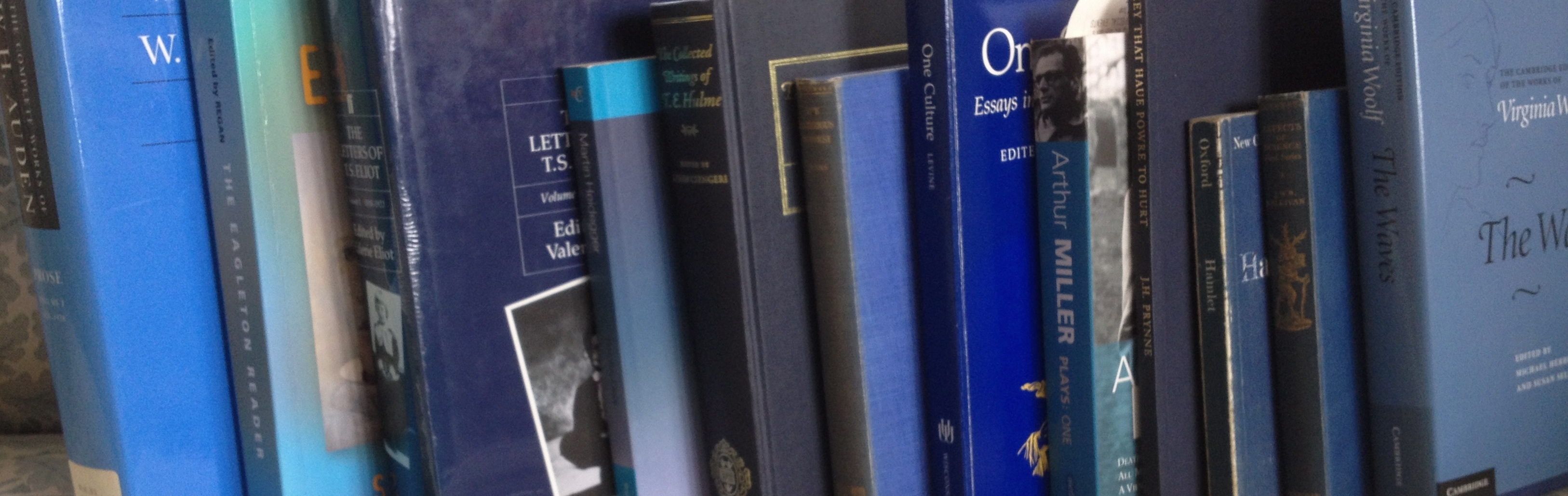
Not an easy one to choose: I’ve got far too many books, and more than enough of them dress in blue.  The hastily assembled long-list looked like this:
IMG_1018


  • Auden’s Prose (vol.1) more for a love of the bright blue than for a love of his early book reviews
  • The Eagleton Reader because he was the one lecturer whose lectures I stuck with through my undergraduate career and into the start of my time as a postgrad.
  • The Letters of T. S. Eliot, not for a love of that volume but because reading ‘Preludes’ when I was in my O-level year (it wasn’t a set text, it was a disciplinary task — more on this another time) was a window onto something different and fascinating.
  • Timothy Clark’s Martin Heidegger in the Routledge Critical Thinkers series because it explains his relevance to literary criticism, and from that point of view is far better than Michael Inwood’s book in the Oxford Past Masters series
  • T. E. Hulme’s Collected Writings, ed. K. Csengeri, because it was my first academic book-review assignment, and I read it with so much care I could have done my own edition by the end of it.
  • James Jeans’s The Mysterious Universe (1930), the best-selling popular science book of its era, which was hugely important to my thesis as a way of countering the objection that literary authors had no way of knowing about science, even though I don’t like Jeans as much as Eddington (who does?)
  • George Levine’s collection of essay One Culture (1987), hugely helpful to me c.1990 when I was trying to find my bearings in relation to the study of literature-and-science
  • Arthur Miller’s Plays (vol.1) bought not out of any great love for his work but because students applying to Oxford often submit essays on Death of a Salesman and so I had to read it. We did The Crucible at A-level, and it seemed dry as dust alongside Hamlet and Heart of Darkness.
  • J. H. Prynne’s They That Haue Power To Hurt, the most astonishing exercise in close reading that you’ll ever find; sadly (with reference to ‘Best Bargain’) hard to obtain now.
  • Shakespeare’s Hamlet in the New Clarendon Edition ed. George Rylands: an exam text for A-level, though I also equipped myself with an Arden edition.  I like the compact size of those New Clarendons, though, and wish they still did them.
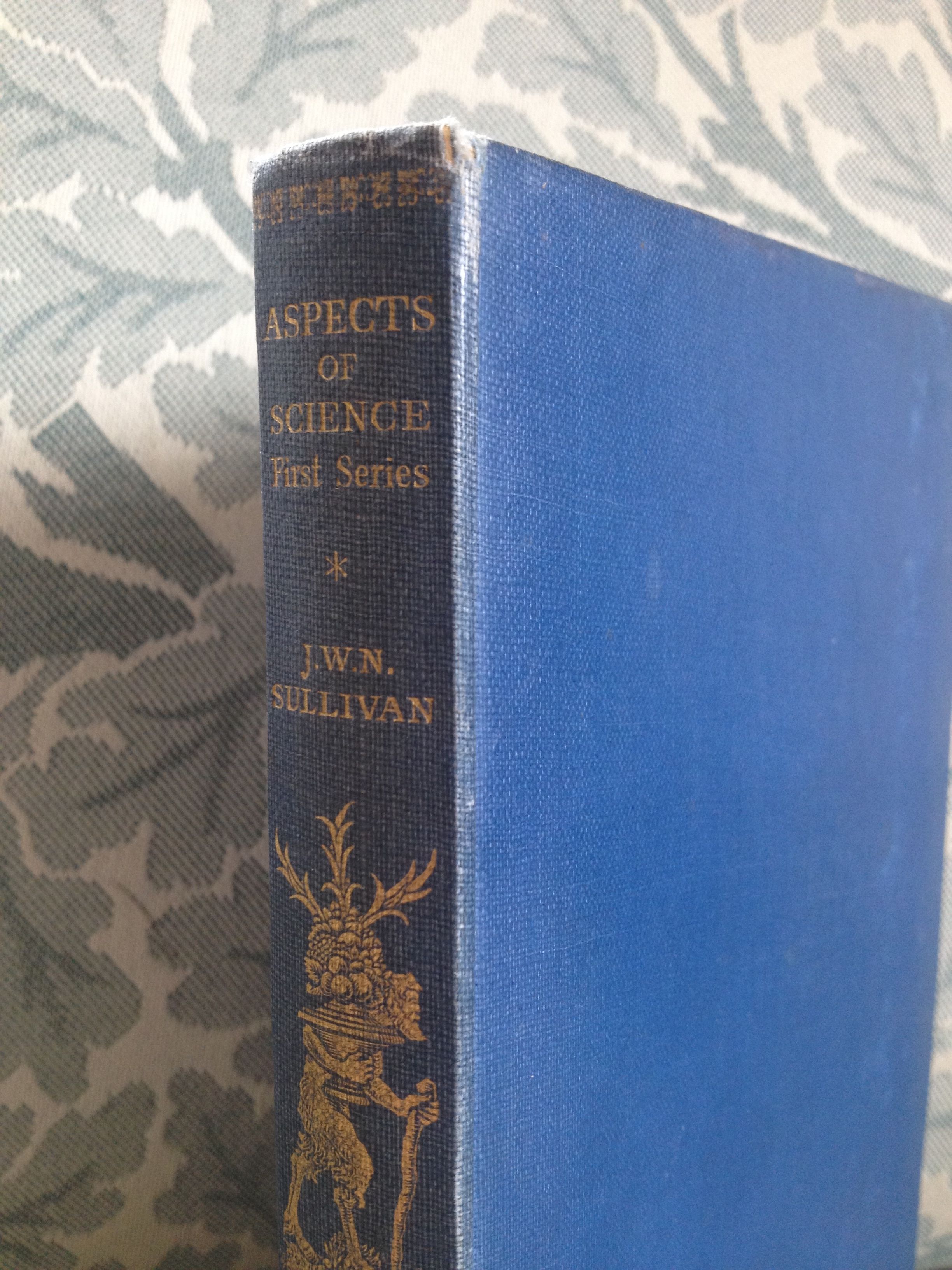
  • J. W. N. Sullivan’s Aspects of Science (1923) in the Traveller’s Library edition of 1927.  This is the one I’d like to single out, so more about it and him below.
  • Virginia Woolf’s The Waves (1930), ed. Michael Herbert and Susan Sellers in the new and ongoing Cambridge Edition.  My own edition of Night and Day (1919) will be coming out in this series, sometime next year I imagine; it’s currently having to wait patiently in a queue behind Mrs Dalloway.
JWNSullivanIMG_1020

Sullivan (1886-1937) was a journalist by trade.  He was born in the East End of London, in Poplar, and had left school at 14 and joined a telegraph company; but he later enrolled on science courses at Northern Polytechnic Institute in London (a forerunner of London Met) and later still (around 1908) at University College, London.  He worked in America for a period between 1910 and 1913, which was where he first turned to journalism. He served in the Ambulance service in Serbia at the start of the First World War, then returned to journalism (writing for The New Witness), and was then recruited by Wellington House, the government’s Department of Information (i.e., propaganda).  It was there he met the literary journalist John Middleton Murry, and when, after the war, Murry was appointed editor of the literary journal The Athenaeum, he appointed Sullivan as his deputy.  (T. S. Eliot was also considered for the role).  For the Athenaeum Sullivan wrote both a scientific column and various literary reviews; Aspects of Science gathers together the science columns, along with some others he wrote for its successor, the merged Nation and Athenaeum.

The first Athenaeum under Murry’s editorship came out in April 1919, and this was very fortunate timing.  In May 1919 Arthur Eddington was due to carry out the observations during a solar eclipse that would confirm Einstein’s General Relativity Theory.  Sullivan recognised the significance of what was happening in physics, and many of his columns aim to explore the change in worldview, and to understand how it might change the relations of science to culture. The five columns gathered as ‘Assumptions’ in Aspects are particularly interesting from this point of view; so too ‘The Scientific Mind’ and ‘The Ideal Scientific Man’.  Sadly Aspects doesn’t gather together the five columns from May and April 1919 in which Sullivan gave a non-technical exposition of relativity theory; the focus of Aspects was more on the cultural implications.  As Sullivan put it, the papers illustrated ‘one point of view’:

That point of view may be described, perhaps as aesthetic, but rather better as humanistic. Scientific ideas have a history; they arose to satisfy certain human needs; to see them in their context is to see them as part of the general intellectual and emotional life of man.  What they exist to do they do better than does anything else, and the needs they satisfy are not peculiar to scientific specialists.

 This account only scratches at the surface of an extraordinary life, made all the more extraordinary by Sullivan’s tendency to embellish it. (He persuaded Aldous Huxley that he was Dublin-born and had studied at Maynooth with James Joyce;  David Bradshaw disentangles fact from fiction in his article ‘The Best of Companions’ (Review of English Studies); it was David, as my D.Phil. supervisor, who first pointed me in the direction of the Athenaeum and Sullivan’s work for it.)  Through his friendship with Murry, Sullivan was introduced to Lady Ottoline Morrell and her salon at Garsington (if you can have a salon in rural Oxfordshire); Virginia Woolf word-sketched him in 1921 as ‘too much of the indiarubber faced, mobile lipped, unshaven, uncombed, black, uncompromising, suspicious, powerful man of genius in Hampstead type for my taste’ (Diary, 18 December 1921).  He had a passion for Dostoevsky and a passion for Beethoven; he long projected a book on the former, but never wrote it; his book in the latter (written for the centenary in 1927) stayed in print longer than any of his other works.  If you search the internet for a photo of Sullivan, you’ll find many more of Beethoven than you will of him.


#bookaday (2): Best Bargain

“Best Bargain” could just lead to an account of book-buying as written by a stock-market dealer.   Those £5 pamphlets by J. H. Prynne that now sell for £50 or £100: bargains!  (Etc.)  But I’m not selling them, so that’s not really the point.

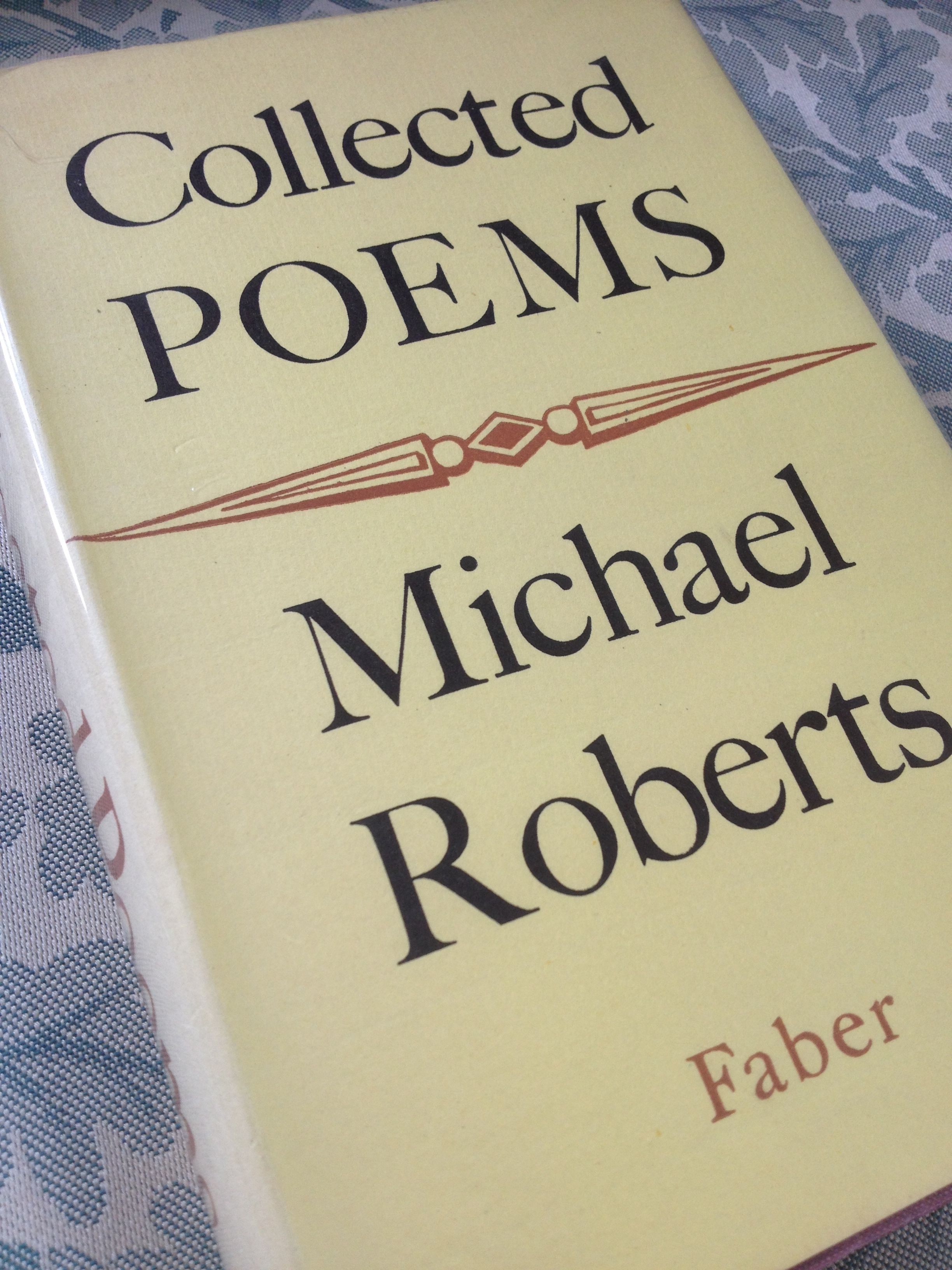
I’d prefer to take my measure as the price:pleasure ratio, but even that becomes complicated. When in 1992 I bought a second-hand copy of Michael Roberts’s Collected Poems (1958) for £30 from Ulysses in Bloomsbury, I’d never previously ventured into an antiquarian bookseller or spent quite so much on a second-hand book; but I was writing a chapter on Roberts in my thesis, and, in the absence of a loanable copy in Oxford, it was necessary and enormously helpful.  A bargain at the price, but in this case it’s as much a measure of the efficiency it brought to my research as it is of the pleasure of Roberts’s poems.  In a similar vein I might mention a secondhand copy of A. S. Eddington‘s The Nature of the Physical World (1928) which I got for £3 in December 1990, in the first term of my doctoral research, and which was completely invaluable then and in writing the book that followed from it.

IMG_1005

Collected Poems, by Michael Roberts

Keats’s Letters I bought in an already battered paperback copy for £1.30 in April 1988 (I systematically inscribed books back then), and battered it some more.  An amazing volume for me: we’d studied Keats at A-level, and the Heinemann text we had then contained some of the letters, but to be able to read all of them allowed me to take a completely fresh look at him. The letters were quite prominent in the relevant tutorial essay, but also starting a persisting interest in the letter as a not-quite-literary form, a form that’s marked mostly by its formlessness, and that’s broadened out into thinking about diaries (especially Woolf’s diaries), and having the pleasure last year of teaching a student with really original ideas about Woolf’s letters.

IMG_1004

Letters of John Keats, ed. Robert Gittings

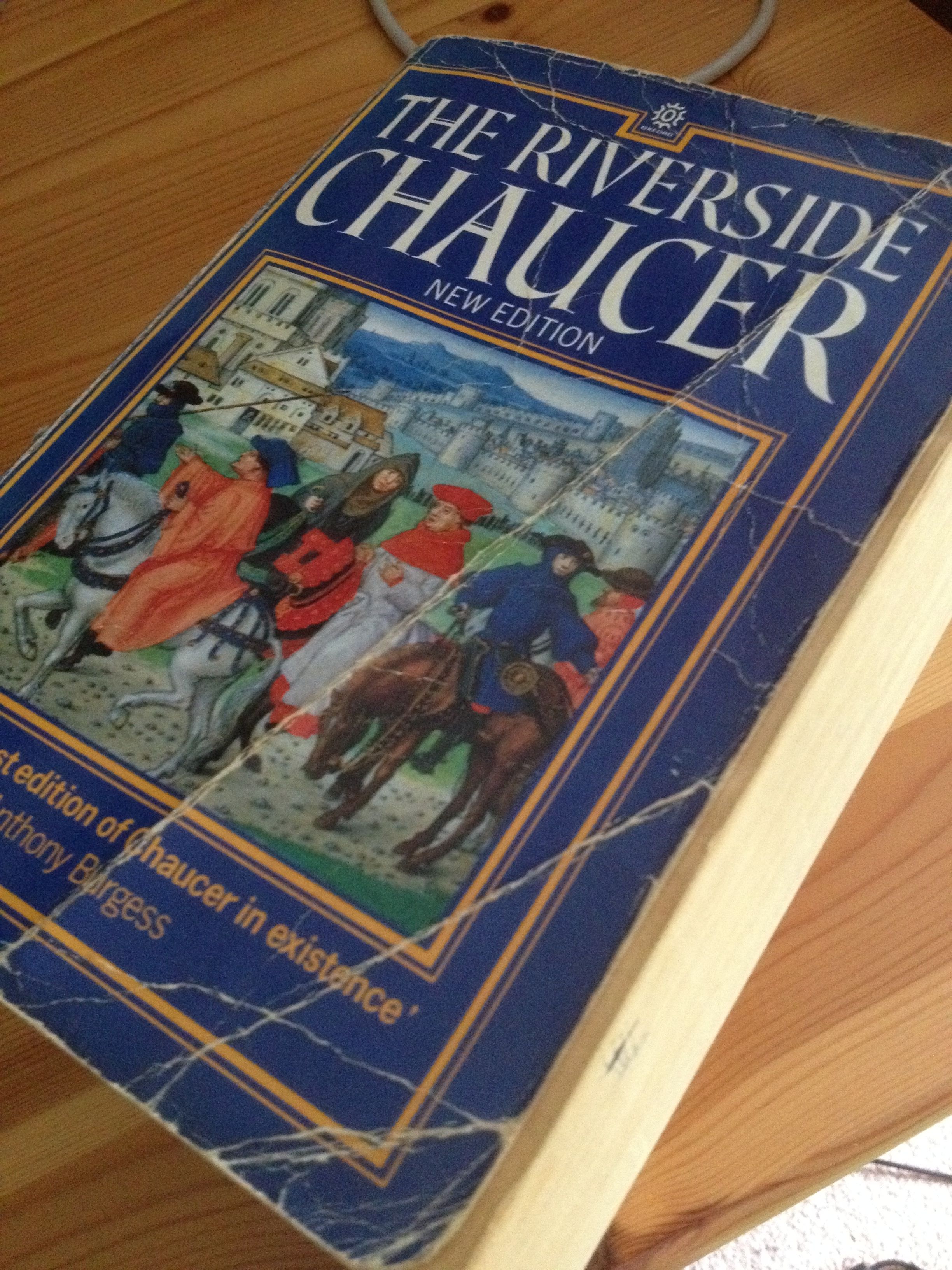
But though it’s great to find something secondhand, the real bargains have turned out to be new books that didn’t represent a great outlay at the time, or even seem to be particularly special as physical artefacts, but which opened up a whole new world of literary possibilities. The Collected Poems of Sylvia Plath (£4.95 seemed modest even in 1986); the Penguin ‘corrected’ Ulysses that I got in 1986 or 1987; the later Oxford World’s Classics edition of the same that I got in order to teach my Ulysses module at Bangor; but more than any of those The Riverside Chaucer, £8.95 in 1988, which served me well through the medieval period paper and the Special Author option on Chaucer.  Chaucer isn’t my favourite medieval poet, but the Riverside edition was a bargain, both for the range of poetry in it and for the compacted density of scholarly information in the notes.

IMG_0990

The Riverside Chaucer

Brabazon’s ‘Ten truths …’: thoughts on no.9

Of all the ‘truths’ in Tara Brabazon’s ‘Ten truths a supervisor will never tell you‘, the one that surprised me the most was no.9: ‘Weekly supervisory meetings are the best pattern.’ I know that my colleagues in Chemistry, and no doubt in other laboratory-based subjects, meet weekly with their supervisees, and see them frequently between those meetings.  But is this a good pattern for the humanities, specifically for English Literature?

I’m not sure it’s a viable pattern.  The Oxford English Faculty handbook currently states that candidates ‘may expect that their supervisor will provide at least two extensive supervision meetings in each term’, and that the candidate will provide a substantial piece of writing towards the thesis each term.  In Oxford, someone in my kind of post — a ‘University Lecturer’ in English — has a normal supervisory load of 6 PhD students, as well as having undergraduate lectures and tutorials to deliver, and usually some involvement in the M.St.  Weekly meetings would represent a significant increase in contact hours.  What would have to give?  Not my own research — there’s never time to do that in term — but more likely the extras such as convening a research seminar.

Even if extra hours were discovered in the working day that would allow weekly meetings, would such a pattern actually be desirable? To hold weekly meetings would be to keep a graduate student in an essentially undergraduate pattern of teaching.  I have some experience of this pattern, acting a supervisor to American doctoral students who have been in Oxford looking after JYA undergraduates.  The meetings reassured me that the doctoral students — both focused and industrious researchers — were putting in the hours in the library, but the written work presented for each meeting tended to be lists and brief notes.  My real concern is that a weekly periodicity might discourage exploratory reading and the kinds of discovery that come serendipitously.  I’m sure my doctoral students could manage to write weekly essays of, say, 3000 words; but I suspect that if they did so they might fall into relatively mechanical ways of doing it; and that even if the material varied from week to week, the argument or the method would remain substantially the same.

Brabazon justifies weekly supervisions by saying that some postgraduates ‘lack time-management skills and would prefer to be partying, facebooking or tweeting, rather than reading, thinking and writing.’  I’m inclined to think if they’re so completely absorbed in those vices as to be unable to produce written work (or other substantial evidence of progress) every month or so, they shouldn’t be doing postgraduate research.  (My own guess is that postgraduates are far more likely to get distracted from their theses by diligent teaching preparation or by finding new, shinier and more exciting topics; this second one is the bad side of exploratory reading.) Maybe if there’s a crisis a postgraduate will need to be put onto the intensive care regime of weekly meetings; but I wouldn’t see it as a desirable norm.  Postgraduate study should foster time-management skills and scholarly independence; in the Humanities weekly meetings could do the opposite.  A good supervisor will be there for an extra meeting if there’s some sort of crisis in the project, or a practical difficulty with obtaining texts; but he/she will also allow the student space to develop the project and his/her thinking.

‘Ten truths a supervisor will never tell you’: some thoughts

Tara Brabazon’s ‘Ten truths a supervisor will never tell you‘ (Times Higher Education, 11-17 July 2013) will be of great interest to those thinking about committing to three or four years of doctoral study. Brabazon clearly writes from experience; but as disciplinary and institutional arrangements differ widely, that experience isn’t always applicable to other PhD programmes.  What I have to say comes from my own experience as a doctoral supervisor in English Literature in two UK institutions, the University of Wales Bangor (as was), and the University of Oxford.

(1) The key predictor of a supervisor’s ability to guide a postgraduate to completion is a good record of having done so’, begins Brabazon.  A commenter on the THE website has already pointed out the problem with this ‘truth’: an institution that embodied it would never allow newly appointed academics to supervise; the established successful supervisors would have a monopoly on supervision, until they died out. (One imagines them being kept on life support mechanisms, until the expense of 24-hour medical care bankrupts the entire doctoral programme.)

Of course some institutions might allow newly appointed lecturers to gain supervisory experience by co-supervising, though Brabazon warns against this in her 6th ‘truth’, ‘Be wary of co-supervisors’, and has particular concerns about ‘the overconfident but inexperienced co-supervisor’ who hijacks the process.

What truths lie beneath this one?

(i) Education is a life-long process; even the ‘experienced’ supervisor is, or ought to be, learning about the supervisory process. Experience can be experience of different kinds of project, of different kinds of supervisee, in different institutional frameworks. So the inexperience of the new supervisor shouldn’t be seen as an obstacle.  What’s important, whether the supervisor is experienced or not, is that the department has robust additional arrangements, such as formal transfer of status interviews, or a supervisory committee that meets periodically to assess your progress.

(ii) An ‘inexperienced’ doctoral supervisor may have extensive experience of supervising final-year undergraduate theses and Masters-level dissertations. He or she will have experience of being supervised, and in most cases of undertaking further large-scale projects.  And, because of the research councils, he or she will be operating within an institutional framework that is very much focused on completion rates.

(2) You choose the supervisor. Do not let the institution overrule your choice’.  I’d agree that it’s important to research the institution properly.  Find out whether the department have appropriate expertise in your area.  Having identified one or more suitable supervisors, before applying, approach them with an outline proposal. (Whether they reply, and how helpful their reply is, might tell you something about their workloads.)  Some application forms (e.g., the one at Oxford) might let you suggest a supervisor.

But after that, there are good institutional reasons why the final choice should remain with the admitting department. An overloaded supervisor will struggle to be a good supervisor, no matter how well qualified he or she is.  Departments may also know which members of staff have good track records at timely completion, and may know that X, Y, or Z has a sabbatical coming up.

Of course if the supervisor you are allocated does not seem able to supervise you adequately, you should approach the department to discuss your options.

* * *

There’s more to say on this, especially about no.9 (‘Weekly supervisory meetings are the best pattern’), but I’ll save those for a future post.