The early Jazz Butcher records had shown an intermittent interest in rockabilly beats, with songs like ‘Red Pets’ and ‘I Need Meat’; their friends The Woodentops likewise mixed those insistent pounding rhythms into their work.
The beat, the harsh echo on the vocals, and the pause in the middle of the chorus locate ‘Lot 49’ clearly enough in that lineage. In the background there are delays on the guitars that almost start to work against the basic beat, especially in the closing 30 seconds or so, and by the end there’s a feedback drone that suggests a more psychedelic style, but these things are only hinted at; ‘Lot 49’ is classical, concise and focused, and doesn’t outstay its welcome.
Lyrics-wise, the title alludes to Thomas Pynchon’s 1960s classic of delirious paranoia, The Crying of Lot 49, and just like that novel, the Jazz Butcher’s ‘Lot 49’ is concerned with postmen, postcards, and the unreliability of the postal system. I think the Jazz Butcher song must have first alerted me to Pynchon’s novel, though it was my interest in literature and science that have me the final nudge towards reading it. The novel’s fantastic, particularly if you’ve been reading Jacobean revenge tragedy for your exams and have murderous henchmen called Antonio spilling out of your ears with their poisoned Bibles, or skulls, or signet-rings. That said, I don’t think you need to read the novel to appreciate the song.
Let’s be clear from the outset: I hate ‘driving music’, if by that we mean bland, unchallenging, predictable, steady-paced stuff that aims to lower blood pressure and heart rate as you hurtle down the fast lane. Moreover, I rarely actually enjoy driving. But for a long while, living in north Wales but trying to keep in touch with friends and family in southern England, I was doing quite a lot of it. And it became almost ritualistic to put on a tape of Fishcotheque, the Jazz Butcher’s first album for Creation Records, which begins with ‘Next Move Sideways’; so much so that I associate it very closely with a particular junction on the A4074 in south Oxfordshire. Something about the opening few chords before the song really gets going also embodies my reluctance to set off on any journey, so maybe that’s why this one feels so closely connected to driving. And of course the lyrics have a lot to say about bypasses, buses, and the car-oriented atmosphere of 1980s Britain.
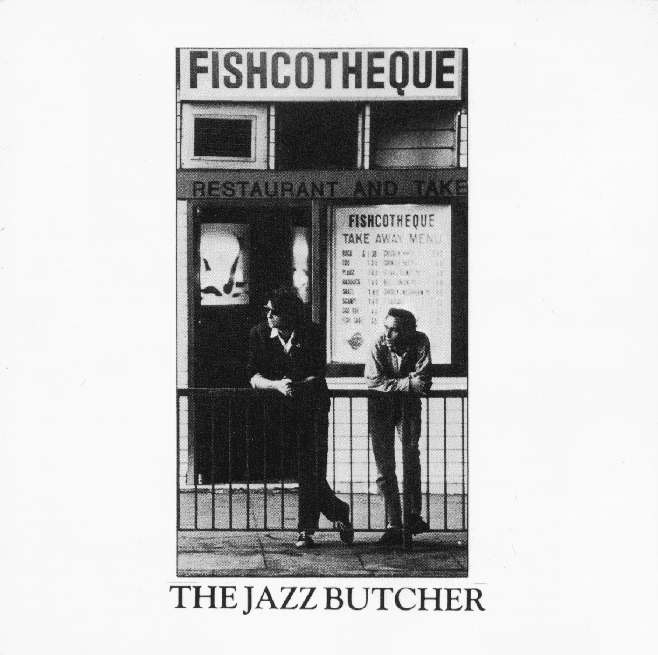
Fishcotheque was released in 1988, but I suspect the songs and the recordings date from late 1987. (Looking at the live line-up, by December 1987 the band has become Pat (guitar and vocals), Kizzy O’Callaghan (guitar), who does play on the album, and Paul Mulready (drums) and Laurence O’Keeffe (bass), who don’t.) It was recorded at Alaska near Waterloo Station, and takes its name from a fish and chips restaurant under the arches of a railway bridge.
‘Next Move Sideways’ is every bit as much a political song as ‘Olof Palme’, but it’s a bigger survey, and kind of Condition-of-England song for the late 1980s. The lyrics are looser-knit than on some of Pat’s earlier songs. Where his wittiest earlier songs had been built around sharp rhyming couplets — ‘Hungarian Love Song’ on Distressed Gentlefolk had been the pinnacle of achievement in this regard — the rhymes in ‘Next Move Sideways’ aren’t insisted on. Likewise, the vocal melody almost deliberately avoids having a catchy tune; in this regard there’s a similarity with The Blue Aeroplanes: what the vocal line lacks in melody, the guitars more than compensate for. The atmosphere is one of disempowerment, of a personal melancholy (‘your letters never arrive’) that isn’t purely personal because it’s due to the political stagnation of the time. It’s a song about being literally and metaphorically bypassed. From this point of view, the single most devastating line is ‘Smoking on the bridge like a tourist by the Houses Of Parliament’: we had become tourists in our own country, and the representational democracy wasn’t representing us. The other great, deep, and complex line is ‘I smell the diesel in the air, it lets me know I’m alive’: it hints at Marx’s recognition that there’s something revolutionary and destabilising about capitalism, even when it’s expropriating everything and polluting the country; all the references to traffic in the song hint at circulation, though the instinct of the owners of capital is not to ‘spread it about’.
Musically, I love the way the relatively careless vocal line plays off against the rhythmical tightness, particularly the very abrupt staccato chords; and the way those chords play off against the sparkling guitars; and the way that Alex Green’s saxophone solo cascades generously over the later part of the song. Musically it manages to acknowledge both downtrodden melancholy, and a concerted effort to make sense of everything, and a gift of optimism that comes unexpectedly from some entirely other place.
The Jazz Butcher website says that the later Big Planet, Scarey Planet album reached the top of M.T.V.’s alternative chart in 1989, but on the whole the charts and the band have scarcely been on speaking terms. In the era on Glass Records, from the 1983 to 1987, the eclecticism of the music must have made them a difficult band to market, but the small-scale nature of Glass probably meant there wasn’t in any case much promotional muscle behind them. In a just world ‘Southern Mark Smith’ would have been a hit, ‘The Human Jungle’ would have been a hit, and ‘Hard’ would have been a hit. They even performed ‘Hard’ on Channel 4’s The Tube in February 1986, and, in a feat of astonishing neurological resilience, Pat claims to remember something of the experience.
One might argue that the British record buying public didn’t get the Jazz Butcher’s variety of irony and emotional reserve. That’s where ‘Angels’ comes in, recorded in May 1986 as part of the Distressed Gentlefolk album, their last for Glass Records. The whole sound and emotional attitude of the song is quite different, while still recognisably being The Jazz Butcher. There was even a video, reconstituted here by a fan from a wobbly VHS tape:
In sleeve notes for a later compilation, Pat says he wrote it on the day the USA bombed Tripoli (i.e., 15 April 1986.) If the lyrics seem a little abstract, his remarks on that compilation aren’t the place to go to for clarification: ‘I never make any sense when I start to talk about this tune. The lyrics just showed up, like automatic writing or something.’ It could easily be the sort of ‘life is hard when you’re on the road’ song that bands with a busy touring schedule end up writing, and 1985-86 were the busiest touring years for the Jazz Butcher Conspiracy. But this one largely avoids the specifics of musicianly suffering, and so becomes a more general song about distance, separation, and longing.
Fans have always loved it; I get the impression Pat has mixed feelings about its simplicity and directness. Someone called out for it once at a gig and he said words to the effect of ‘you don’t want to hear that stadium shit, do you?’ In the production that John A. Rivers brought to it, the sound is almost too big, shimmering in digital reverb and a big snare-drum sound, but the song itself is solid, and works when played by the band or played solo.
The Swedish Prime Minister Olof Palme was assassinated on 28 February 1986. Exactly when Pat wrote and recorded this song I don’t know, but as the split with Max Eider came later that year (27 November, after a gig in Zurich), it was some time in 1986; the recording surfaced on the fabulous compilation Big Questions (The Gift of Music, vol.2) released the following year.
Around the time ‘Olof Palme’ came out, the only kind of leftist political songwriting that got attention was in the vein of Billy Bragg: passionate, direct, unambiguously committed. (And by the way, if my sources are to be trusted, Billy Bragg and Pat Fish were born on the same day in 1957.) Most indie bands were perceived as anti-Thatcherite and belonging to a 1980s version of the counter-culture, but there was a gulf between indie irony and playfulness on the one hand, and what counted as political writing on the other.
For me at least, ‘Olof Palme’ was a revelation about a different way of writing political songs. It’s the first song in this series that doesn’t currently have a version on YouTube, but there’s a snippet on the Jazz Butcher website that gives a flavour:
Although Max contributes, this is almost a solo piece; it’s broadly in the cafe-jazz line of Jazz Butcher writing that started with ‘Party Time’. There’s another strand to their early writing that I haven’t represented here, except perhaps in ‘What’s the Matter Boy?’, and that’s kind of witty drinking song; Max Eider’s ‘Drink’ and ‘Down the Drain’; ‘Olof Palme’ grafts that strand onto a more serious purpose, but keeps the light-hearted tone.
Well, you didn’t read about him in the English papers much
But he used to govern Sweden with a magic touch
Everybody liked him even though the liquor prices were high
And my god are they high
But all the taxation helped to pay the bills
For stuff like better work conditions and the curing of ills
It made sense, and ladies and gents that’s why…
I can’t think of any other song that makes a concise justification for redistribution and makes it light-hearted. Reminding us of the high price of alcohol in Sweden while exhorting us to drink in Palme’s memory is a lovely touch. It’s not the first political song in the Jazz Butcher’s work: ‘Real Men’ from Scandal in Bohemia has macho masculine identity in its sights; more tongue in cheek, ‘Red Pets’ on Sex and Travel celebrates all things female and Eastern Bloc to an unstoppable rockabilly beat; and in ‘Southern Mark Smith’ there’s a passing reference to the BBC as an mouthpiece of the establishment. But ‘Olof Palme’ is the one where Pat really nails it, quietly, modestly, and brilliantly.
Even granting the diversity of styles employed by the Jazz Butcher in the mid 1980s, musically speaking ‘City of Night’ isn’t typical of them; it feels like Pat is channelling someone else’s muse and I can’t put my finger on just who. The song was recorded 20 March 1986, and first appeared on a Glass Records sampler album, 50,000 Glass Fans Can’t Be Wrong; in then came out on the Jazz Butcher’s Big Questions compilation (1987), and reappeared on Cake City (2001).
Giving the keyboard such prominence, writing the melody in some weird Egpytian-sounding mode, and having a drum part that sounds like a preset electronic rhythm all make this an unusual proposition. The lyrics, though, are unmistakably Pat’s, and have the same self-deflating swift turns that characterise ‘The Human Jungle.’ In particular, the lines ‘I’ve seen the handcuffs on your shelf / I’d like to help, I’d like to help myself’; and ‘could it be shyness? It could be stupidity.’
The filmic quality comes mostly from the atmosphere of the music. The drum pattern reinforces the sense of a life being lived to a mechanical rhythm; the weird melodic mode makes otherwise ordinary London images and scenes take on an exotic quality. The film this places me in is predominantly monochrome, full of sharp contrasts between the bring lights of the city and its shadows, full of glittering surfaces and worn-down faces.
‘The Human Jungle’ doesn’t in fact allude to a film, but to a British TV series from 1963-1965 based around the casebook of a fictional psychiatrist, Dr Corder, played by Herbert Lom. I’ve never seen it, but suspect that doing so wouldn’t massively change my appreciation of the song. Mark Duguid writes that the case studies were ‘convincingly rounded and often bold’: ‘including a suicidal stripper, a young couple suffocated by their families’ love, and a schoolteacher punishing herself for a long-repressed crush on a pupil’ (BFI Screenonline). Here are the opening credits.
Pat Fish’s song takes the title as its starting point:
The Human Jungle starring Herbert Lom was never this much fun
And I’m ready to swear to that
The room is swaying like a boat
But I’m still afloat and that’s a matter of fact.
— all this suggests the connection between song and TV show is that our singer’s world is populated by mad people, and reliable reference points are few and far between. Musically it’s subtle and stylish. It emerges from the same laid-back faux-jazz sound that gave us ‘Partytime’, but there’s a lot more going on. But don’t believe me: listen. And listen, in particular, to the extended version.
Musically there’s an intriguing similarity to ‘Walk on the Wild Side’, but in a way that feels like an allusion rather than a theft: it’s there in the rhythm that Owen taps out on the hi-hat, in the sliding bass line, even in the rhythm of the vocal line. There’s a feeling of familiarity about it, but nothing that should have got Lou Reed’s copyright lawyers excited. Having that allusion further populates the song’s world with Reed’s New York transvestites and transexuals, without the lyrics having the mention them.
The lyrics are more abstract than any Jazz Butcher song I’ve written about so far.
I’m a camera, I’m a clown
And every move you make, I write it down
I know all about your house, I know all about your mouth
I know when I’ve got to leave your town
No sooner has the allusion to Christopher Isherwood come out — with further suggestions of decadence, inter-war and Berlin-based this time — and the possibility that Pat’s being just a bit too literary, than it’s qualified by ‘I’m a clown’. And similarly with the stalkerish suggestions about knowing all about her (presumably) house and mouth: no sooner is that uttered than he realises he’s overstepped the mark and will have to escape.
Musically there’s a lot going on: vocals and guitars are carrying melodies, but they’re also interacting rhythmically. There are subtle things: the four note guitar phrase that comes in at about 4.24: the first three repeats are based on one rhythm, but the fourth and final one varies it subtly to avoid monotony. And in the long version, the final minute or so of playout has a really joyful exuberance to it, Felix the bassist playing high notes, other instruments risking discords. I didn’t see the band in this incarnation, but this recording gives the impression that they were tight enough and confident enough to improvise. There’s nothing quite like this on a Jazz Butcher studio recording until Condition Blue in 1992, by which time the band’s sound had changed dramatically.
There’s also a video of a live version performed on German TV, from the AlabamaHalle in Munich, in November 1985. The sound quality is excellent; the band look entirely at their ease, even if musically they don’t stray far from the studio version:
In 1986, in my second year at sixth-form college, it was decided to put on a touring production of A Midsummer Night’s Dream. Arrangements were made to go to Köln, München, and, more adventurously still, Czechoslovakia. Costumes were hired from the RSC. I played Lysander and had an old silvery costume from Love’s Labours Lost once worn by Derek Jacobi. Bottom, when transformed, had a magnificent ass’s head. The fairies were definitely not ‘gauzy’, but emanations from the unconscious, clad in skin-tight veiny costumes.
In Czechoslovakia we stayed in Karlovy Vary and Prague, though for our actual performances we were bussed out miles into the countryside, on one occasion to play in a Dom Kultury in what seemed to be a small village, and on the other to play at a holiday camp by a lake. Our audiences there were not Czech, but East German holiday-makers. Some of the cast were at the end of their lower sixth year, but the majority of us had finished A-levels, and were in the mood for a party. The entire contingent acquainted themselves thoroughly with Germany’s and Czechoslovakia’s finest lagers. I’d known many of the cast since starting secondary school, though others I’d met only at sixth form; but we were all fairly comfortable and trusting with each other, so it was ideal.
‘What’s the Matter Boy’, from the Jazz Butcher’s Sex and Travel album, doesn’t exactly allude to A Midsummer Night’s Dream, or to Ovid’s Metamorphoses, but its central character is a familiar figure:
The shape of this is perfect. It could go into the chorus after the first verse, but defers it for a while so that the clues are all presented and we’re fully primed for the big revelation. And then more cunningly still, it shifts its sympathies slightly: the donkey-man may be a figure of ridicule, but he’s also a figure of pathos; people don’t like to be around him because ‘you make them feel uneasy when you say something profound.’
It doesn’t actually remind me of any very specific event, but of the whole tour and of the summer that followed. Girls dropped drinks into their laps; boys fell off their chairs. Catchphrases were invented and were mutated, in-jokes became deeply in-bred and cryptically funny only the initiates. The carefree mood of the music in ‘What’s the Matter Boy’ sums up that whole summer. The song itself maybe goes a little deeper: there’s fun being had, but there are also superficial judgements being made, whereby the ignorant protect themselves from the profound stuff they don’t want to deal with. But it wears its criticisms lightly.
More perfect pop, but of a different kind from ‘Rain’, ‘Big Saturday’ comes from the Jazz Butcher’s 1985 album, Sex and Travel.
I love how it builds from the delicate guitar melody, and how that’s suggestive of spring; love how the drummer (Owen Jones) initially holds back, only playing snare on the fourth beat in each bar, so there’s a kind of acceleration when he starts playing on the second beat as well; and love Max Eider’s embellishments and his Spanish-flavoured solo. The lyrics are perfect too: it’s a simple celebration of the beginnings of a relationship, but, with lines like ‘it doesn’t mean I’d die for you’, Pat prevents it from becoming too slushy. And as well as checking his affection in that regard, there’s also ‘We went through Saturday / And not everybody did that.’ Who were these people who didn’t go through Saturday? Lovers who split up? People who died? This is a song that starts by telling us that the weather’s grim, and for all that it’s celebratory, it’s also aware of what lies beyond and outside.
In this live version, from 1989, some of the delicacy goes, and there are significant changes to the vocal melody. The Jazz Butcher Conspiracy line-up at that date was great, but they don’t aim to create the feel of the studio version and they don’t put anything in its place:
And here’s a later live version, from 2013, just Pat and Max, which is closer in spirit to the studio version
Perfect indie-pop, a little rough around the edges, instantly catchy, and full of interesting guitar decorations. ‘Rain’ is from the same session that brought us ‘Roadrunner’, so I’m slightly out of chronological order with this one. Things to love include the backwards guitar (at least, that’s what it sounds like to me, though it also sounds fiddle-like); the staccato descending phrase that announces the vocals; Max’s various chiming embellishments; and the backing vocals, both on ‘Let the rain …’ and ‘Now-na-na–na-now’. For me this is the start of a line of short, sharp, focused pop songs by Pat Fish that later on brought us ‘Bad Dream Lover’ (on Big Planet Scarey Planet) and ‘She’s On Drugs’ (Cult of the Basement). It’s also the song that gave me a revelation about the lineage of indie-pop in general. That it sounds like the Velvet Underground is obvious enough — as with ‘Roadrunner’, it’s in the backing vocals — but that style of song and performance also owes something to American soul music from the 1960s; Lou Reed loved doo-wop and apparently also loved Motown. (Alex Petridis notes that the start of ‘There She Goes Again’ is virtually a quote from the start of Martha and the Vandellas’ ‘Hitch Hike’). Pat’s love of soul emerges most clearly in ‘Come On Marie’ (on, of course, Rotten Soul, in 2000), but there are hints of it from the very beginning of his career.
A song I sang the wrong lyrics to for ages: Girlfriend
This sounds brings together much that’s excellent about the early Jazz Butcher records, both in music and lyrics. My confusion about the misheard lyrics has redoubled in writing this piece, because I’ve now seen a transcription that suggests I was right all along, but I want to write about it anyway.
The sound has much in common with ‘Southern Mark Smith’: an acoustic guitar (presumably Pat) and another, highly chorused one (Max’s) adding melodic details; backing vocals gentle and high-pitched. It’s a soft sound — there’s little distortion on the guitars, the backing vocals don’t do the hard, mechanical Velvet Underground thing — but it delivers surprising power. The acoustic guitar strums in the basic chords twice round before the whole band comes, and Max delivers his main guitar solo before the lyrics begin. It’s a bitter-sweet story of drunken inappropriate relationships: the happy-sad, bitter-sweet tone was widely prevalent in indie music at the time; and someone also wrote that having a song called ‘Girlfriend’ was a prerequisite for any indie pop band; but in neither aspect does Pat’s take seem derivative. What blew me away when I first heard this — it was another on the compilation that Chris did for me — was combination in the music of melodic details and unmelodic raw details (the rapidly strummed descending part near the close), and in the lyrics the ironic and nuanced take on romantic relationships: ‘It’s a measure of a feeling that I can’t identify that I can let you go’. Who had ever written anything as complex as that before? Well, probably plenty of songwriters, but it was still a revelation to me.
The ambiguous bit of the lyrics comes in the first verse. Here’s what I thought I heard:
Here I am, I’m just lying on the floor with you
We had to get drunk, it was the only thing we could do
Well, it’s funny ‘coz I thought that it could have turned out quite romantic
But it isn’t like that, which is fine, ‘coz it means I can stand it.
I liked the idea that the ‘romantic’ relationship was the one that would have been unbearable. But having sung this for some years, I saw — or thought I saw — a transcription that had the crucial word as ‘traumatic’. Once you’ve seen it written that way, it sounds that way; it would still be a great song, but it would be a marginally less interesting lyric. Now, turning to David Whittemore’s excellent Jazz Butcher website (source of the above lyrics), I’m led to believe I heard it first the right time.

 Michael Whitworth