Category Archives: Books

#bookadayUK (27): Want to be one of the characters

Wanting to be a character, no; but wanting to live in their worlds, yes. I don’t know if I’m an anomalous reader from this point of view, but even when reading the novels and plays that have most absorbed me, even as  young reader, I don’t think I wanted to be anyone else.  Of course, when you’re completely drawn into a fictional world, you might identify with a character,   but that’s not the same as wanting to be them.

Sometimes the wanting to live in their worlds is a matter of wanting to hang out with the characters, wanting have conversations with their particular qualities of eloquence, or wit, or menace, or obliquity.  Some of the scenes of Stephen Daedalus and his student friends in Ulysses affected me that way, and coloured my second term at university, even while I was aware that his view was being placed relative to those of other characters, above all Bloom.  (Bloom got into me in a different way, in the curious tentative tumpty-tum rhythm of his thoughts.)  Sometimes it’s something less about character than about place or situation: Thomas Hardy is particularly evocative in this way, in The Woodlanders and Tess of the D’Urbervilles, and in places in The Mayor of Casterbridge.  I’m not sure my response was exactly one of wanting to live in Hardy’s Wessex, but the place I lived was geographically close enough and physically similar that I couldn’t help but see it as Wessex; and in any case, Hardy’s Wessex is always constructed as a place full of survivals, things that have escaped the tide of modernity, so the glimpsed decaying shepherd’s hut or rusting piece of unidentifiable farm machinery was Hardyesque in being the evocative exception.  And then there’s a whole other category of bodily evocation. D. H. Lawrence’s The Rainbow got to me, when I was 17 or 18, with its intense evocation of bodily awareness and bodily rhythms: this wasn’t wanting about wanting to live in Lawrence’s East Midlands landscape, and it wasn’t about wanting to be Will, or Anna, or Ursula; but it was about feeling that my experience of the world had been transfigured.


#bookadayUK (26): Should have sold more copies

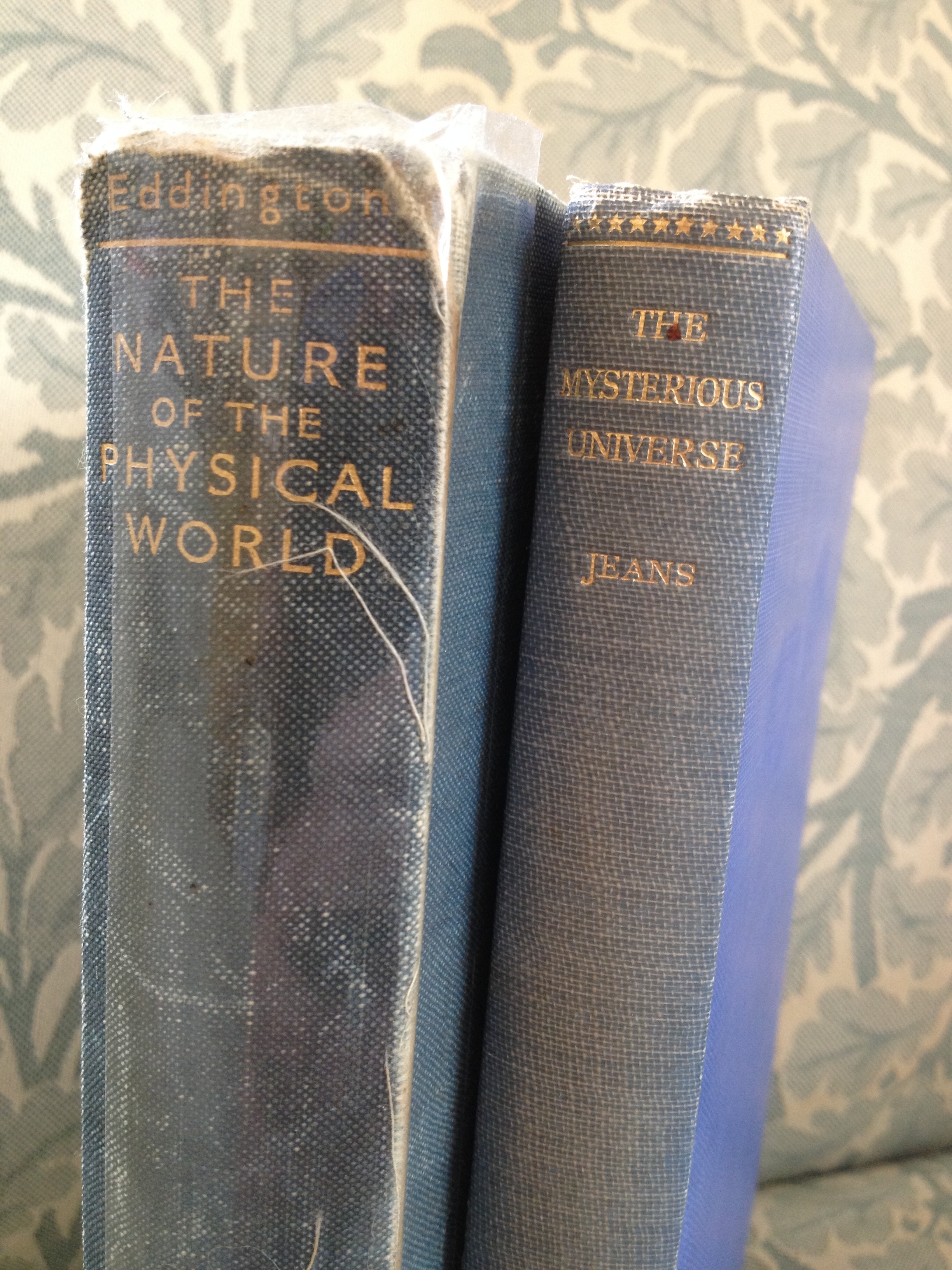
There were two giants in popular science writing in the late 1920s, certainly in the sub-sector of popular writing about physics and astronomy: A. S. Eddington and James Jeans, both physicists working at Cambridge University.  Works by both sold astonishingly well, but if the qualities of the writing are considered, Eddington should have outsold Jeans, and he didn’t.

Eddington_and_Jeans

My interest in how science became available to literary authors led me early on to popular science writing.  One might argue that popularity is a quality of the style of writing (its mode of address, the way it introduces and deploys technical terms, and the way it frames strictly scientific questions with humanistic concerns), and that popularity in terms of sales figures is a separate issue, but, for better or for worse, my initial impulse was to pursue sales figures.  Eddington, Cambridge professor and author of The Nature of the Physical World (1928), was a faintly obsessive record keeper, especially when it came to numbers, and the notebooks held by Trinity College, Cambridge, record the lengths of his cycle rides, the weights of his prize medals, and — most usefully to me — the annual sales figures for each of his books.  For other 1920s and 1930s authors like James Jeans, it is possible to find out about print runs from the archives of Cambridge University Press. Here’s one of the less exciting pages of my D.Phil., concerning Eddington’s Space, Time, and Gravitation (1920):

DPhil_AppxB

The upturn in sales in 1942 is something I’ve seen in Herbert Read’s figures too, and I think it’s more widely recognised; people were staying at home more because of the war-time blackout regulations. The upturn in sales in 1929 was probably caused by the success of The Nature of the Physical World, published in November 1928; although Space, Time, and Gravitation, is a more technical work, it’s likely that the later work stimulated interest and demand.

Jeans’s career as a popular science writer had begun with Eos, or the Wider Aspects of Cosmogony (1928), in Kegan Paul’s To-Day and To-Morrow series, and had continued with The Universe Around Us (1929). But his biggest success was The Mysterious Universe (1930), an expanded version of the Rede Lecture which he delivered in November 1930.  Published the day after the Rede Lecture, by the end of December it had sold 70,000 copies in the UK.  The Nature of the Physical World had managed about 2500 in its first two months.  Jeans’s book, shorter than Eddington’s, is a lucid exposition of developments in modern physics, but Jeans didn’t have Eddington’s gift for taking difficult physical concepts, at times counter-intuitive ones, and rendering them tangible.  Nor does Jeans deliver coups-de-theatre such as Eddington’s opening scene in which he stands before two tables, the one his everyday table, the other a table as described by science.  If I were selecting one to be reprinted as a classic of its time, it would be Eddington’s; but whether because of price or brevity or some freak whim of the marketplace, it was Jeans’s work that found more prominence.


#bookadayUK (25): Never finished it

Given the length of Proust’s In Search of Lost Time and the minuteness of the portion that I’ve read, it would be fair to ask whether I’ve ever really started it.  In 1992 Chatto and Windus brought out a revised version of the original Scott Moncrieff and Kilmartin translation, and in 1994, somewhere in the closing stages of my D.Phil., I bought the first volume.  How soon I began reading it I can’t remember, but I do distinctly recall thinking that the shape of the sentences and the metaphorical suggestiveness of the language was utterly gripping, and that the pace natural to reading it was not a fast one, but a leisurely, contemplative one; the book was definitely the one for me, but definitely not at that particular moment.

Proust_1992

Most significantly, this translation removed Scott Moncrieff’s very literary and Shakespearean title, Remembrance of Things Past, in favour of a more literal rendering, one that transforms the rememberer a more active searcher.  I believe that this translation has now been further superseded, but it’s still the one I want to go back to.

#bookadayUK (24): Hooked me into reading

As Biblicists know, eating an apple can get you into all kinds of trouble.  I’m not writing about the work that first hooked me into reading, because that was Ted Hughes’s The Iron Man, and I’ve already written about it.  The work that took my reading to a new level was T. S. Eliot’s group of short poems ‘Preludes’.  I’d been a voracious reader at primary school, but lost interest between 11 and 16 because no-one could recommend anything suitable for me. Then a couple of works grabbed my interest during my O-level years.

The first was Edwin Muir’s ‘The Horses’, which we covered  as a poem in our anthology, Rhyme and Reason.  I wrote an essay on it, had a spine-tingling moment when I realised that it was a kind of parallel creation myth, and the teacher was lavish in her praise.  (She didn’t even grade it; just wrote ‘Superb’.  You could overdo that kind of praise, but it was an important endorsement and confirmation.)

The other encounter happened by accident in the last lesson one Friday afternoon; spring or early summer, I’d guess.  The teacher, Mrs Harris, was off sick, and the lesson was being covered by a youthful, likeable Geography teacher, Mr Koenig.  I was hungry (my packed lunches were never big enough), and realised I still had an apple in my bag, so figured that I might as well eat it.  The chairs were arranged in double horseshoe configuration, so even though I was on the outer row, there wasn’t a great deal of cover.  I was spotted, and as a punishment, Mr Koenig took an old anthology from the cupboard, found a poem by a poet I’d never heard of and told me to write an essay on it: write about the urban imagery in ‘Preludes’ by T. S. Eliot. He must have done English Lit at A-level, to be able to identify a suitable topic with such speed.  At first I was resentful, as eating when you’re hungry didn’t seem such a terrible thing to do, and I’d never before been set a punitive essay or subjected to any ‘demerit’ or detention.  But at home, when I began to read the poems, and still more when I began to write about them, I was really blown away: the tone and manner were completely different from anything else we’d done.

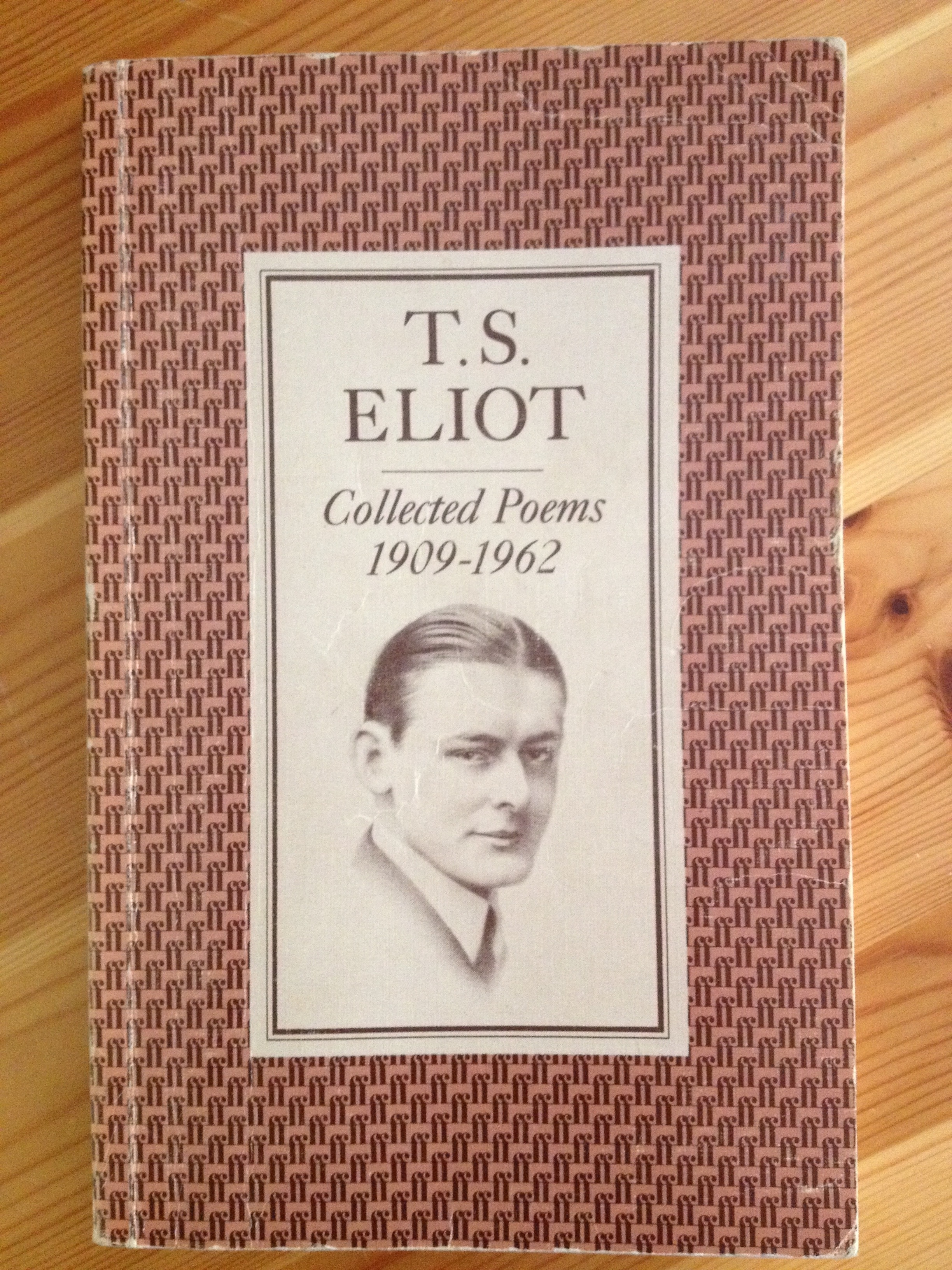
My guess is this must have been the spring of my O-level year.  I can’t remember whether there were any other Eliot poems in the anthology, but somehow I must have found out more about him.  At the point when I left secondary school I was signed up to do science A-levels at sixth-form college (Maths, Biology, Chemistry, Physics), with a vague plan of going on to do a medicine degree; but over the summer I started to feel that I needed some expressive, artistic dimension to my studies, so after the O-level results came I phoned the sixth-form and swapped one of the science subjects for English Literature. At some point in September of that year, I bought Eliot’s Collected Poems; I wrote the date September 1984 in it, but nothing more precise. I remember distinctly buying it in Wallingford, a small market town ten miles from home where we didn’t shop very often; or rather, I remember beginning to read it in the car on the way home.  Within a year I’d dropped another science subject, and set myself on studying English at University, now with the unusual subject combination of Chemistry, Maths, and English.

EliotTS_Collected

My copy, bought September 1984

#bookadayUK (23): Made to read at school

I can recall a few works that I resented having to read at school, or that at the very least I said goodbye to with complete indifference, but on the whole I was lucky with the things I was made to read at O-level, and with those I half-chose to read by taking A-level English. So I can ask with good reason what the Associated Examining Board thought it was doing when it chose Gavin Maxwell’s Ring of Bright Water as a set text — presumably working on some undigested Romantic assumption that Nature is morally uplifting — but generally speaking I’ve no cause for complaints.

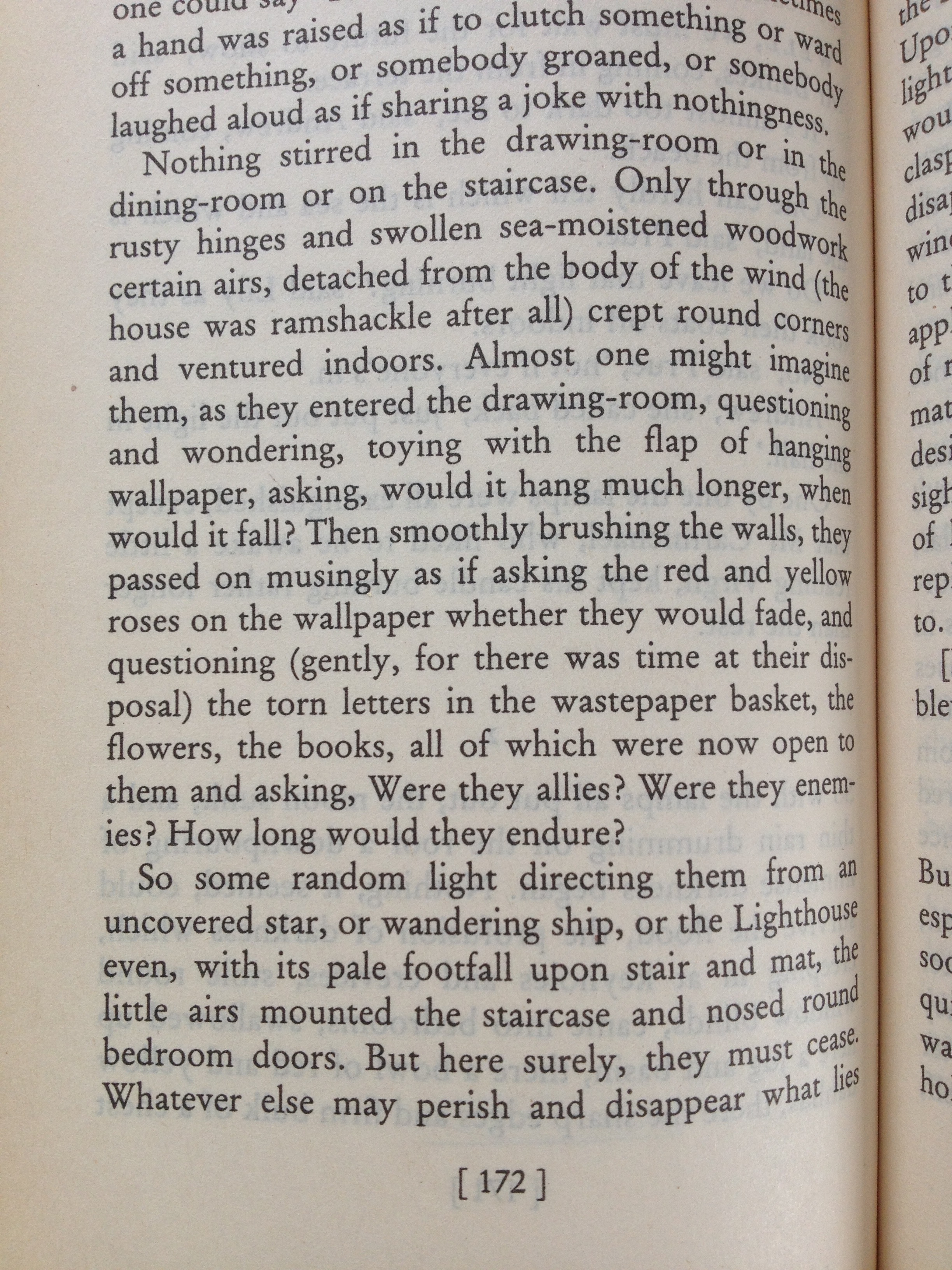
The text I was made to read at sixth-form college that had no connection to our syllabus was the ‘Time Passes’ section of Virginia Woolf’s To the Lighthouse. Our class usually studied two texts in parallel with two different teachers, Miranda O’Connell and Joan Clark, but at some point in the spring of the second year, Mrs Clark suffered a slipped disc and had a week or so away. In the first instance the college drafted in a teacher from the Henley Technical College, who I think was called Sally Benjafield, and so we found ourselves doing a practical criticism exercise on ‘Time Passes’.  Opinions were divided: I found it strange but haunting, and couldn’t put my finger on why it sounded like poetry; Dan P., who regularly sat next to me, and who was refreshingly free of illusions, declared it to be ‘pretentious’.

Woolf_TimePasses

Whether this was the first time I’d ever heard of Woolf I can’t be sure.  Colin Gregg’s adaptation of To the Lighthouse had first broadcast on the BBC in March 1983, and was given front-cover treatment in the Radio Times, but I didn’t watch it then; we saw it on videotape some time at sixth form: possibly as a follow-up to the close-reading class on ‘Times Passes’, but possibly as a quite separate extra. And although this was the first time I’d read Woolf, and although I remembering being intrigued by it, I didn’t immediately rush out and get hold of To the Lighthouse.  In part because I was busy preparing for A-levels, and busy preparing for that summer’s production of A Midsummer Night’s Dream, and in part too because presenting ‘Time Passes’ without any narrative context might make for a good practical criticism exercise, but it doesn’t make for the best introduction to Woolf.


#bookadayUK (22): Out of Print

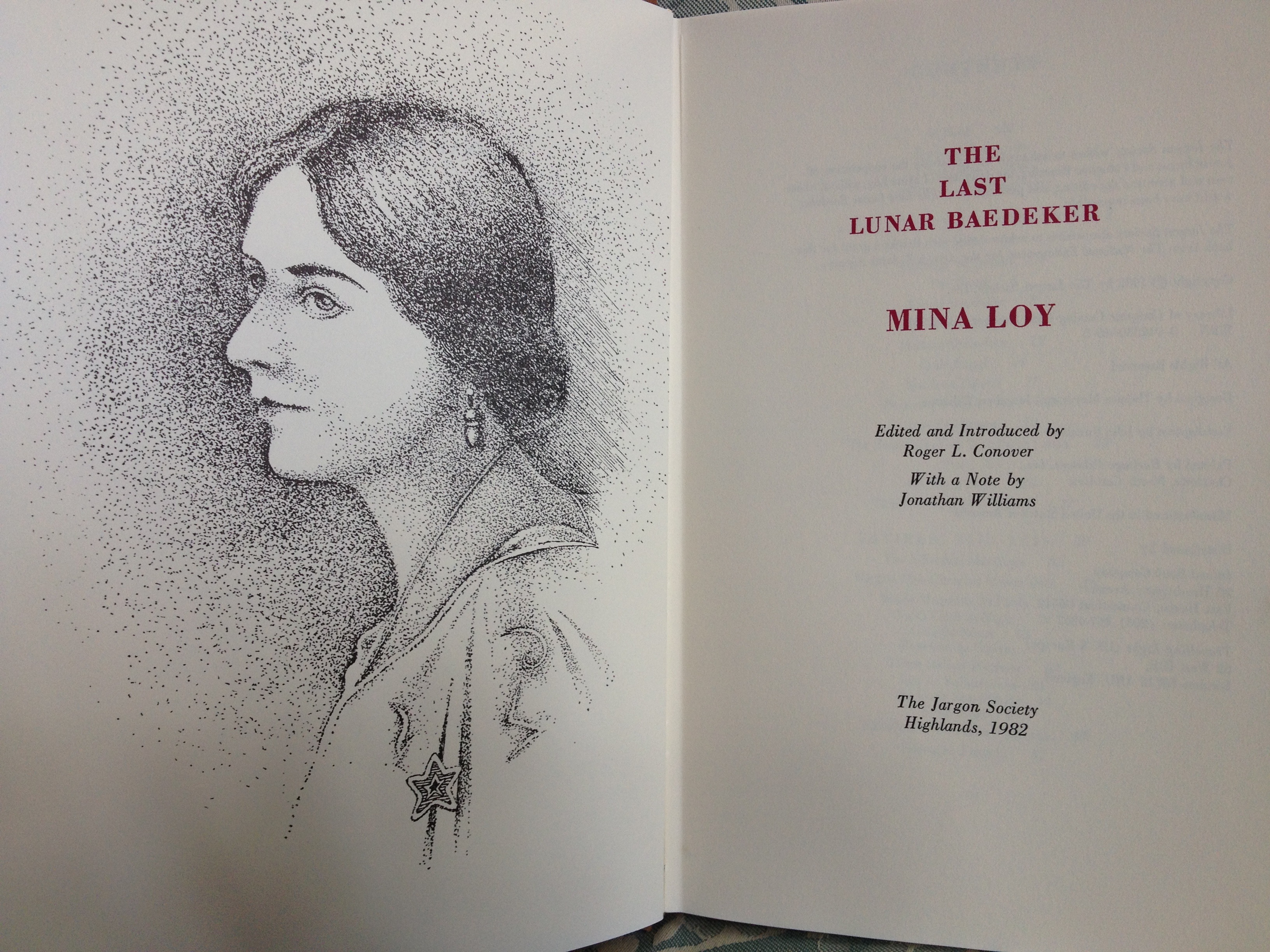
Pig Cupid, a small pamphlet of poems in response to Mina Loy’s ‘Songs to Johannes’, was where I first became aware of this neglected modernist poet.  That was in 2000; later, when Lawrence Rainey’s Modernism anthology came out (2005), I read her for the first time, and was amazed by ‘Parturition’ in particular, for the way it connected intense physical experience with philosophical abstractions. Rainey’s selection led me to what remains the most readily obtainable selection her poetry, and undoubtedly the best place to start, The Lost Lunar Baedeker, ed. Roger Conover (Farrar, Straus & Giroux, 1996; later published by Carcanet).  But tantalisingly, what Conover wasn’t able to include in that selection, given that he wished to include annotations and an introduction, was Loy’s autobiographical poem ‘Anglo-Mongrels and the Rose’.  He had included it in an earlier collection of her work, The Last Lunar Baedeker (Jargon Society, 1982), a beautifully made and hefty book that now re-sells for equally hefty prices.

Loy_LastLunar

You can get a good feel for Loy’s poetry without reading ‘Anglo-Mongrels’, but nevertheless, it attempts something quite different: an autobiography.  And it’s an autobiography that explores where personhood comes from, so rather than beginning with Loy’s childhood, it begins with her parents: her Hungarian-born Jewish father, Sigmund Felix Lowy, and her English mother, Julia Bryan. And her presentation of them isn’t straightforward: Sigmund becomes ‘Exodus’, and Julia is initially named ‘English Rose’, later to become ‘Ada’. In consequence, we see them as types rather than individuals, she ‘simperiing in her / ideological pink’, and he something of  Jewish stereotype, ‘loaded with Mosaic / passions that amass / like money.’  Mina Loy herself is born twenty pages into the poem (it’s about sixty pages long in total) and is referred to as ‘Ova’; her later lover Arthur Cravan is presented at the moment of his birth as ‘the male fruit / of a Celtic couple’, and is named ‘Colossus’.  The narrative doesn’t carry the main characters far beyond their early childhoods and formative impressions.  While ‘Anglo-Mongrels and the Rose’ is by no means perfect as autobiographical poetry, it’s a singular and striking experiment that deserves to be more widely read.


#bookadayUK (21): Summer read

‘How do you manage to fill those long summer holidays?’ The question was asked by a graduate at Bangor at his graduation-day party, and seemed charged with genuine concern.  If I couldn’t fill those empty months without seminars or lectures, he seemed to imply, I’d be at danger of going off the rails.  The student — let’s call him Johnny DeNiro, for he truly had changed his surname to that of an Italian-American film star — was a likeable and bright guy who had overcome many obstacles to get his degree; but I was astonished that he’d spent three years at university and still thought that lecturers spent the summer vacation with nothing to do. It’s the time when books and articles get written, when editions get edited and annotated, and when conference papers are delivered and discussed. Last summer I examined two PhD theses, one in Edinburgh and one in St Andrews, and on the train home from the first viva voce examination I began reading the thesis for the second one.  I understand the idea of a summer read, as something slightly less demanding than usual, or as a break from the usual routine, but I understand it in a distant and theoretical way; savoir, not connaitre. In practice I’m too busy reading in the summer to find time for summer reading; and when I’m not reading, I’m writing.

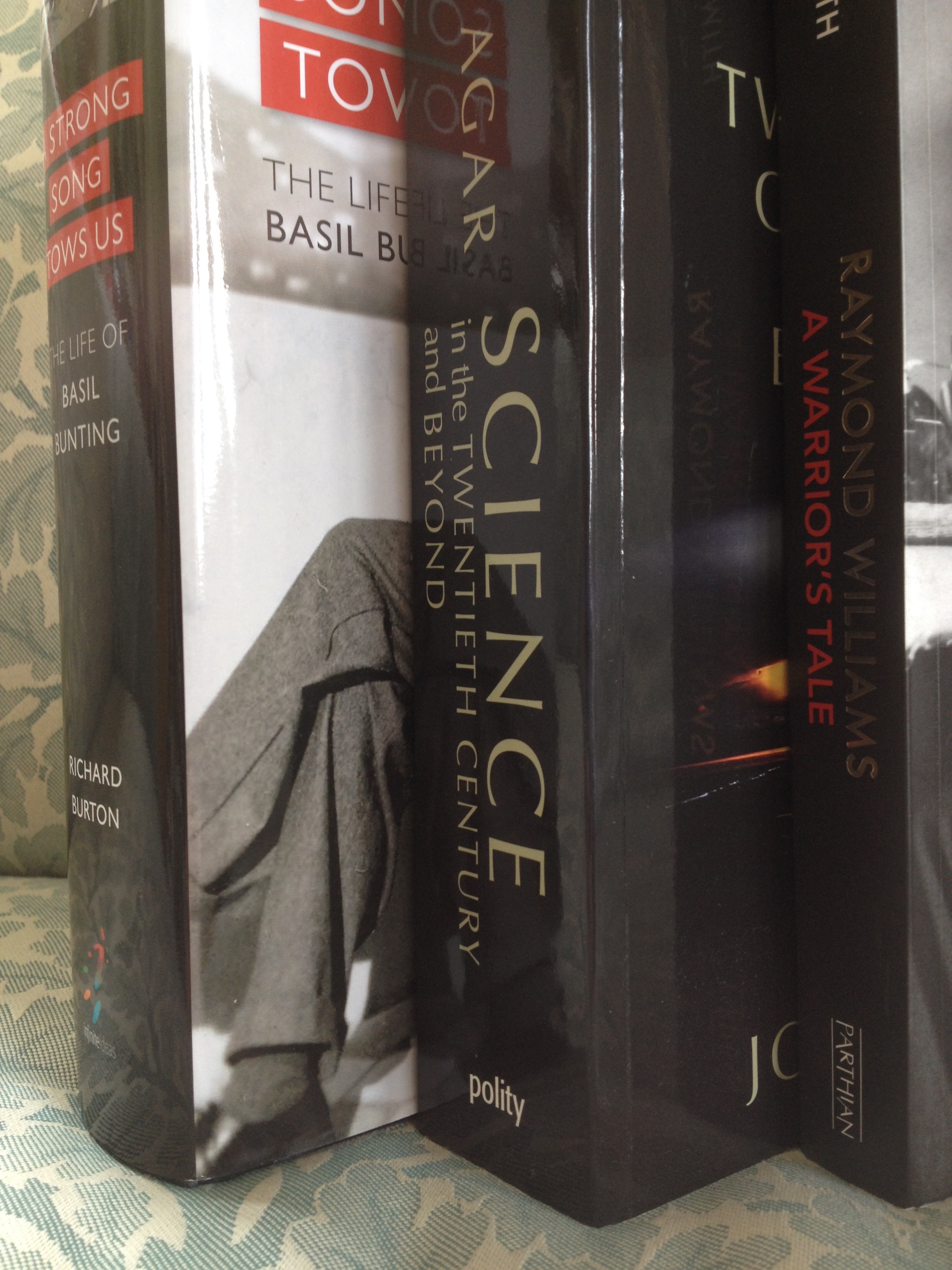
My most sand-filled books are Noel Malcolm’s Kosovo: A Short History, which I read on various beaches in North Wales in the summer of 1998, trying to understand what on earth was happening in the Balkans, and a Penguin translation of the Odyssey, which I read in the Mani in the summer of 2001, as I was teaching a module on Ulysses the next academic year and thought I could talk more authoritatively about Joyce’s ‘mythical method’ if I’d read Homer.  (In fact it made little difference, but I loved reading it). If the first was intensely serious, it was at least a break from work; the second was a pleasure, but there was a justification for it. I don’t suppose either fulfils other people’s criteria for summer reading; they don’t even fulfil mine. If I’m taking time off and spending it with a book, it’s more likely to be over the Christmas break; but, for the sake of naming something, if I have time this summer for reading that doesn’t fulfil an immediate research need, I’m be catching up with some biographies — Richard Burton’s A Strong Song Tows Us, or Dai Smith’s A Warrior’s Tale — or perhaps history of science, Jon Agar’s Science in the Twentieth Century.  That said, lining them up for the photoshoot, I’m alarmed by their monumentality; perhaps I need to continue the search for something light and distracting.

summerreading

#bookadayUK (20): Favourite Cover

In September 1990 I was living in Oxford, just about to begin my postgraduate study, and I noticed something familiar and unexpected in the window of what was then Blackwell’s Paperback Bookshop on Broad Street:
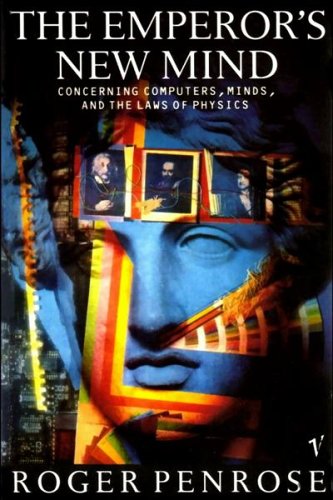
Penrose (D Leigh)

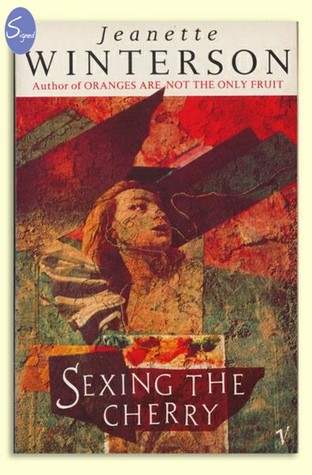
Roger Penrose’s The Emperor’s New Mind had come out in a Vintage paperback, and I instantly recognised the style of the cover artist.  A little later, I saw another very familiar jacket, and asked the staff if I could have one of the large promotional posters they’d had in the window:

Winterson Sexing (Leigh)

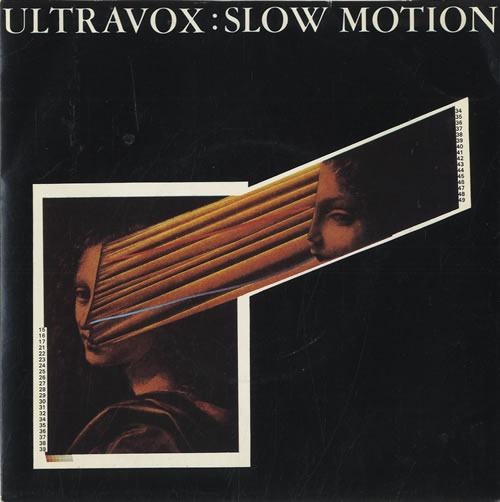
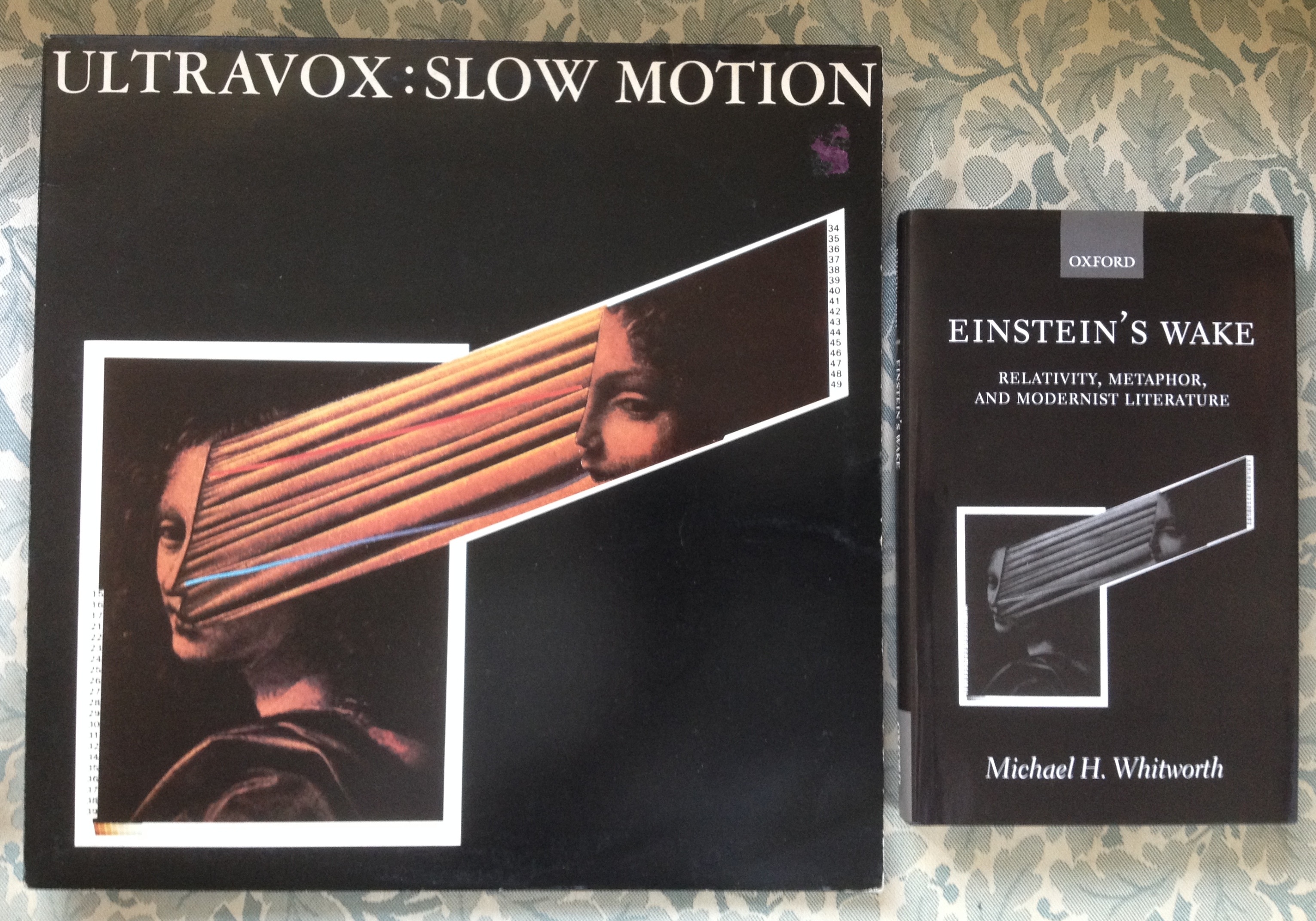
I’d been listening to John Foxx’s music since around the time of his album The Garden; I’d come to him via the Midge-Ure-era incarnation of Ultravox, and had discovered the earlier Foxx-era Ultravox and then Foxx’s solo work.  Born Dennis Leigh in Chorley, Lancashire, he had studied at art college in Lancashire and later at the Royal College of Art, before starting a band; from the outset he had been involved in the design of Ultravox’s sleeves. Early sleeves (‘RockWrok’ and  ‘Young Savage’ around 1977) had employed  rough-and-ready collage style that was ubiquitous in punk, but with the first single from their Systems of Romance album, a more refined style had emerged: less of the kidnap-gang and ransom-note style, more of a detached reworking of high European culture.

Ultravox_SlowMotion

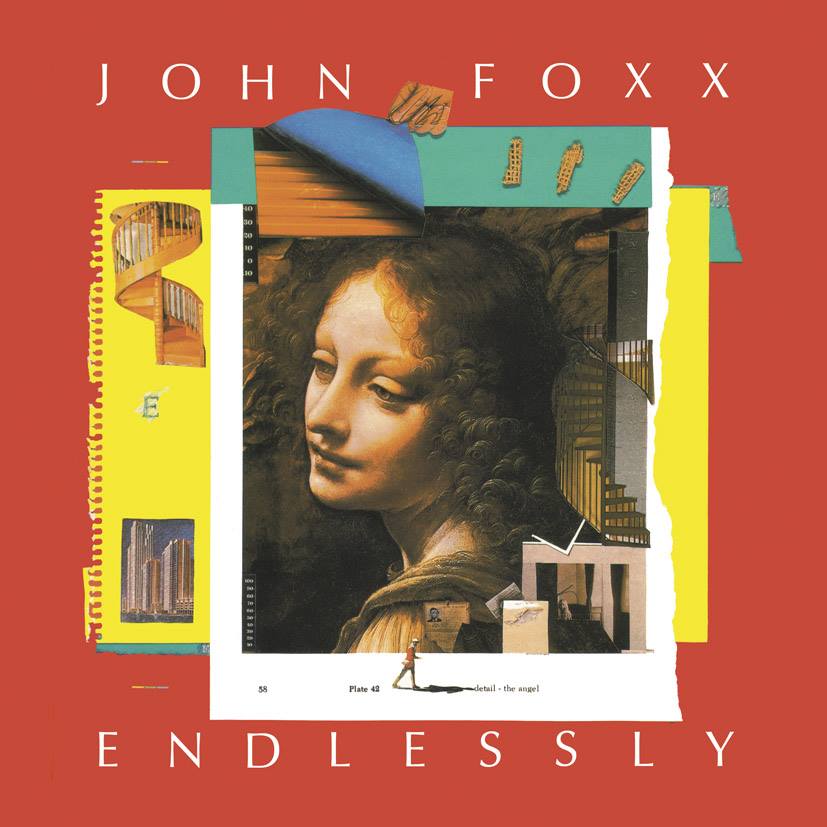
Foxx dropped that style for the stark minimalism of his first solo album, Metamatic, and for the associated singles, but it re-emerged in the sleeve for the single ‘Europe After the Rain’ (1981), and, having been allowed to drop for a few more singles, emerged again for several more singles: the second version of ‘Endlessly’, ‘Your Dress’, and ‘Stars on Fire’.
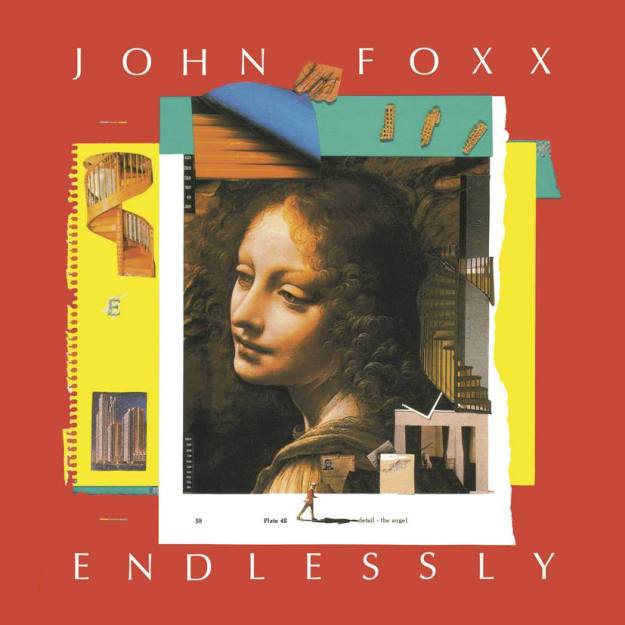
Endlessly_sleeve

Dennis Leigh, front cover of Endlessly (second version)
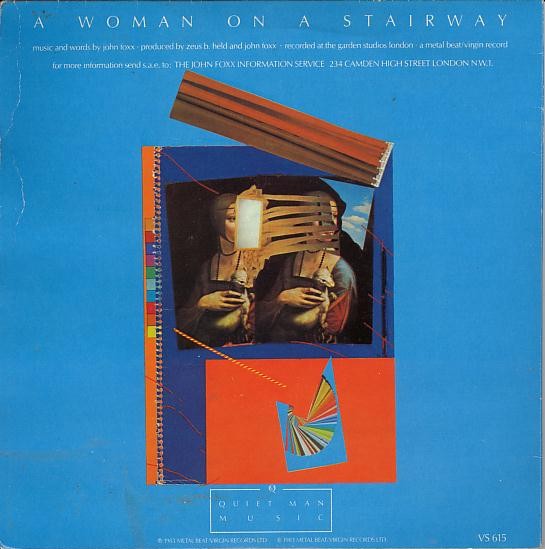
Foxx_YourDress_back

Dennis Leigh, back cover of ‘Your Dress’
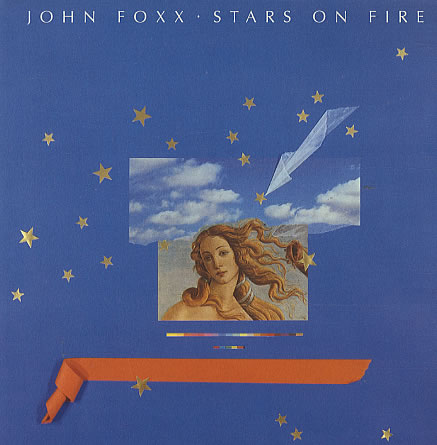
Foxx_StarsOnFire

Although there are all sorts of different methods being used in these sleeves, they’re united by  their sources (Italian paintings, especially Botticelli) and framing elements (the numbers at the edge of ‘Slow Motion’, the colour strips at the edge of of ‘Stars on Fire’) which reference colour-printing quality control or some sort of indexing system.

After ‘Stars on Fire’ and the album from which it was drawn, In Mysterious Ways, Foxx withdrew from the music industry.  He lectured on design in the art departments of various universities, and worked as a book-cover designer, under his real name, hence the Penrose and Winterson covers.  (A few years years later I discovered that he’d been living a few miles up the road from my parents, in south Oxfordshire; I bumped into a friend from school who had been having French conversation lessons with his wife). My own musical tastes moved on too.  The remembered versions of the songs stayed with me, but the relatively commercial production values of the last two albums grated. The early Ultravox material stood the test of time much better.

Much of my D.Phil. involved thinking about the popular science writing of the 1920s, and although Penrose’s book is very different from (say) Eddington’s The Nature of the Physical World (1928), the popular science boom that followed Stephen Hawking’s A Brief History of Time was an important element of dialogue between the past and the present.  Seeing Leigh’s designs on the covers of both literature and science was a reminder that at some points, literary and popular scientific culture overlapped.  At some point in reworking my thesis into a book, Einstein’s Wake, I imagined the sleeve of ‘Slow Motion’ as the ideal image. A crucial argument both in thesis and book concerns the finite velocity of light, and the way it becomes an image for the belatedness of knowledge in modernity.  Many expositors adopted Camille Flammarion’s ideal that, seen from a distant point in space, the Battle of Waterloo appeared to be happening in the present moment.  The way the image of the woman’s face is spread across space speaks to that idea.  The sequences of numbers in the margins also intrigued me, and touched on the idea that our knowledge is relative to our frame of reference; I particularly liked the way that the sequence at the left has a gap in it, as if the frame isn’t quite as reliable as it should be.  I was contracted to publish with Oxford University Press, and at that date its jackets were typographically conservative (Roman fonts) and tended to include a small framed image centrally in the page; I liked the way that ‘Slow Motion’ would fit that tradition but also break it; modernist fracturing of a settled tradition. It seemed worth asking if Leigh would allow me to re-use the image. I didn’t know how to go about contacting him, but found an Ultravox fan-club website and asked the fan-club organiser if he could pass on a question; the answer came back indirectly that it would be okay, but that the image should be credited to John Foxx.

I had the 12″ single of ‘Slow Motion’, and though that would improve the image quality, but scanning an image that was slightly too large for any available flat-bed scanner proved to be a nightmare.  (This was sometime in 2001).  I had to scan it in two parts and then digitally piece them together, and more or less manually sharpen the edges of lines, pixel by pixel.  Doing it this way gave me the opportunity to eliminate some of the scuff marks on my own copy, but at some point the labour expended went beyond reasonable and beyond enjoyable, and became more of a labour of love. Somewhere in the line of transmission the pointed corner at the top right was flattened, which is frustrating, and of course OUP were never going to reprint the image in colour; but on the whole I’m happy with how it worked out.
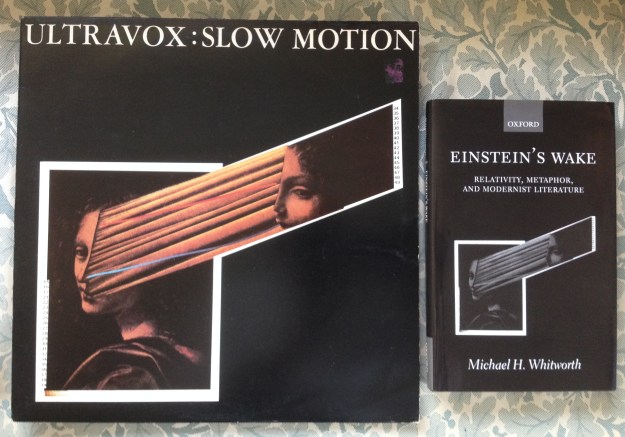
Slow Motion and Einstein's Wake


#bookadayUK (19): Still can’t stop talking about it

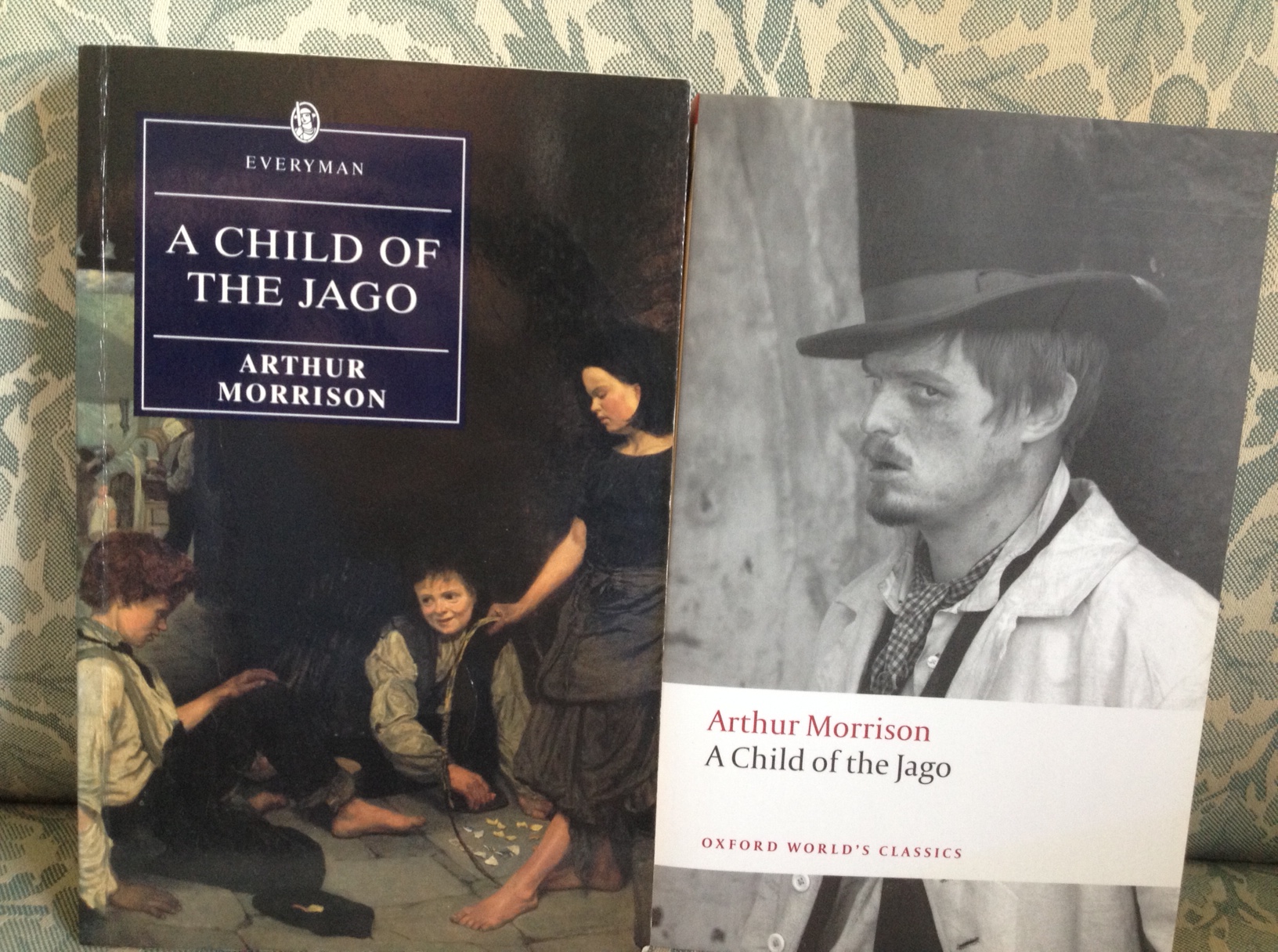
The photograph ‘though it seems distinct enough to the gaze which concentrates itself successively on the various parts of the picture, yet fades, when the attempt is made to view it in its entirety, into a mere blur.’   The reader ‘comes out from the Jago with the feelings, not, as he had expected, of a man who has just paid a visit to the actual district under the protection of the police, but of one who has just awakened from the dream of a prolonged sojourn in some fairyland of horror.’ I was reading issues of the Fortnightly Review from the 1890s when Arthur Morrison first caught my attention. Early on at Bangor I’d discovered that, although its library didn’t compare well to the Bodleian (how could it?), it had an interesting accumulation of late nineteenth-century monthlies and quarterlies, and I started to work my way through them, their old leather bindings crumbling into my notebooks and leaving stains like crushed moths.  I like the serendipity of old periodicals.  In his article ‘The New Realism’ (c.1897) H. D. Traill clearly wasn’t enamoured of Morrison’s A Child of the Jago (1896) but I was intrigued by the sketch he painted of its account of desperate lives and brutal violence in an East End slum, and the impression he gave of Victorian representational techniques nearing their limits.  Fortunately, at around the same time, Everyman brought out a new edition (edited by Peter Miles) with extensive notes and other background materials.

Morrison Jago

Peter MIles’s 1996 Everyman edition and his 2012 Oxford World’s Classics edition

The novel proved to be every bit as enjoyable and as interesting as I’d hoped. Morrison manages to be both ironically detached from his subjects, and deeply immersed in their lives.  The late nineteenth-century metaphor of the photograph has some truth in it, in that Morrison records things unthinkable in Victorian novels from a few decades earlier, and records them with a kind of detachment.  But to think of A Child of the Jago as merely ‘literary photography’ is to miss its pleasure in the act of representation, which is sometimes an artfully refracted act, and its pleasure in language and the artifice of language. For all the detachment and the references to the inhabitants as rats or vectors of infection, the narrator’s discourse is free enough to absorb the local dialect:

There were many market-porters among the Dove Laners, and at this, their prosperous season, they and their friends resorted to a shop in Meakin Street, kept by an ‘ikey’ tailor, there to buy the original out-and-out downy benjamins, or the celebrated bang-up kicksies, cut saucy, with artful buttons and a double fakement down the sides. And hereabout they were apt to be set upon by Jagos; overthrown by superior numbers; bashed; and cleaned out. Or, if this purchases had been made, they were flimped of their kicksies, benjies or daisies, as the case might be. So that a fight with Dove Land might be an affair of some occasional profit; and it became no loyal Jago to idle in the stronghold. (Chapter 17)

As this suggests, the narrator sometimes adopts the language of anthropology and treats the Jago-dwellers as a primitive tribe, and sometimes adopts a heroic or mock-heroic language:

Presently down from Edge Lane and the ‘Posties’ came the High Mobsmen, swaggering in check suits and billycocks, gold chains and lumpy rings: stared at, envied, and here and there pointed out by name or exploit. ‘Him as done the sparks in from Regent Street for nine centuries o’ quids’; ‘Him as done five stretch for a snide bank bill an’ they never found the oof’; ‘Him as maced the bookies in France an’ shot the nark in the boat’; and so forth. (Chapter 13)

But there’s also great pathos, emerging primarily from the narrative’s focus on young Dicky Perrott, a child who is sufficiently stunted in growth to show great promise as a pickpocket, but who also shows some doubts about the world he is growing up in.


#bookadayUK (18): Bought on a recommendation

Science-fiction ought to interest me, everyone assumes, and it increasingly does; but it has to overcome a high degree of resistance. Ever since 1987, my first term as an undergraduate, when Patricia Ingham suggested I read Gillian Beer’s Darwin’s Plots, I’ve been interested in how literature might have drawn on science, but in the vast majority of cases the way that science fiction draws on it is less interesting than the way that mainstream literature does. Put sweepingly, science fiction seems to ask how a scientific idea, extrapolated or implemented, might alter the real world, and it then represents that world; mainstream literature asks (though only occasionally) how a scientific idea might alter the way we write, and it then writes about the world through that altered medium. How might human relationships look different in the light of Darwin’s proto-ecological view of the world, the ‘tangled web’?  How might narratives of change look different in the light of Darwin’s gradualism?  These are the kinds of question that, on Gillian Beer’s account, Thomas Hardy and George Eliot ask.

My resistance to science fiction hadn’t set in place when I read John Wyndham at school; I wish once I’d exhausted Wyndham I had been pointed towards further science fiction. I have the feeling that someone suggested Isaac Asimov; certainly there was a family friend a few years older than me who read him obsessively.  If I did get as far as reading him, it didn’t connect; and I suspect I got no further than being put off by the covers. H. G. Wells I read a little of while writing my thesis, because he’s a frequent point of reference for popularisers of relativity theory: most often The Time Machine, but also ‘The New Accelerator’.  At some point in the 1990s Dent / Everyman did a great cheap edition of a lot of the early novels — mostly the scientific romances, but also some of the realist fiction like Kipps.  They were riddled with typographicals, but at least they were affordable and well printed, and so I read a little more widely in his earlier work.

I’ve not, in general terms, been very receptive to recommendations as to what I might read.  Well-meant suggestions were a constant burden in the first few years of my thesis, when on hearing a brief account of what I was working on, people would suggest something — often science fiction — and I would have to smile politely. (Part of the problem being that I didn’t have a rock-solid definition of what it was I was doing, so couldn’t take the conversation forward.)  A variant of this came very early on when I met a very bearded Linguistically Innovative Poet at an end of term party (so probably in June 1991), and mentioned my interest in poetry and science, which at that point was focused on Peter Redgrove and Ted Hughes.  He pooh-poohed my interest in mainstream poets and suggested I should take a look at J. H. Prynne.  Although I was hurt by what seemed an out-of-hand dismissal of my then-key poets, Lingustically Innovative Poet seemed more engaged with what I was saying than most, so I looked up Prynne on the Bodleian catalogue and ordered up a pamphlet or two: I can’t remember which, but I guess I chose the one with the most promising title, and that that must have been High Pink on Chrome.  Unfortunately nothing in my undergraduate experience had given me a way of grasping what I encountered, and further guidance was much harder to come by at a time when there was no internet worth mentioning, and only a fraction of the Bodleian’s catalogue was electronic. It was another seven years before I came back Prynne.

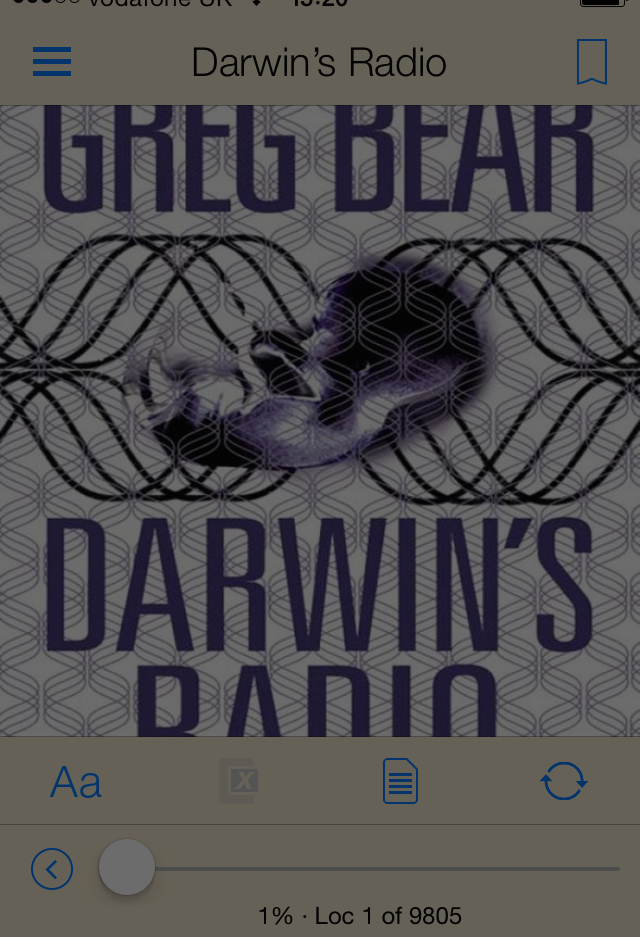
Taking up recommendations is a combination of the right person at the right moment.  I think I owe my reading William Gibson’s Neuromancer to a very persuasive postgraduate medievalist at Bangor, and Neuromancer went a long way to rehabilitating science fiction in my eyes. In an odd way, something about the writing reminded me of Virginia Woolf: I’ve never returned and read it more analytically to decide what, but it must be to do with the intense fusion of external reality and internal consciousness.  I’d worked as a programmer for a year between A-levels and university, and the idea of experiencing data-structures as physical structures seemed intuitively right. But though Neuromancer rehabilitated the genre, it didn’t lead to any further reading.  My most recent purchase-on-recommendation came at the suggestion of Peter Middleton, I think following an amazing conference paper by the historian of science Jim Endersby about the evening primrose and what early C20th science perceived as its ability to evolve not by gradual accumulation of small changes, but in large scale reorganisations.  The book that Peter mentioned was Greg Bear’s Darwin’s Radio.

BearGreg

Darwin’s Radio: I read it on Kindle

Bear imagines a mechanism whereby homo sapiens might undergo a radical reorganisation that would make a difference as large as that between homo neanderthalensis and sapiens, and also imagines that the same mode of reorganisation was responsible for the emergence of sapiens from his neanderthalensis.  What would happen, socially and politically, if a wave of mutant births began to occur? How might scientists disagree about the causes, and how might politics and other non-scientific factors affect their judgements? The novel raises these large issues, but by keeping a tight focus on a scientist and his pregnant partner, it avoids being a discussion novel. The plot is basically thriller-like, so the characterisation isn’t deep or complex, but it’s deep enough, and the ideas are completely fascinating.  As I neared the conclusion and the expected birth of the central characters’ baby, I had to stop reading for a while: early in the novel, very few of the mutant pregnancies have come to full term, and the novel insinuates than many of the miscarried foetuses were horrendously misformed. One might accuse Bear of being manipulative in this aspect of the plotting, taking a primal human interest and relying on it rather than any subtler emotional investment; but given the central theme of the novel, it’s necessary, and as the main structure of the novel is thriller-like, it’s an unusual move to build the final phase of the action around a pregnancy and its outcome.