Anyone looking at this photo might reasonably conclude that I own twelve copies of Virginia Woolf’s Night and Day — but I would deny it.
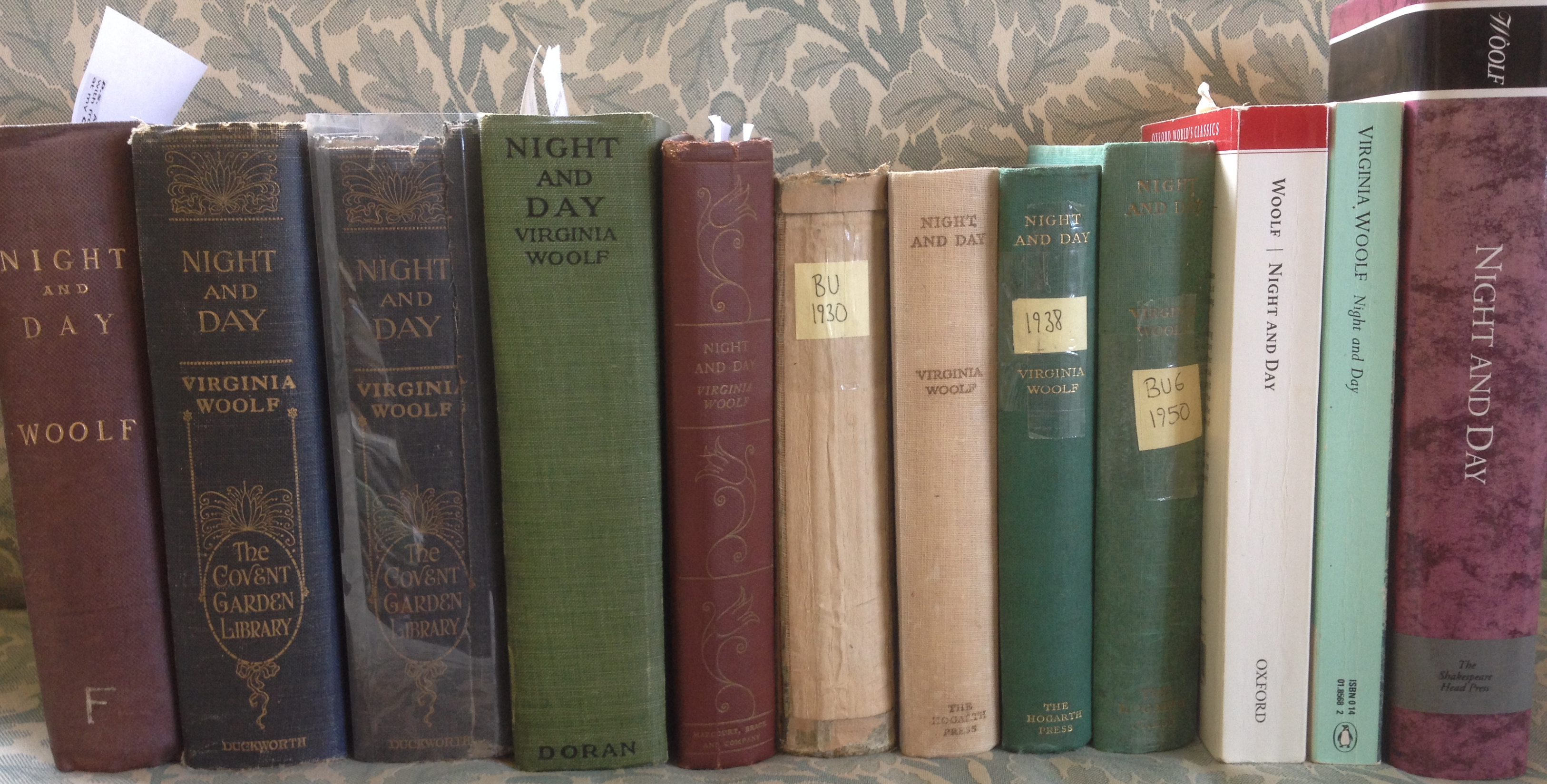
Twelve of my copies of Night and Day

Anyone looking at this photo might reasonably conclude that I own twelve copies of Virginia Woolf’s Night and Day — but I would deny it.
Twelve of my copies of Night and Day
‘Forgot I owned it’ is a self-contradictory category: identifying such a book is like coming into a dark room and turning on the light very quickly so you can see what it looks like in the dark. I’ve undoubtedly forgotten about some books I own, and that why I can’t tell you about them here. I can tell you about one that I forgot about and remembered too late.
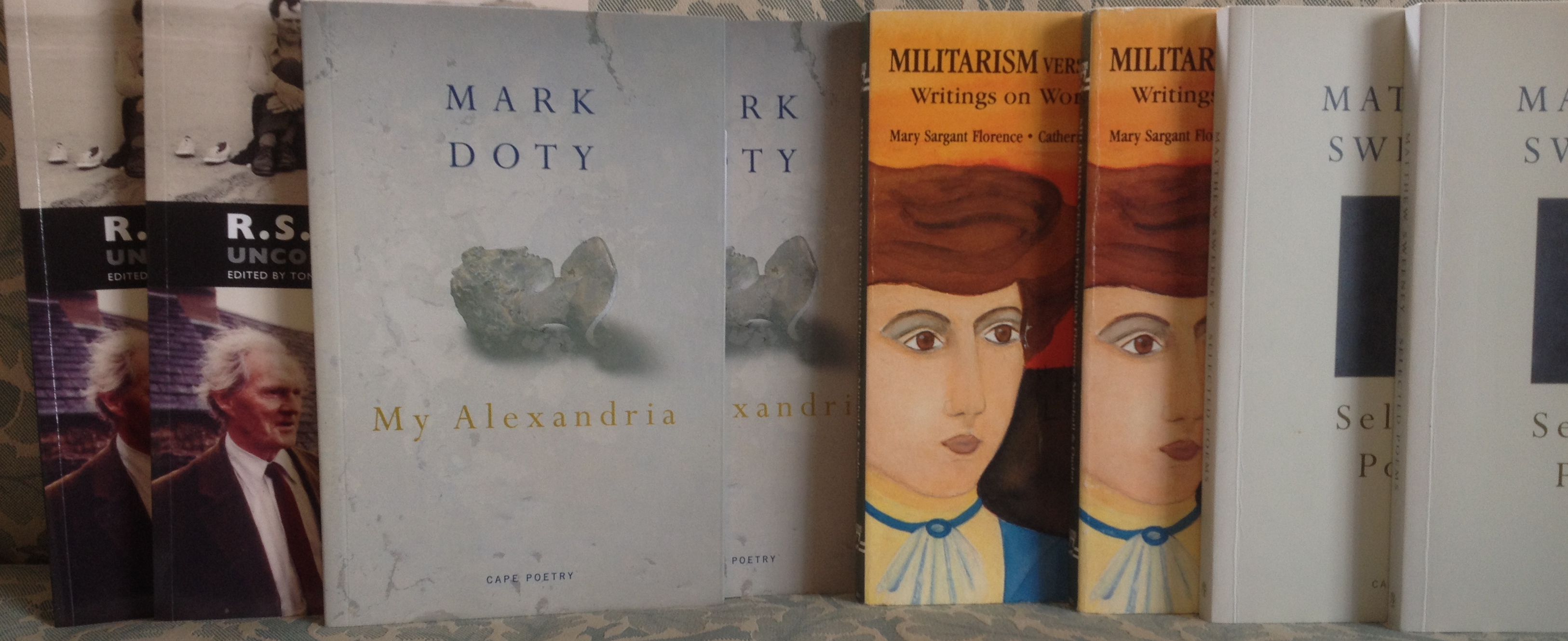
This line-up probably looks like incriminating evidence, but it’s not as bad as it seems:
The double in modern literature
Militarism versus Feminism (1915), by Mary Sargant Florence, Catherine Marshall, and C. K. Ogden, here in its later Virago edition with the terrible cover, is a classic of feminist and anti-militarist polemic; I first heard of it in an essay by Sowon Park which argues that some of Woolf’s ideas in Three Guineas (1938) had been in circulation for many years previously. For one year only I taught an M.St. option in Woolf, and bought a couple of these so that students could borrow them; I’ve got a third one at home. So, I definitely didn’t forget I owned it; quite the contrary.
The R. S. Thomas Uncollected Poems (2013) is a simple case of my having bought a copy and then being sent a complimentary one by one of the editors, my former Bangor colleague Tony Brown. While editing the collection he’d been trying to track down where the poem ‘A1’ was first published: all he had was a photocopy from an unpaginated newspaper arts page; it was clear that the publication of the poem had been brokered by Peter Hoy, one time Tutorial Fellow in French at Merton College. Tony rightly surmised that it must be an Oxford publication, and some other evidence on the page pointed towards a certain year. The absence of a page number and the typographical messiness suggested a semi-amateur production, and I guessed at The Cherwell. I ordered up the relevant year’s Cherwell in the Bodleian, and found the poem very quickly; very satisfying detective work.
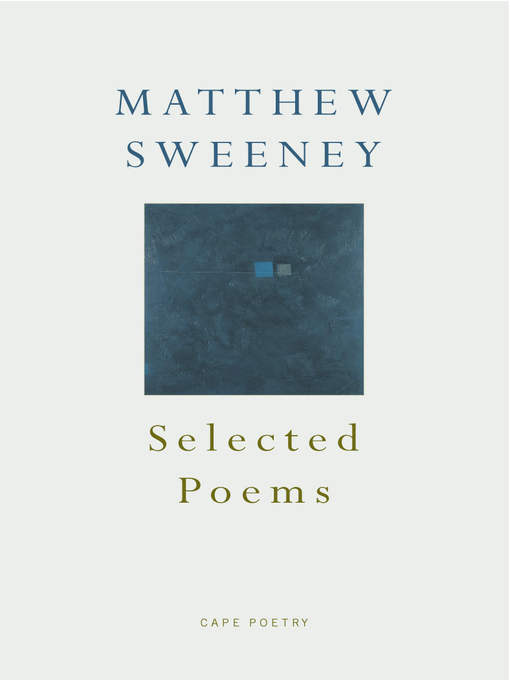
Mark Doty’s work I first came across with his poem in the LRB about the filming of The Hours and I went on to get School of the Arts. Then in London, popping into the sadly missed Pan Bookshop in the Fulham Road, I found an earlier collection My Alexandria (1995) and bought it. I got home and found that on one page there was a poem, ‘White Feathers’, by an entirely different poet. I contacted the publisher and they were unflapped: post them the the back page and title page, and they would send me a new copy. (I thought what I’d found must mean the entire impression was faulty, but apparently not.) I’ve kept the faulty copy for its curiosity value.
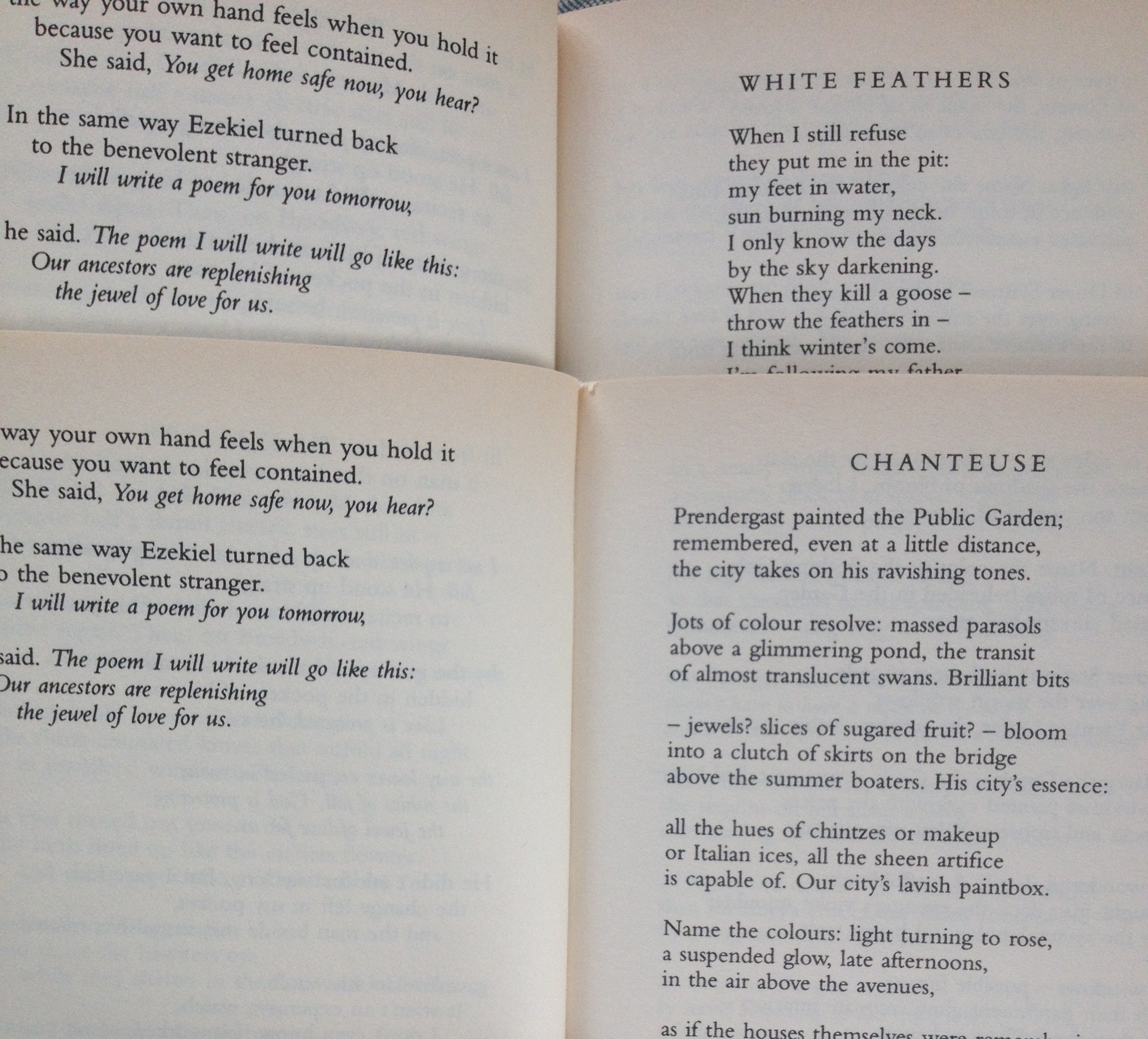
But when it comes to Matthew Sweeney’s Selected Poems (2002) I’ve got to admit to an embarrassing lapse. I like his work; I had several of the earlier volumes: Blue Shoes (1989) and Cacti (1992). Ian Gregson invited him to read at Bangor — he’s a very engaging and memorable reader of his work — and in at least one year we included his work on the Late Twentieth-Century Literature module. In February 2002 I bought the Selected (I dated it on the title verso), probably from the lovely Tyler’s bookshop which I walked past every day on my way to work. But I then apparently failed to launch myself into the Selected with the degree of enthusiasm that would have made my ownership register. In October 2005 I moved to Oxford. In December that year, in a fit of renewed enthusiasm for Sweeney’s work, I bought another one. I don’t remember when I realised that I had two of them; perhaps, to excuse me, I’d never unpacked the first one after moving. And it must be added that Cape Poetry book covers at that date aren’t the most eye-catching or distinctive of designs.
If it’s any consolation to the poet, I’ve done the same with Madame Bovary. You’re in esteemed company, Mr Sweeney.
There isn’t a single book that I always give as a gift. I often give books as presents, but there’s nearly always an attempt to suit the gift to the recipient. Isn’t the urge to give the same book to everyone a secular version of the Gideons, or of those evangelical characters in Dickens who are always handing out their tracts to people? In that vein, the vein of spreading the word, I’ll admit I have gifted one copy of J. H. Prynne’s Poems and one copy of R. F. Langley’s Collected Poems, but that’s about the limit, and the puzzled response to the Langley book suggested it should stop. There’s one author whose works I’ve consistently given to people, especially to my partner and my parents, and that’s me; but even then I choose a different work each time.
A book that doesn’t belong to me? This one is easy: the full Oxford English Dictionary, in twenty volumes (1989), or in its wonderful electronic form. My main disappointment in writing this post has been to discover that Anthony Burgess’s hilariously fruity remark about the OED — ‘I have taken this book like a mistress to bed (a weighty one but handleable)’ — referred not to the twenty-volume second edition, but to the fourth and final supplement (1986, covering Se-Z) to the previous edition. The image of Burgess in bed with twenty volumes is just that little bit better than him paying amorous attention to the language from ‘se’ to ‘zymosan’. In my case, even if I could have afforded to buy all twenty volumes, I’d have had to take them to bed because there’s no space left on the bookshelves.

The Twenty-Volume OED
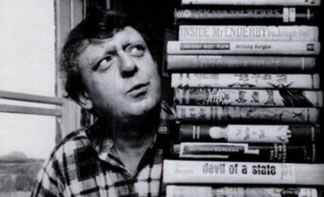
Anthony Burgess and his progeny
Do I have a ‘favourite author’? It’s a professional hazard of being a lecturer in English literature that ‘favourite author’ becomes an unwieldy implement, an unusable tool. I’ve no problem with the idea of value or with admitting that I like some authors more than others, but to single out just one is impossible. That’s partly because I like them for different reasons and in different modes and moods. Professionally, I enjoy giving tutorials on some, enjoy giving lectures on others; enjoy researching some, and enjoy writing about others. Personally, poetry and narrative treat me differently; linguistically innovative poetry touches different parts of the self from conventional lyric. Some works I enjoyed reading when I was a student, and so I cherish the memory, but I wouldn’t necessarily want to go back to. (New category: Favourite author you could happily never read again.) And working professionally with literature means makes it harder to have an author who exists in some way privately for me as an irrational and unanalysed preference.
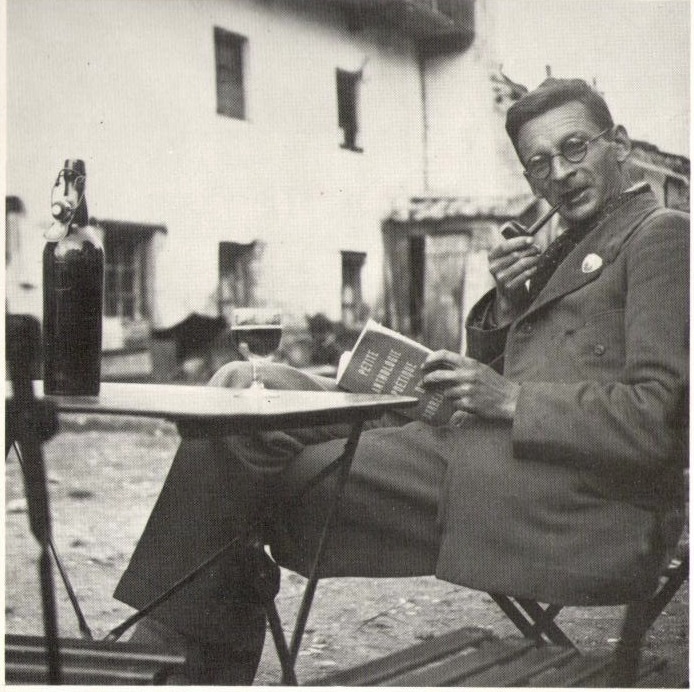
Michael Roberts, Val D’Isère, 1935
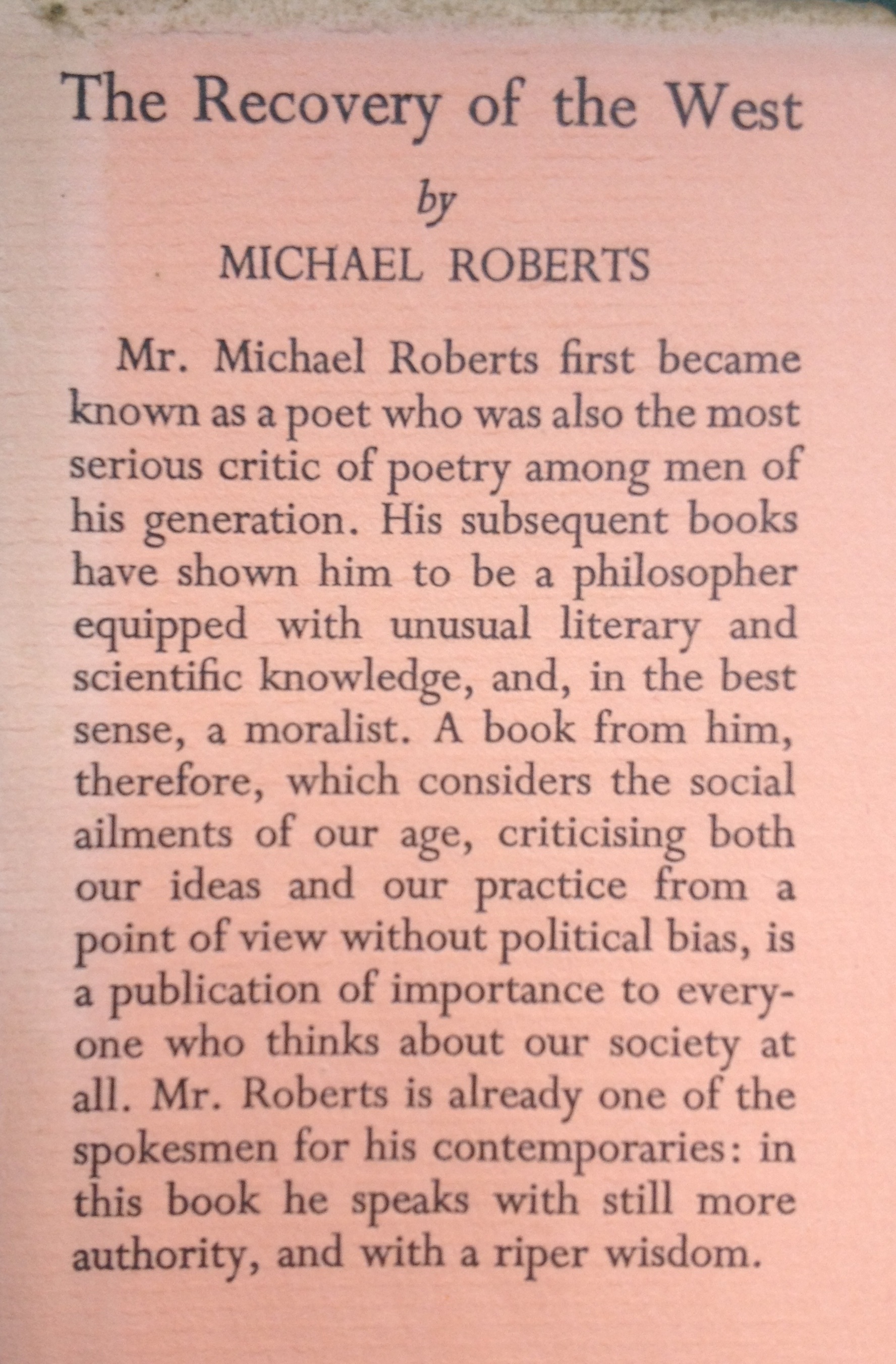
Michael Roberts (1902-1948) is a favourite, not least because I felt for a while that I was the only person in the world who had read him, and because meeting Janet Adam Smith, his widow, around 1992, was a rare moment of being able to connect with a lost world of modernist literature. In his case, the least favourite book selects itself quite easily: The Recovery of the West (1941). I like him for his poems, and like his essays and reviews for their lucidity and their wit. He was a schoolteacher by profession, and I get the feeling he would have been wittily entertaining at the same time as being intellectually questioning and rigorous. His letters are more exuberant (depending on who he’s writing to), but witty and passionate too: you can glimpse that side of him in the prose fantasy ‘Non-Stop Variety’, in the Hogarth Press New Signatures. But by 1941 Europe had become a darker place, and his mood was more sombre. The blurb — it’s a Faber book, so it’s probably a T. S. Eliot blurb — gives a measure of its tone:
I read it in 1992 when my interests really lay in how Roberts’s poetry related to his education as a scientist: he had studied chemistry at King’s College, London, and mathematics at Trinity College, Cambridge, before embarking on his career as a schoolteacher and, in his spare time, poet and critic. The poems in These Our Matins (1930) show his first efforts in this direction, alongside some juvenilia, and Poems (1936) continues the exploration; his criticism, both in Critique of Poetry (1934) and uncollected essays, frequently invokes science and mathematics as a point of comparison for poetry and the difficulty of poetry. By the time of his 1941 writings, his agenda and mine had parted company: The Recovery of the West wasn’t speaking to my interests. Also, by 1941 he had also become a Christian, and there was something off-putting to me about chapter titles like ‘The Reality of Evil’ and ‘The Need for Christian Doctrine.’ In fact I nearly didn’t select this book, and hence this author, because I feel I know it so little that it doesn’t properly achieve the status of least favourite.
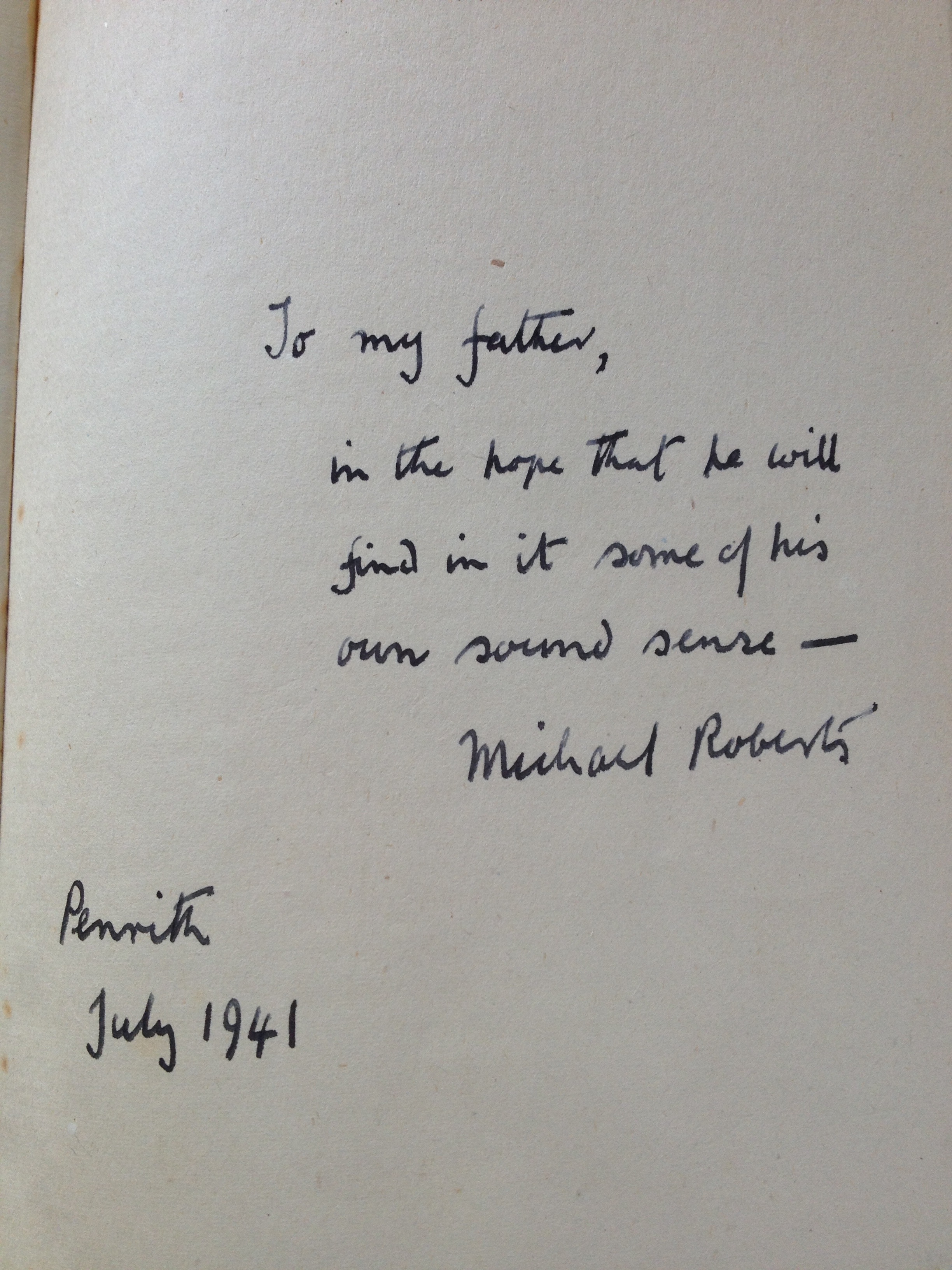
I feel bad saying this; I should give it another try, and try to understand it on its own terms rather than mine, even though those terms are very much wrapped up in the contingencies of its historical moment. I’m touched and intrigued by an inscription in a copy that was sent to me out of the blue a few years ago (thank you, Dr H. of Exeter). Roberts and the whole of the Royal Grammar School, Newcastle, had been evacuated to Penrith for the war.
Normally I write formal academic essays, and my main opportunity to speak less formally comes in lectures: the #bookaday hashtag will be an interesting opportunity to write in a less formal way. It’s a way to review my reading, to ask what matters about the books I read, and hopefully to share a few books. I don’t know if I’ll find a book for some of these categories, but the blog’s a way of reflecting on why they don’t fit my experience.
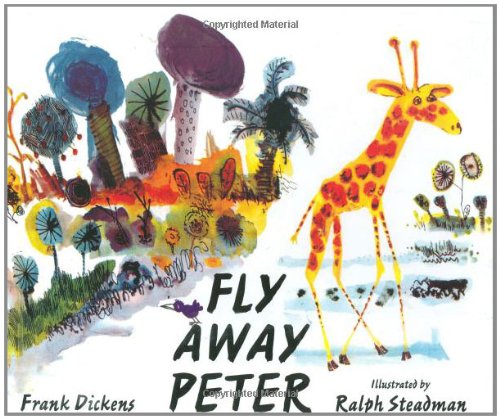
‘Childhood’ covers a pretty broad period, and I was being read to from an early age: on what criteria does one choose? When does reading stop being childhood reading? On my dad’s account, I very nearly drove him insane by repeatedly demanding to be read Lois Lenski’s The Little Farm. I also liked being read Frank Dickens’s Fly Away Peter (with illustrations by Ralph Steadman): the range of animals allowed my mum great scope for putting on different voices.
Robert Westall’s The Machine Gunners (1975) made a big impression on me, somewhere around the end of primary school; I wrote an essay about it in my first year at secondary school. (I also liked Stig of the Dump at primary school and in my first year at secondary was taken aback that we were being asked to study it. It seemed like kids’ stuff. My reading ground to a halt for a few years at secondary.) I liked the dialogue in The Machine Gunners: people who actually said “bloody”. This wasn’t the fantastic and cushioned world of Narnia and that kind of children’s book. And I liked the adult character (a Polish man?) who spoke scathingly about English bourgeois respectability and its neat privet hedges. There may also have a been a kind of northern-ness to the dialogue that I connected with, as the son of northern parents living in southern England. Not having the same vowels as everyone else was something I was constantly aware of.
Which brings me to The Iron Man by Ted Hughes.
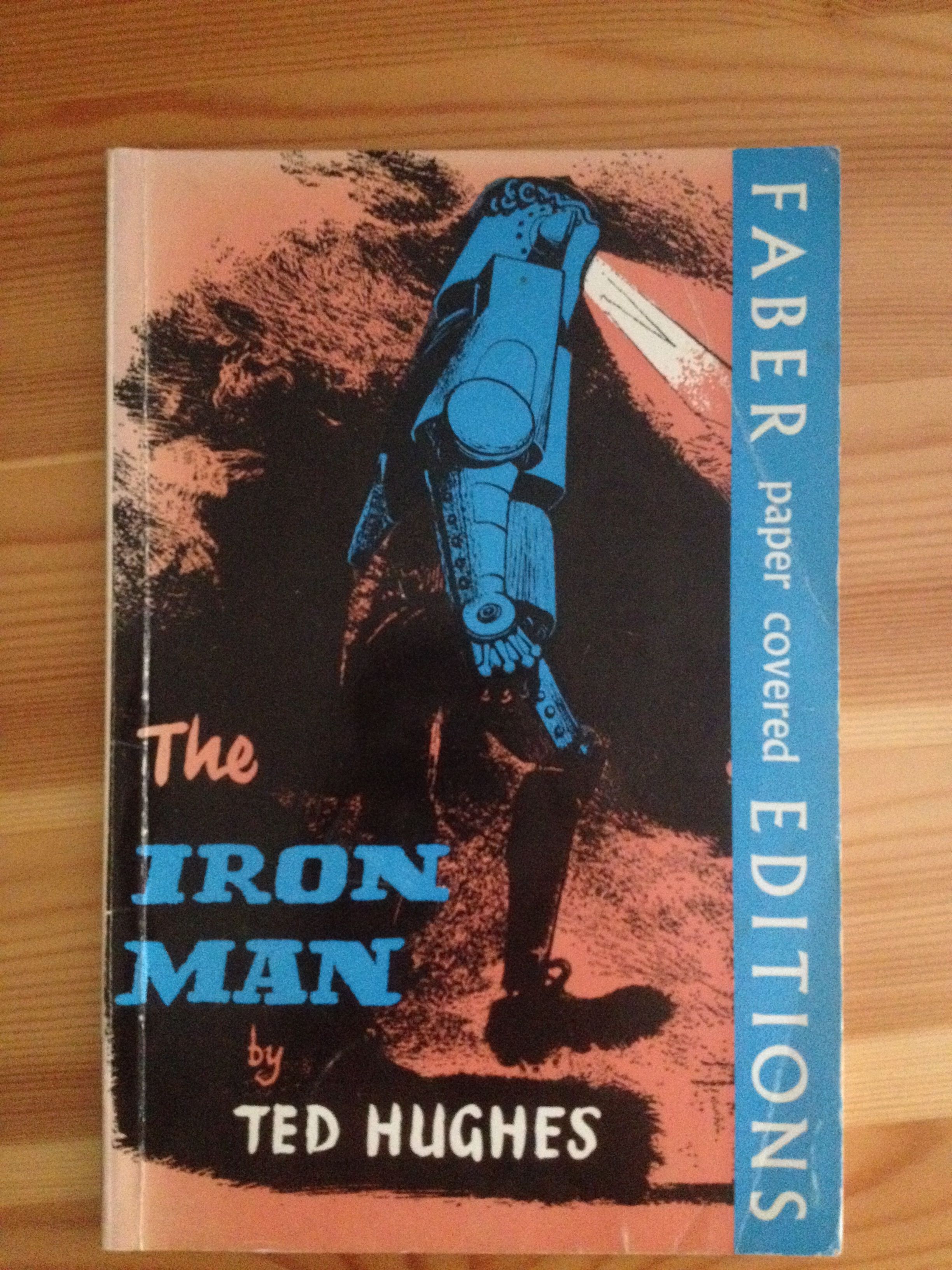
On my mum’s account of things, I’d learned to read when I came to this, but with it my reading and my interest in reading took a huge leap forward. Most of that’s no doubt due to it being an exciting and mysterious and very hyperbolic narrative, but I can’t help wondering whether there’s some kind of northern speech in the rhythms, or something in the manner of expression, that connected with me. That sort of blunt gruffness that Hughes also deploys in ‘View of a Pig.’ A performance of northernness, maybe, but still real. Were my parents also reading it to me, and was there something in the prose that allowed them to give a performance more enthusiastic than normal?
The other reason for singling out The Iron Man is that when I came to Hughes’s poetry during A-level (in George Macbeth’s Longman anthology), I realised that it was the same writer I’d read ten or more years previously; and the great thing about The Iron Man is that it comes from the same imaginative world as Hughes’s adult poems. (A little bit later I discovered that we also had Meet my Folks, which is so different that it could be another writer.) So if we treat the ‘from’ with pedantic precision — it’s not the same as your favourite book ‘in’ childhood — this one wins because it made the journey. I wrote about Hughes for the optional thesis in the final year of my English degree, and was writing about him and other poets of the 1950s and 1960s when I began my doctoral studies. So for all that I would now acknowledge faults in his poetry and his worldview, I owe him one.
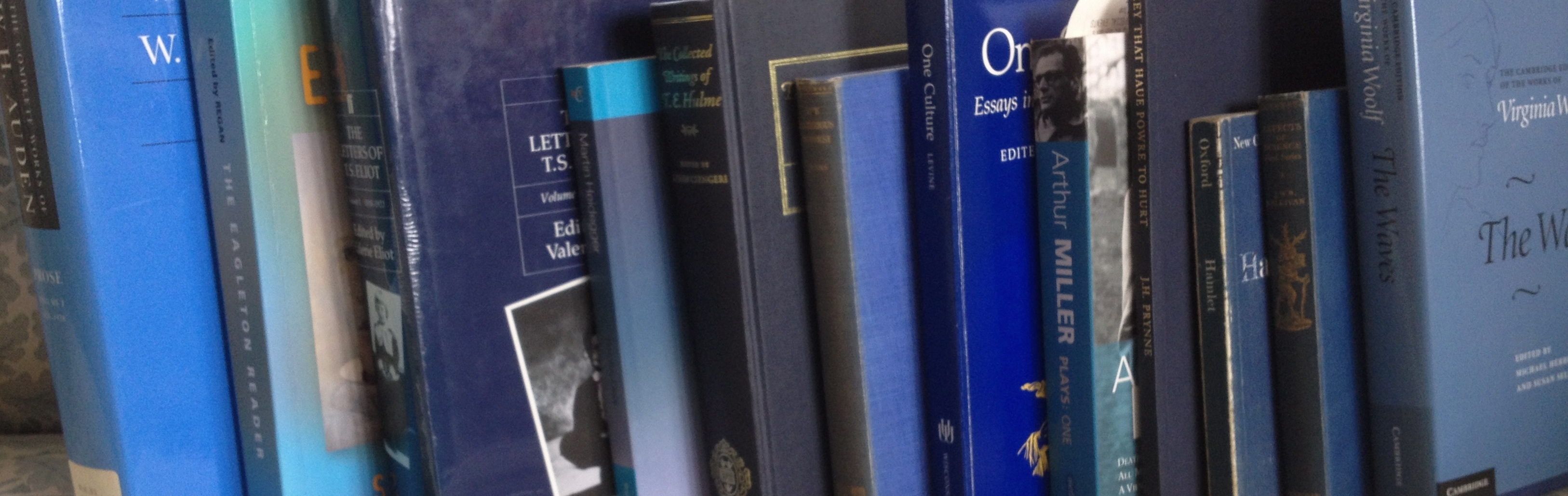
Not an easy one to choose: I’ve got far too many books, and more than enough of them dress in blue. The hastily assembled long-list looked like this:
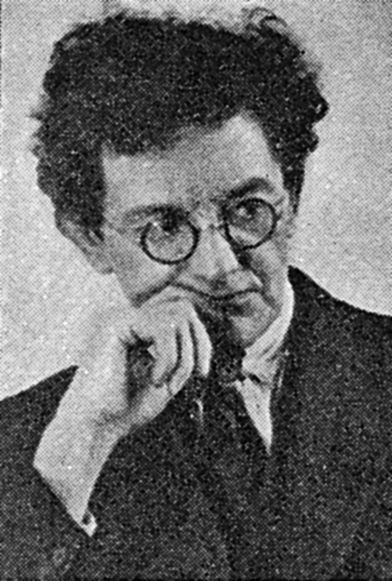
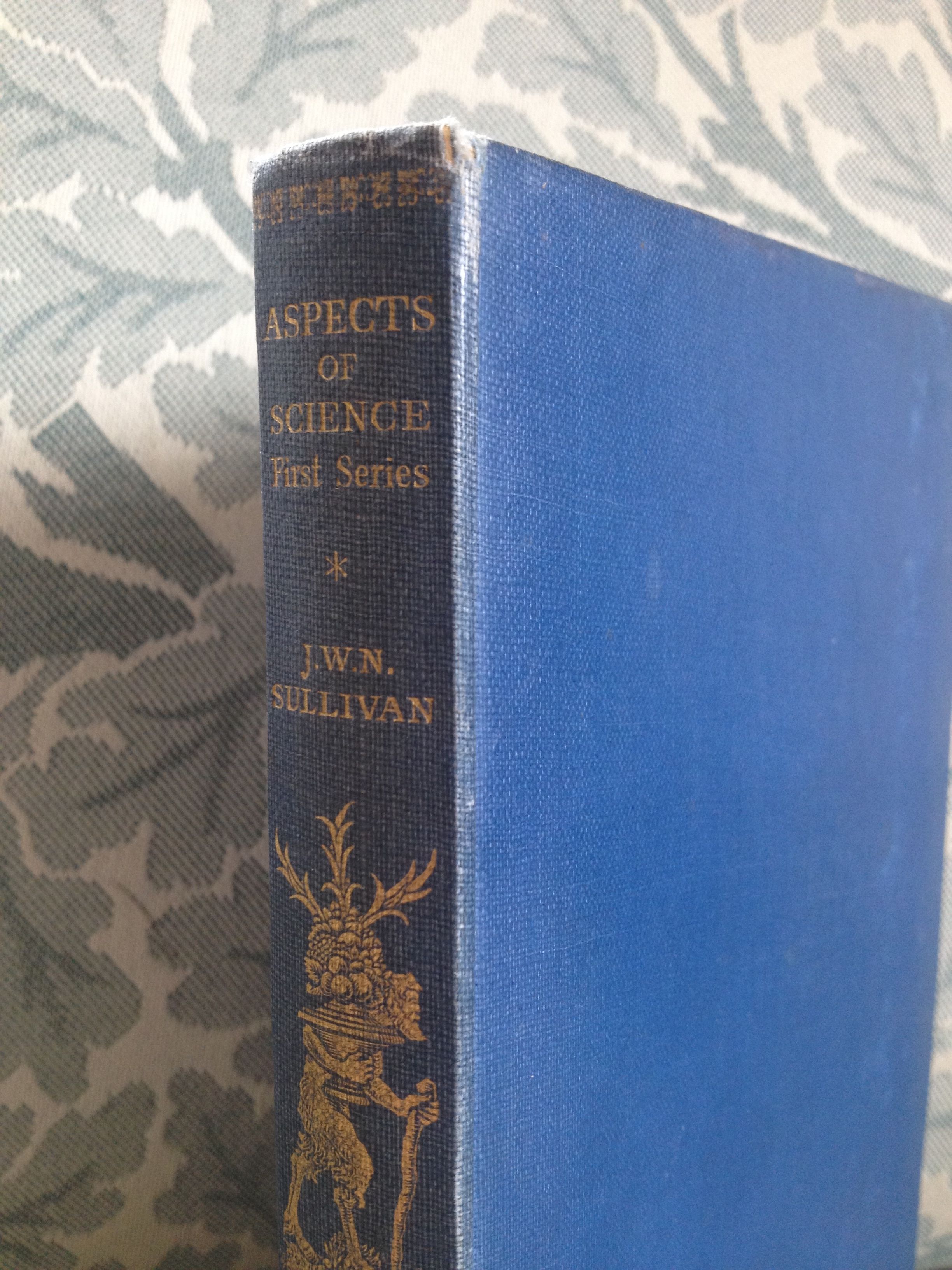
Sullivan (1886-1937) was a journalist by trade. He was born in the East End of London, in Poplar, and had left school at 14 and joined a telegraph company; but he later enrolled on science courses at Northern Polytechnic Institute in London (a forerunner of London Met) and later still (around 1908) at University College, London. He worked in America for a period between 1910 and 1913, which was where he first turned to journalism. He served in the Ambulance service in Serbia at the start of the First World War, then returned to journalism (writing for The New Witness), and was then recruited by Wellington House, the government’s Department of Information (i.e., propaganda). It was there he met the literary journalist John Middleton Murry, and when, after the war, Murry was appointed editor of the literary journal The Athenaeum, he appointed Sullivan as his deputy. (T. S. Eliot was also considered for the role). For the Athenaeum Sullivan wrote both a scientific column and various literary reviews; Aspects of Science gathers together the science columns, along with some others he wrote for its successor, the merged Nation and Athenaeum.
The first Athenaeum under Murry’s editorship came out in April 1919, and this was very fortunate timing. In May 1919 Arthur Eddington was due to carry out the observations during a solar eclipse that would confirm Einstein’s General Relativity Theory. Sullivan recognised the significance of what was happening in physics, and many of his columns aim to explore the change in worldview, and to understand how it might change the relations of science to culture. The five columns gathered as ‘Assumptions’ in Aspects are particularly interesting from this point of view; so too ‘The Scientific Mind’ and ‘The Ideal Scientific Man’. Sadly Aspects doesn’t gather together the five columns from May and April 1919 in which Sullivan gave a non-technical exposition of relativity theory; the focus of Aspects was more on the cultural implications. As Sullivan put it, the papers illustrated ‘one point of view’:
That point of view may be described, perhaps as aesthetic, but rather better as humanistic. Scientific ideas have a history; they arose to satisfy certain human needs; to see them in their context is to see them as part of the general intellectual and emotional life of man. What they exist to do they do better than does anything else, and the needs they satisfy are not peculiar to scientific specialists.
This account only scratches at the surface of an extraordinary life, made all the more extraordinary by Sullivan’s tendency to embellish it. (He persuaded Aldous Huxley that he was Dublin-born and had studied at Maynooth with James Joyce; David Bradshaw disentangles fact from fiction in his article ‘The Best of Companions’ (Review of English Studies); it was David, as my D.Phil. supervisor, who first pointed me in the direction of the Athenaeum and Sullivan’s work for it.) Through his friendship with Murry, Sullivan was introduced to Lady Ottoline Morrell and her salon at Garsington (if you can have a salon in rural Oxfordshire); Virginia Woolf word-sketched him in 1921 as ‘too much of the indiarubber faced, mobile lipped, unshaven, uncombed, black, uncompromising, suspicious, powerful man of genius in Hampstead type for my taste’ (Diary, 18 December 1921). He had a passion for Dostoevsky and a passion for Beethoven; he long projected a book on the former, but never wrote it; his book in the latter (written for the centenary in 1927) stayed in print longer than any of his other works. If you search the internet for a photo of Sullivan, you’ll find many more of Beethoven than you will of him.
“Best Bargain” could just lead to an account of book-buying as written by a stock-market dealer. Those £5 pamphlets by J. H. Prynne that now sell for £50 or £100: bargains! (Etc.) But I’m not selling them, so that’s not really the point.
I’d prefer to take my measure as the price:pleasure ratio, but even that becomes complicated. When in 1992 I bought a second-hand copy of Michael Roberts’s Collected Poems (1958) for £30 from Ulysses in Bloomsbury, I’d never previously ventured into an antiquarian bookseller or spent quite so much on a second-hand book; but I was writing a chapter on Roberts in my thesis, and, in the absence of a loanable copy in Oxford, it was necessary and enormously helpful. A bargain at the price, but in this case it’s as much a measure of the efficiency it brought to my research as it is of the pleasure of Roberts’s poems. In a similar vein I might mention a secondhand copy of A. S. Eddington‘s The Nature of the Physical World (1928) which I got for £3 in December 1990, in the first term of my doctoral research, and which was completely invaluable then and in writing the book that followed from it.
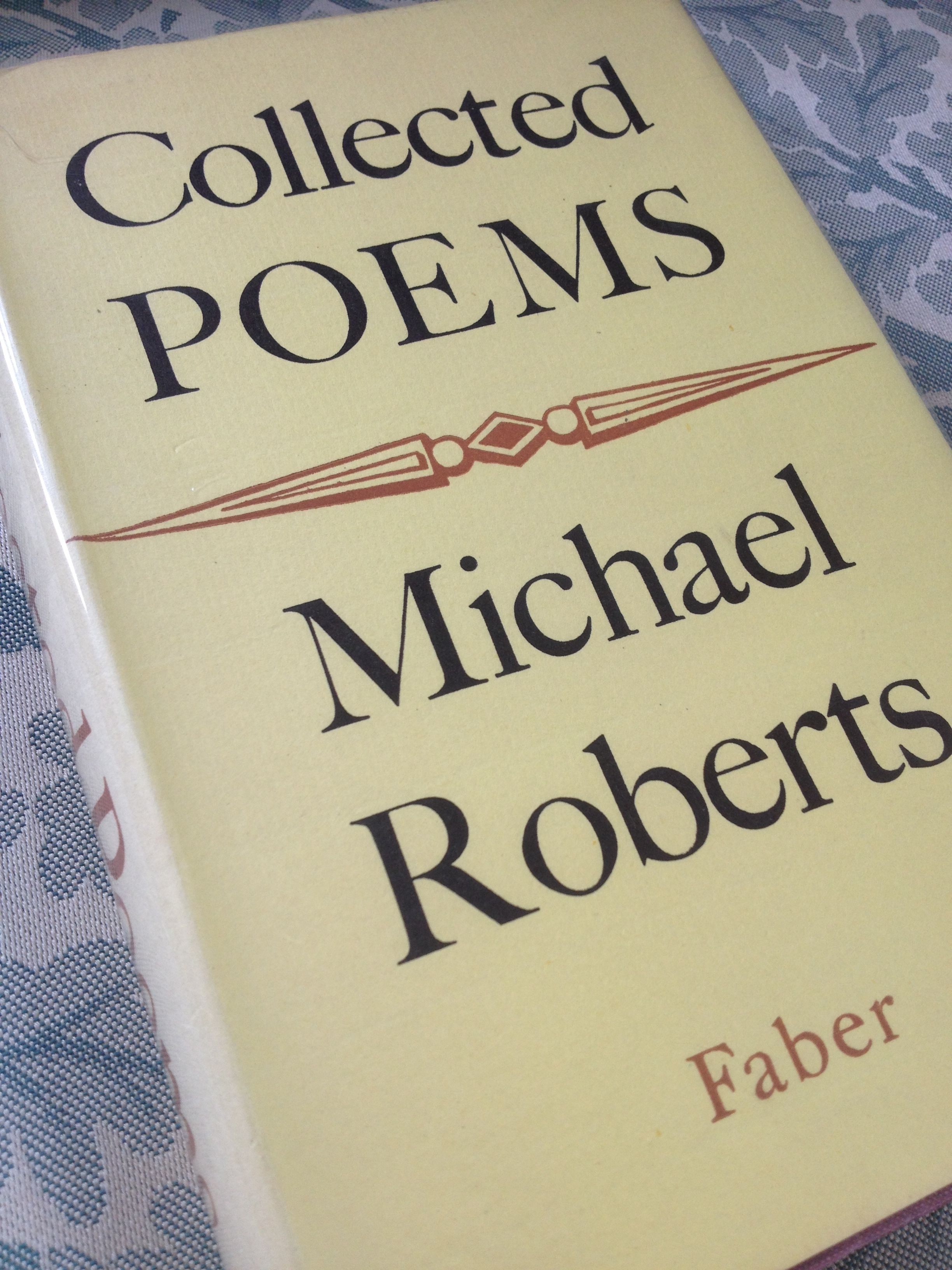
Collected Poems, by Michael Roberts
Keats’s Letters I bought in an already battered paperback copy for £1.30 in April 1988 (I systematically inscribed books back then), and battered it some more. An amazing volume for me: we’d studied Keats at A-level, and the Heinemann text we had then contained some of the letters, but to be able to read all of them allowed me to take a completely fresh look at him. The letters were quite prominent in the relevant tutorial essay, but also starting a persisting interest in the letter as a not-quite-literary form, a form that’s marked mostly by its formlessness, and that’s broadened out into thinking about diaries (especially Woolf’s diaries), and having the pleasure last year of teaching a student with really original ideas about Woolf’s letters.

Letters of John Keats, ed. Robert Gittings
But though it’s great to find something secondhand, the real bargains have turned out to be new books that didn’t represent a great outlay at the time, or even seem to be particularly special as physical artefacts, but which opened up a whole new world of literary possibilities. The Collected Poems of Sylvia Plath (£4.95 seemed modest even in 1986); the Penguin ‘corrected’ Ulysses that I got in 1986 or 1987; the later Oxford World’s Classics edition of the same that I got in order to teach my Ulysses module at Bangor; but more than any of those The Riverside Chaucer, £8.95 in 1988, which served me well through the medieval period paper and the Special Author option on Chaucer. Chaucer isn’t my favourite medieval poet, but the Riverside edition was a bargain, both for the range of poetry in it and for the compacted density of scholarly information in the notes.
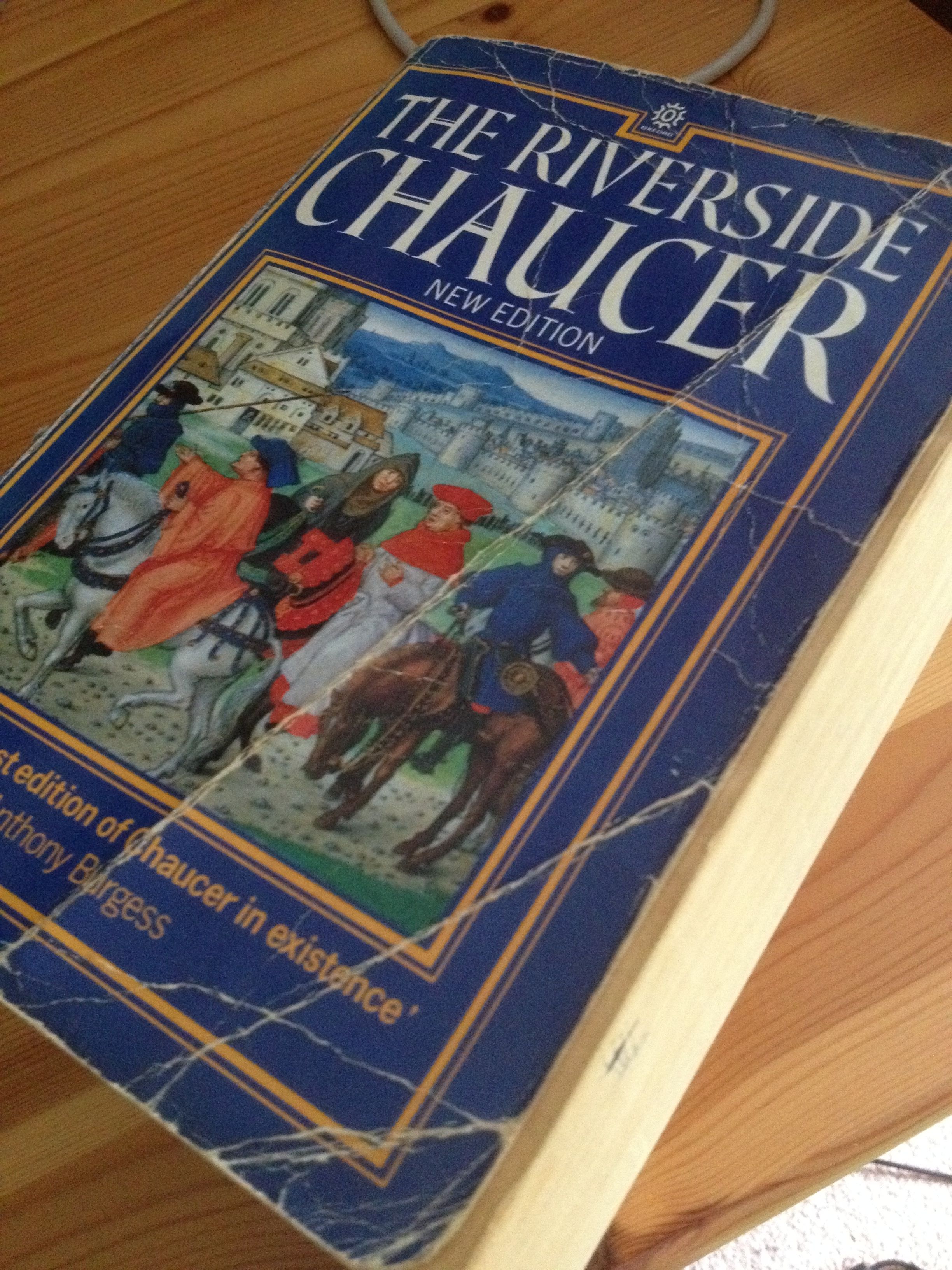
The Riverside Chaucer
 Michael Whitworth