#31songs: 1: The first song I ever heard by them

Throughout July I’m going to be writing a blog a day about a favourite singer/songwriter, Pat Fish: mostly his work as The Jazz Butcher, but also with Sumosonic and Wilson.  I’ve already set myself my list of cues, but I’ll be reordering them to provide an almost chronological narrative.

Southern Mark Smith (Big Return)

It’s intriguing and illuminating, and at times disorientating, when bands reinterpret their own material: not just granting themselves more bars for a guitar solo or to play out in a live version, but when they change the essential mood of the song.  The Jazz Butcher reworked ‘Southern Mark Smith’ quite rapidly in the first years of their existence as a band.  The first version was recorded in the summer of 1983 and came out as their debut single soon after; it was later collected on The Gift of Music (1985). The second (‘Big Return’) was recorded the following summer and appeared on their second album, A Scandal in Bohemia (1984). The first has a roughness, jauntiness, and directness to it; the revised version is smoother, but hints at a musical energy and rage that only fully emerged many albums later.  In the first version, the organ mostly sets down the main chords, while on the later one it moves more sinuously, reinforcing a song built around guitars, acoustic and chorus-pedalled.  In the first version the guitars are choppily asserting a rhythm, but in the revision they’re softer and more melodic.

There are differences in the lyrics, too.  In the first, thousands of people are ‘queueing in the rain to meet the pope’, while in the second, there’s a less specific ‘thousands of people out there’ who ‘have to be okay’.  By some rules of lyric  and poetry writing, this shouldn’t work (be specific, go in fear of abstractions, etc.), but it does: attention turns from the rain-sodden seekers of salvation to the singer’s own ambivalence.  In the first version ‘don’t you know they only make those bracelets out of plastic’ suggests disenchantment with consumerist disposability; crucially in the revised version, this becomes ‘don’t you know they only make pop records out of plastic.’  This could come across as self-contemptuous, but in the smooth-running musical context of the revised version, it comes across only as cautiously self-aware.

The self-awareness is important, because, cryptic though it is, it appears to be a self-referential song about finding one’s personal or musical identity.  For a long time I thought the Southern Mark Smith of the title was Gerard Langley of The Blue Aeroplanes, who had been speak-singing his lyrics since 1978; there’s been two-way traffic between the two bands, but when they first became aware of each other I don’t know.  More recently, Pat Fish, who is essentially is ‘The Jazz Butcher’, has said that the title is an oxymoron: Mark E. Smith is irreducibly northern (English) in his identity, and a southern one would be a contradiction in terms. So it’s about coming to terms with those inner contradictions and mysteries, but because it never says so directly, it’s less earnest than any paraphrase can make it sound.  There’s an aura of melancholy about it too, especially in the ‘Big Return’ version, to do with the way the vocal melody descends.

I must have first heard it in the summer of 1986.  Chris F., a friend at sixth-form, was appalled that I was listening mostly to early Genesis (Nursery Cryme, Foxtrot, etc.) and put together a tape with a few Jazz Butcher songs on it and some early James (the Village Fire E.P.); and maybe some Woodentops and Jesus and Mary Chain. He didn’t make me see the error of my ways (I’d still defend Nursery Cryme if I had to), but he did open me up to a whole load of new bands.  He handed the tape over to me at the Angel-on-the-Bridge in Henley.  I may be conflating several such afternoons, but also present was Huw R., whose younger brother would go on to become a Chemical Brother, and Peter Crouch, who would go on to play guitar on several Jazz Butcher albums.


#31songs: Thirty-one song challenge, July 2014

I enjoyed #BookadayUK, enjoyed the opportunity to write flexibly and personally, and the discipline of having to do it regularly, but wouldn’t want to do it for another month.  Instead, I’m going to try to write about 31 songs by a favourite songwriter and musician, one a day for a month.  The categories are hopefully flexible enough that I’ll be able to use them again in future for other musicians and bands. I want the account to be more-or-less chronological, so apart from the first and the last categories, I won’t be doing them in this order.

  1. First song you ever heard by them.
  2. 
Song you sang the wrong lyrics to for ages.
  3. Song that should have been a hit.
  4. Favourite song from least favourite album.
  5. Best cover version.
  6. Best intro to a song.
  7. Best ending to a song.
  8. A song that reminds of you of somewhere.
  9. 
A song that reminds you of a certain event.
  10. A song that reminds you of a great night out.
  11. A song about other worlds, outer space, dreams.
  12. A song with a number in the title
.
  13. A song with a name in the title / A song about a famous person.
  14. A song with the day of a week in the title.
  15. Best drums
, or best bass.
  16. Best instrumental solo.
  17. One you want to listen to in the car.
  18. A song about travelling.
  19. A song that makes you feel like you’re in a film.
  20. A song about music / about the creative process.
  21. Best guest appearance on someone else’s work.
  22. A song about the weather
.
  23. Title alludes to a film.
  24. Song about death / song you’d have played at your funeral.
  25. A political song.
  26. Song you disliked at first but grew to love.
  27. Song you liked at first but liked less over time.
  28. Best closer on an album.
  29. Song you always used to put on a mixtape.
  30. A song that makes you laugh out loud.
  31. If I could choose just one for my desert island disc?

Some of these derive from various thirty-song challenges that have done the rounds on the internet; for others, many thanks to Rachel B., Paul W., and Alex H.

#bookadayUK (30): Would save if my house burned down

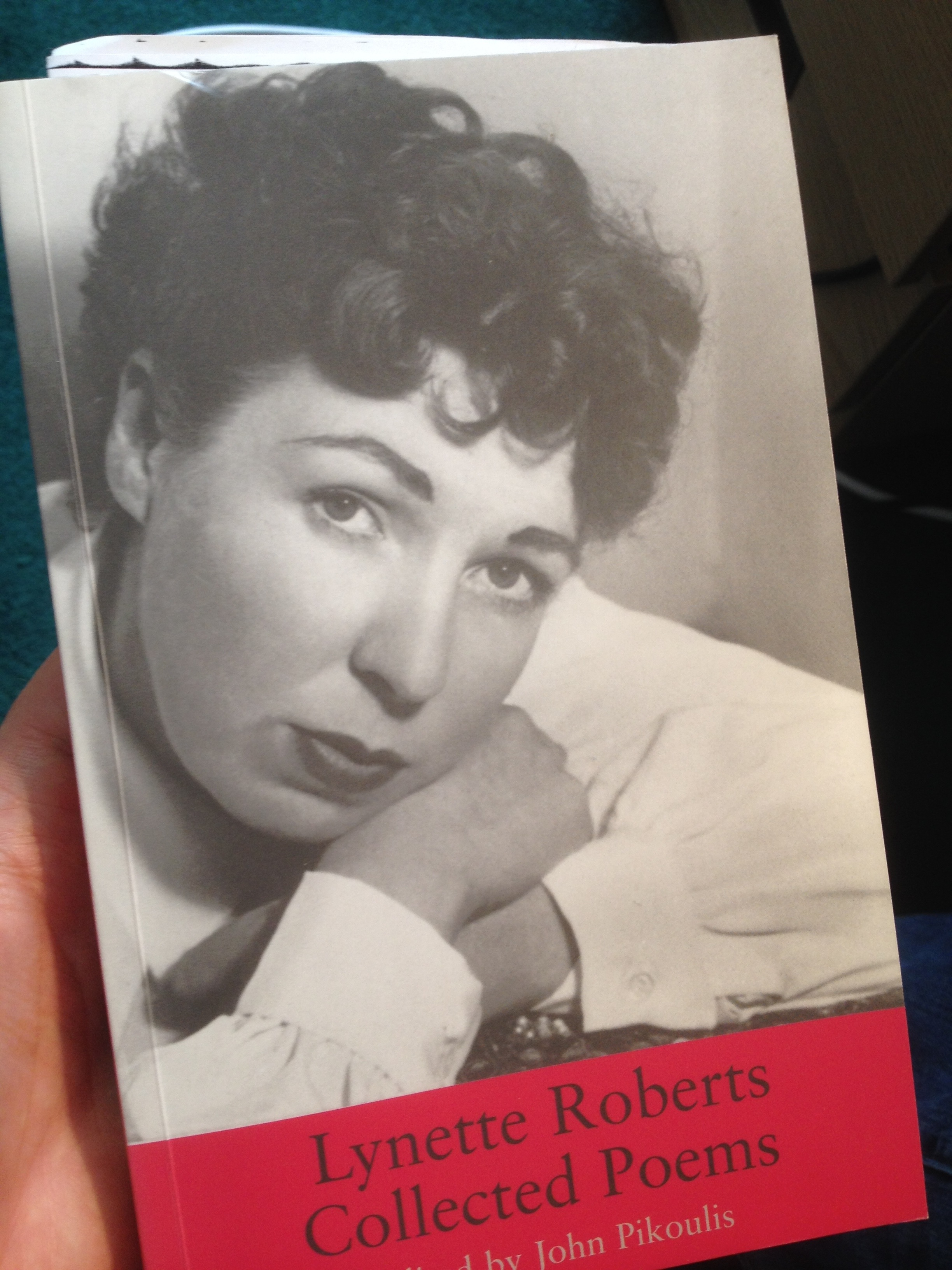
The books I’d most want to save are actually in my office at Merton.  The only thing I own that is remotely close to being a unique copy is my copy of Lynette Roberts’s Collected Poems, ed. John Pikoulis (Bridgend: Seren, 1998), a book that the publisher withdrew and pulped before publication, but not before six or so copies had been accidentally released to the Oxford Blackwells.

Roberts Lynette CollPoems

But even that edition circulated in photocopied form, and since Patrick McGuinness’s edition came out (Manchester: Carcanet, 2005), its loss has been less keenly felt.

The other category of book I’d want to save is those with annotations.  A heavily annotated text can represent years of work, and though half the value lies in having the insight that led to the annotation, and the act of annotation is really just a means of physically sealing that insight, I’d still be sorry to lose certain books.  The trouble would be, which ones should I select?

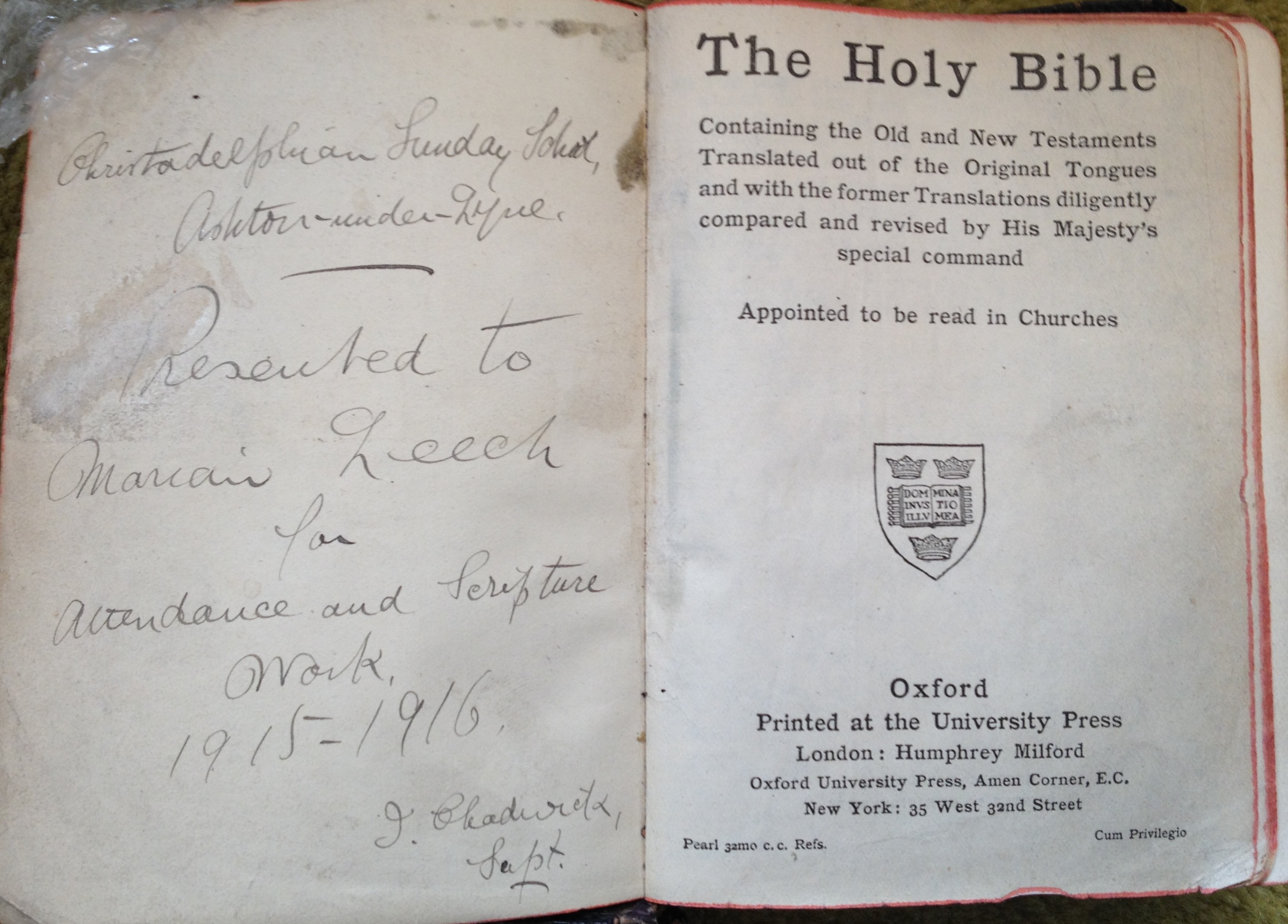
Finally, there are books with personal connections.  Here, I’d probably be inclined to save my grandmother’s Bible, presented to her at the Christadelphian Sunday School in Ashton-under-Lyne for attendance and scripture work, 1915-16. I’m not sure of her date of birth, but I think she must have been about 8 years old; she died long before I was born.  The millenarianism didn’t get passed down through the family, but the book did.

Bible_MarianLeach

#bookadayUK (29): Most re-read

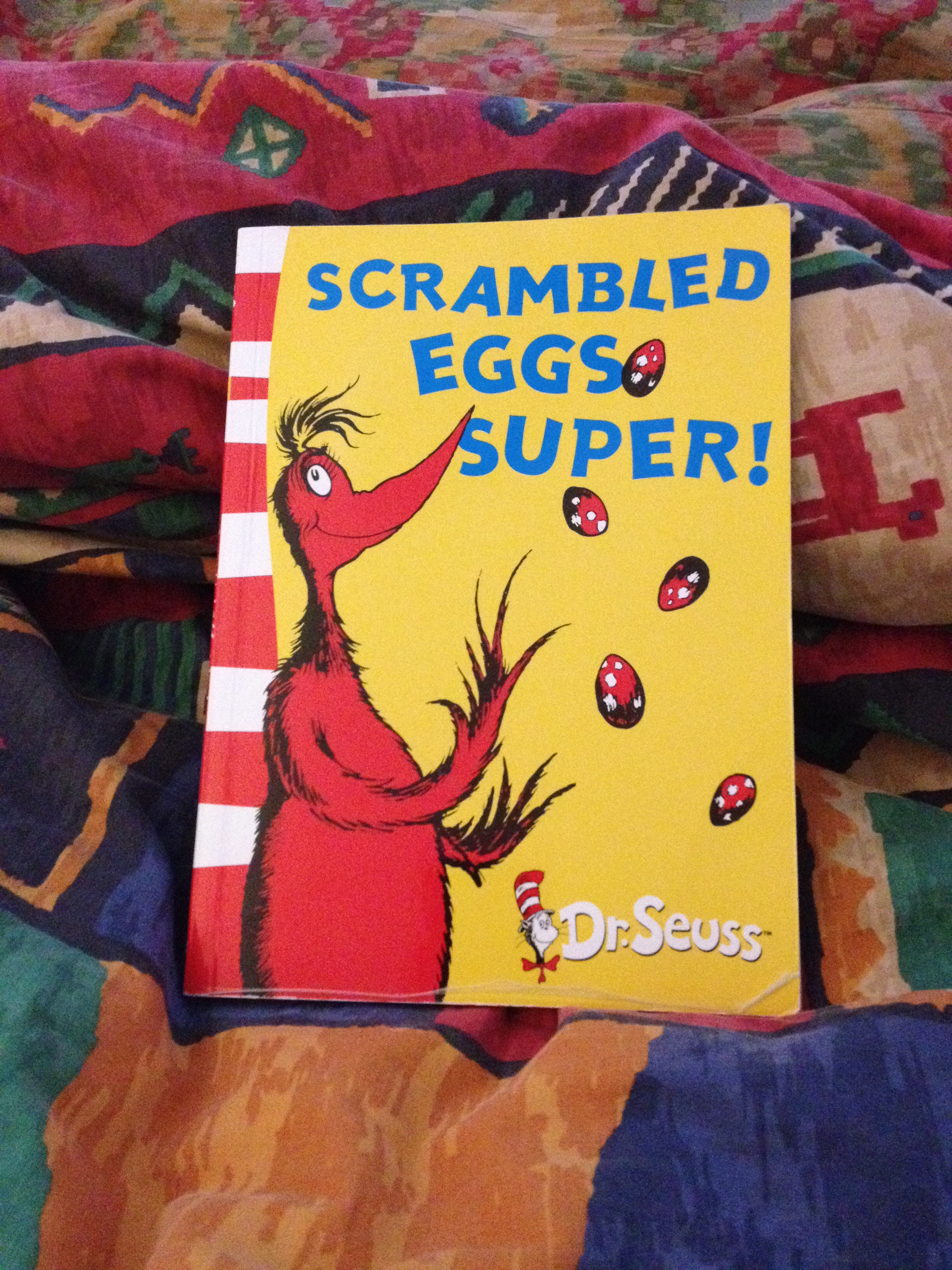
Mrs Dalloway or Scrambled Eggs Super!?  I was on the verge of choosing the former, when I saw someone else tweet Judith Kerr’s The Tiger Who Came to Tea, and realised that across six months or so last year and earlier this year, I read Dr Seuss’s egg-collecting romance epic pretty much every night to our three/four-year-old.  And although my re-readings of Mrs Dalloway may stretch into the dozens, I’ve no reason to think that they run over a hundred.

DrSeuss

But there’s a respect in which I have genuinely re-read Mrs Dalloway more often than Scrambled Eggs Super. When I’m reading the latter, I’m scarcely little more than a vocalisation machine for Dr Seuss’s words. I tried, for the sake of my own sanity, to find minor variations in rhythm and intonation each time I read it: sometimes running one line into another, sometimes emphasising line-endings and rhymes; sometimes accelerating and decelerating.  But for all that I tried, it’s not particularly flexible verse for a reader; it’s got its own insistent rhythms and it doesn’t want to allow you much leeway.  And as for interpretation at a semantic level, if there is scope for that, I’ve not risen to the challenge.

Whereas with Mrs Dalloway, each re-reading has brought new emphases, has found new images emerging, or new interconnections, or new questions as to why Woolf does what she does.  Although I have re-read it cover-to-cover many times, I’ve also re-read selected scenes and episodes far more often, sometimes with a view to an impending class or tutorial, sometimes with a view to writing a lecture or seminar paper. I first read it in an unannotated Grafton paperback in 1987, as one of several novels by Woolf for one of my first-year tutorials;  that was the copy I was still using when I decided that Woolf would form part of my doctorate, probably sometime in 1991 or 1992.  When I started teaching Woolf for a module at Bangor (1996 or 1997) I insisted that everyone use the Oxford World’s Classics editions, but soon after had to obtain the Penguin Classics ones for writing a chapter in the Cambridge Companion.  Then in 2000 David Bradshaw did an excellent new edition for Oxford World’s Classics and I had to learn to find my way around yet another pagination. As I’ve become more familiar with it, re-reading a small part reactivates memories of the whole; also, as I’ve become familiar with the various copies I’ve owned, I’ve learned to find passages quickly, in spite of the lack of chapter divisions.

Mrs Dalloway teaches its reader about the power of repetition and echo from the very start: everyone notices Big Ben and the leaden circles dissolving in air, and many readers must be grateful to have Big Ben’s chimes as a substitute for chapter divisions, as a fixed reference point in the text in the absence of chapter divisions, even while the text reminds us that there’s a kind of violence in such divisions and subdivisions, through the clocks of Harley Street slicing and shredding the day.  Once you’ve followed that cue, there are plenty of others: those shaped around the parallelism between Septimus and Clarissa, especially, but also others that are more elusively riddling such as Peter Walsh’s image of himself as a buccaneer being echoed in Elizabeth Dalloway’s idea of the omnibus being a pirate ship.  Mrs Dalloway has rhythms: not — or not only — prose rhythms, but structural rhythms.  Unlike Dr Seuss’s verse rhythms, they’re subtle and they allow the reader great flexibility about where to place the emphasis.  As Woolf said in her often-quoted essay ‘Modern Fiction’, ‘the accent falls differently from of old.’

#bookadayUK (27): Want to be one of the characters

Wanting to be a character, no; but wanting to live in their worlds, yes. I don’t know if I’m an anomalous reader from this point of view, but even when reading the novels and plays that have most absorbed me, even as  young reader, I don’t think I wanted to be anyone else.  Of course, when you’re completely drawn into a fictional world, you might identify with a character,   but that’s not the same as wanting to be them.

Sometimes the wanting to live in their worlds is a matter of wanting to hang out with the characters, wanting have conversations with their particular qualities of eloquence, or wit, or menace, or obliquity.  Some of the scenes of Stephen Daedalus and his student friends in Ulysses affected me that way, and coloured my second term at university, even while I was aware that his view was being placed relative to those of other characters, above all Bloom.  (Bloom got into me in a different way, in the curious tentative tumpty-tum rhythm of his thoughts.)  Sometimes it’s something less about character than about place or situation: Thomas Hardy is particularly evocative in this way, in The Woodlanders and Tess of the D’Urbervilles, and in places in The Mayor of Casterbridge.  I’m not sure my response was exactly one of wanting to live in Hardy’s Wessex, but the place I lived was geographically close enough and physically similar that I couldn’t help but see it as Wessex; and in any case, Hardy’s Wessex is always constructed as a place full of survivals, things that have escaped the tide of modernity, so the glimpsed decaying shepherd’s hut or rusting piece of unidentifiable farm machinery was Hardyesque in being the evocative exception.  And then there’s a whole other category of bodily evocation. D. H. Lawrence’s The Rainbow got to me, when I was 17 or 18, with its intense evocation of bodily awareness and bodily rhythms: this wasn’t wanting about wanting to live in Lawrence’s East Midlands landscape, and it wasn’t about wanting to be Will, or Anna, or Ursula; but it was about feeling that my experience of the world had been transfigured.


#bookadayUK (26): Should have sold more copies

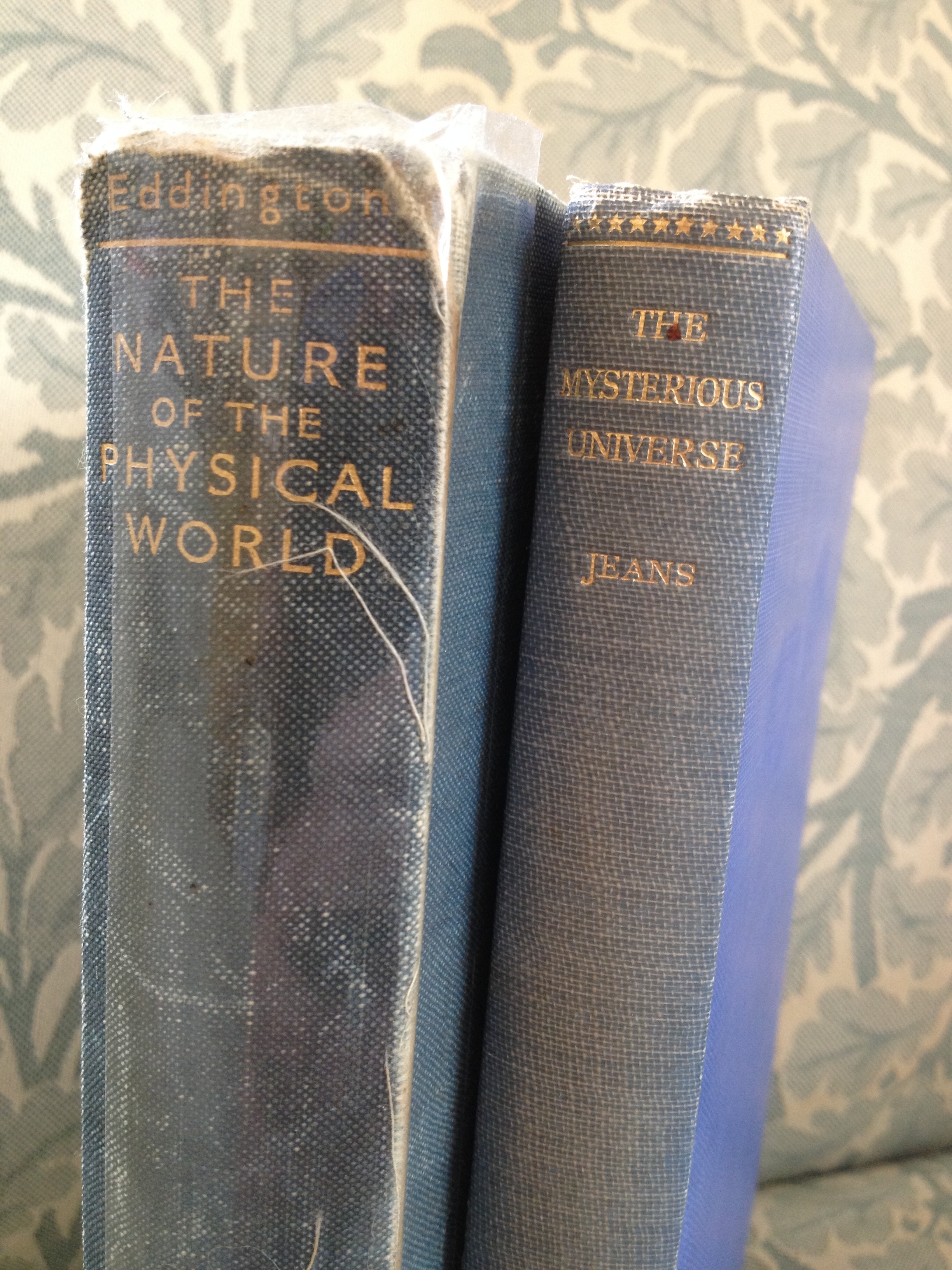
There were two giants in popular science writing in the late 1920s, certainly in the sub-sector of popular writing about physics and astronomy: A. S. Eddington and James Jeans, both physicists working at Cambridge University.  Works by both sold astonishingly well, but if the qualities of the writing are considered, Eddington should have outsold Jeans, and he didn’t.

Eddington_and_Jeans

My interest in how science became available to literary authors led me early on to popular science writing.  One might argue that popularity is a quality of the style of writing (its mode of address, the way it introduces and deploys technical terms, and the way it frames strictly scientific questions with humanistic concerns), and that popularity in terms of sales figures is a separate issue, but, for better or for worse, my initial impulse was to pursue sales figures.  Eddington, Cambridge professor and author of The Nature of the Physical World (1928), was a faintly obsessive record keeper, especially when it came to numbers, and the notebooks held by Trinity College, Cambridge, record the lengths of his cycle rides, the weights of his prize medals, and — most usefully to me — the annual sales figures for each of his books.  For other 1920s and 1930s authors like James Jeans, it is possible to find out about print runs from the archives of Cambridge University Press. Here’s one of the less exciting pages of my D.Phil., concerning Eddington’s Space, Time, and Gravitation (1920):

DPhil_AppxB

The upturn in sales in 1942 is something I’ve seen in Herbert Read’s figures too, and I think it’s more widely recognised; people were staying at home more because of the war-time blackout regulations. The upturn in sales in 1929 was probably caused by the success of The Nature of the Physical World, published in November 1928; although Space, Time, and Gravitation, is a more technical work, it’s likely that the later work stimulated interest and demand.

Jeans’s career as a popular science writer had begun with Eos, or the Wider Aspects of Cosmogony (1928), in Kegan Paul’s To-Day and To-Morrow series, and had continued with The Universe Around Us (1929). But his biggest success was The Mysterious Universe (1930), an expanded version of the Rede Lecture which he delivered in November 1930.  Published the day after the Rede Lecture, by the end of December it had sold 70,000 copies in the UK.  The Nature of the Physical World had managed about 2500 in its first two months.  Jeans’s book, shorter than Eddington’s, is a lucid exposition of developments in modern physics, but Jeans didn’t have Eddington’s gift for taking difficult physical concepts, at times counter-intuitive ones, and rendering them tangible.  Nor does Jeans deliver coups-de-theatre such as Eddington’s opening scene in which he stands before two tables, the one his everyday table, the other a table as described by science.  If I were selecting one to be reprinted as a classic of its time, it would be Eddington’s; but whether because of price or brevity or some freak whim of the marketplace, it was Jeans’s work that found more prominence.


#bookadayUK (25): Never finished it

Given the length of Proust’s In Search of Lost Time and the minuteness of the portion that I’ve read, it would be fair to ask whether I’ve ever really started it.  In 1992 Chatto and Windus brought out a revised version of the original Scott Moncrieff and Kilmartin translation, and in 1994, somewhere in the closing stages of my D.Phil., I bought the first volume.  How soon I began reading it I can’t remember, but I do distinctly recall thinking that the shape of the sentences and the metaphorical suggestiveness of the language was utterly gripping, and that the pace natural to reading it was not a fast one, but a leisurely, contemplative one; the book was definitely the one for me, but definitely not at that particular moment.

Proust_1992

Most significantly, this translation removed Scott Moncrieff’s very literary and Shakespearean title, Remembrance of Things Past, in favour of a more literal rendering, one that transforms the rememberer a more active searcher.  I believe that this translation has now been further superseded, but it’s still the one I want to go back to.

#bookadayUK (24): Hooked me into reading

As Biblicists know, eating an apple can get you into all kinds of trouble.  I’m not writing about the work that first hooked me into reading, because that was Ted Hughes’s The Iron Man, and I’ve already written about it.  The work that took my reading to a new level was T. S. Eliot’s group of short poems ‘Preludes’.  I’d been a voracious reader at primary school, but lost interest between 11 and 16 because no-one could recommend anything suitable for me. Then a couple of works grabbed my interest during my O-level years.

The first was Edwin Muir’s ‘The Horses’, which we covered  as a poem in our anthology, Rhyme and Reason.  I wrote an essay on it, had a spine-tingling moment when I realised that it was a kind of parallel creation myth, and the teacher was lavish in her praise.  (She didn’t even grade it; just wrote ‘Superb’.  You could overdo that kind of praise, but it was an important endorsement and confirmation.)

The other encounter happened by accident in the last lesson one Friday afternoon; spring or early summer, I’d guess.  The teacher, Mrs Harris, was off sick, and the lesson was being covered by a youthful, likeable Geography teacher, Mr Koenig.  I was hungry (my packed lunches were never big enough), and realised I still had an apple in my bag, so figured that I might as well eat it.  The chairs were arranged in double horseshoe configuration, so even though I was on the outer row, there wasn’t a great deal of cover.  I was spotted, and as a punishment, Mr Koenig took an old anthology from the cupboard, found a poem by a poet I’d never heard of and told me to write an essay on it: write about the urban imagery in ‘Preludes’ by T. S. Eliot. He must have done English Lit at A-level, to be able to identify a suitable topic with such speed.  At first I was resentful, as eating when you’re hungry didn’t seem such a terrible thing to do, and I’d never before been set a punitive essay or subjected to any ‘demerit’ or detention.  But at home, when I began to read the poems, and still more when I began to write about them, I was really blown away: the tone and manner were completely different from anything else we’d done.

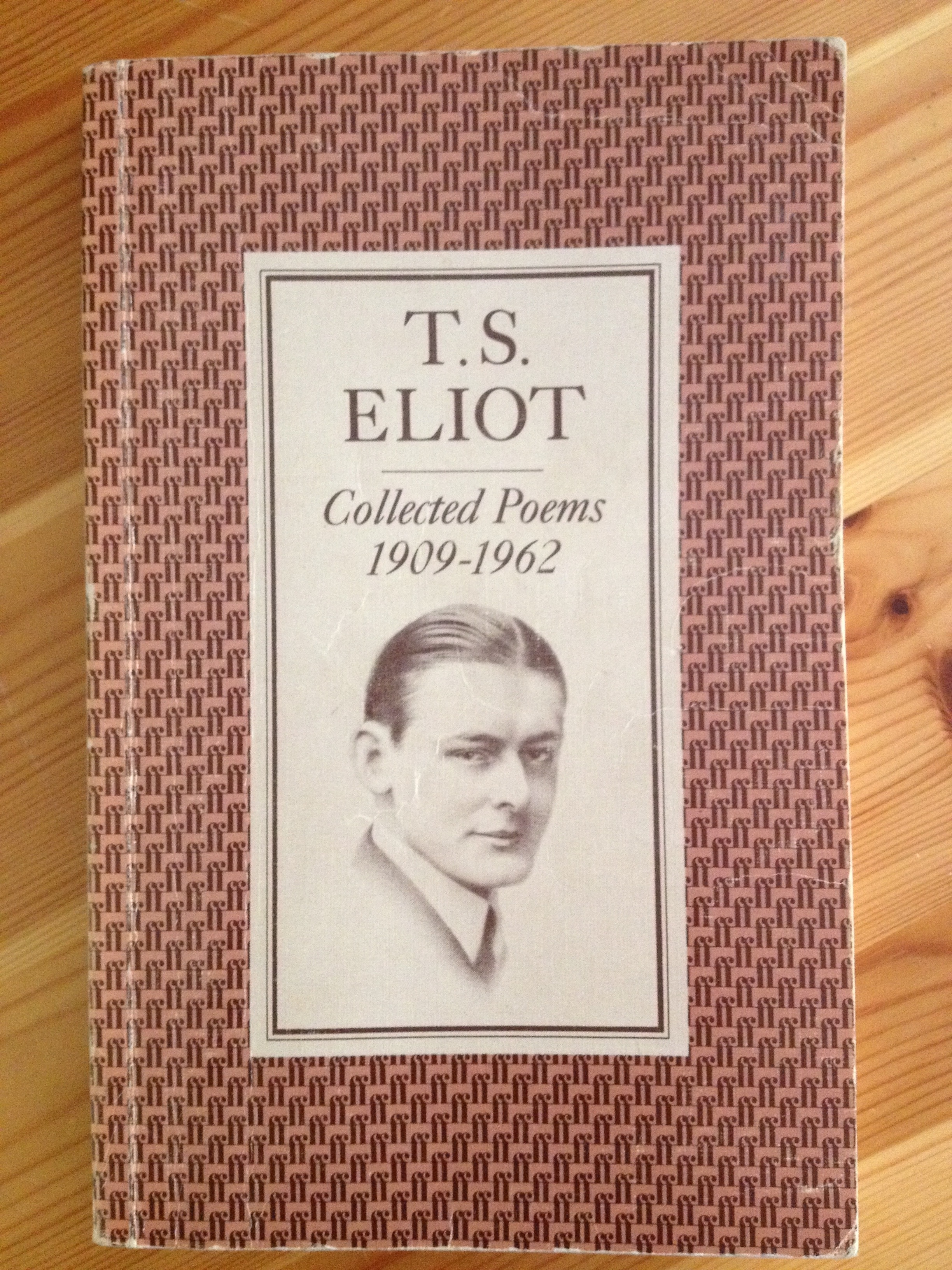
My guess is this must have been the spring of my O-level year.  I can’t remember whether there were any other Eliot poems in the anthology, but somehow I must have found out more about him.  At the point when I left secondary school I was signed up to do science A-levels at sixth-form college (Maths, Biology, Chemistry, Physics), with a vague plan of going on to do a medicine degree; but over the summer I started to feel that I needed some expressive, artistic dimension to my studies, so after the O-level results came I phoned the sixth-form and swapped one of the science subjects for English Literature. At some point in September of that year, I bought Eliot’s Collected Poems; I wrote the date September 1984 in it, but nothing more precise. I remember distinctly buying it in Wallingford, a small market town ten miles from home where we didn’t shop very often; or rather, I remember beginning to read it in the car on the way home.  Within a year I’d dropped another science subject, and set myself on studying English at University, now with the unusual subject combination of Chemistry, Maths, and English.

EliotTS_Collected

My copy, bought September 1984

#bookadayUK (23): Made to read at school

I can recall a few works that I resented having to read at school, or that at the very least I said goodbye to with complete indifference, but on the whole I was lucky with the things I was made to read at O-level, and with those I half-chose to read by taking A-level English. So I can ask with good reason what the Associated Examining Board thought it was doing when it chose Gavin Maxwell’s Ring of Bright Water as a set text — presumably working on some undigested Romantic assumption that Nature is morally uplifting — but generally speaking I’ve no cause for complaints.

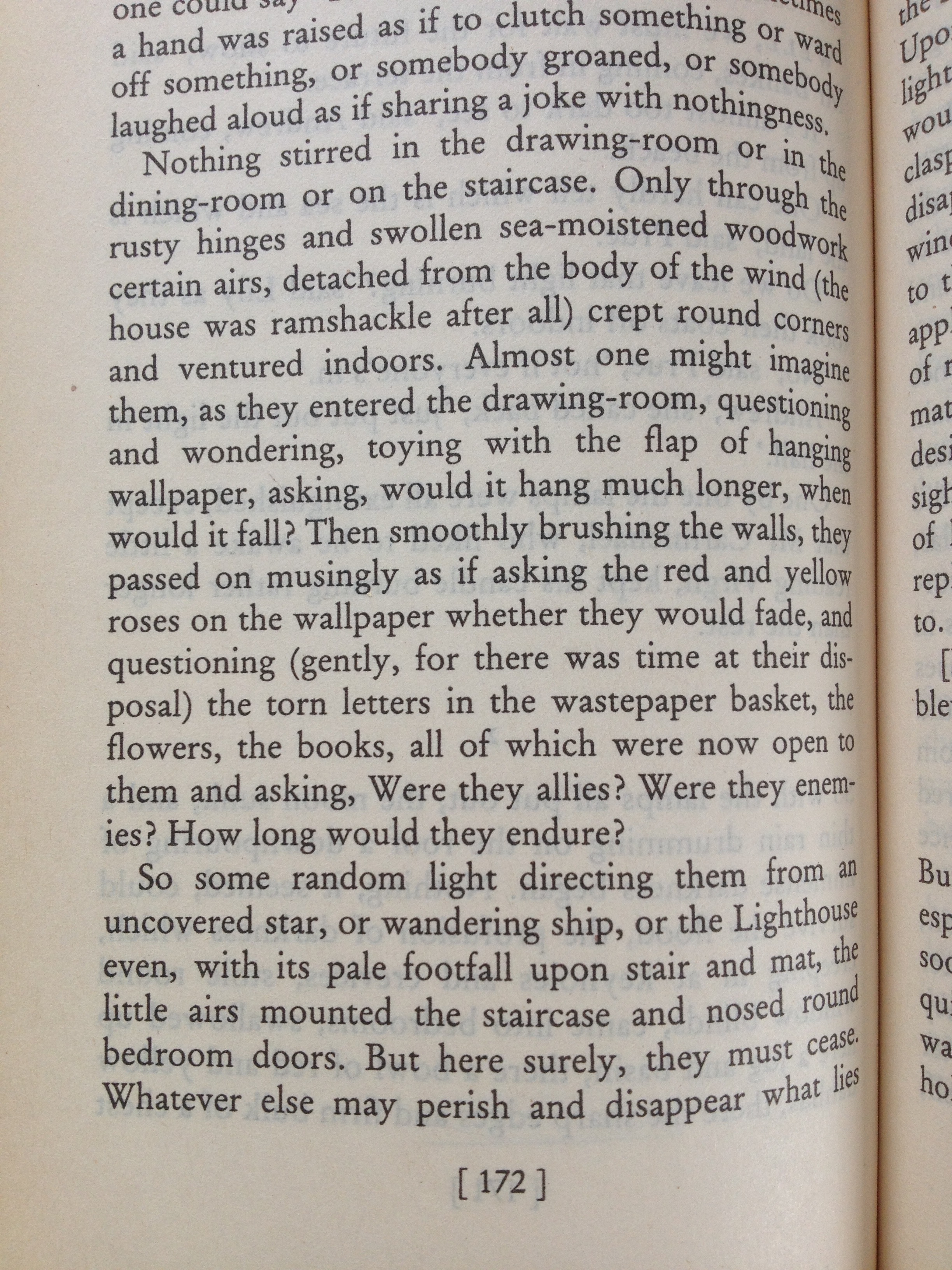
The text I was made to read at sixth-form college that had no connection to our syllabus was the ‘Time Passes’ section of Virginia Woolf’s To the Lighthouse. Our class usually studied two texts in parallel with two different teachers, Miranda O’Connell and Joan Clark, but at some point in the spring of the second year, Mrs Clark suffered a slipped disc and had a week or so away. In the first instance the college drafted in a teacher from the Henley Technical College, who I think was called Sally Benjafield, and so we found ourselves doing a practical criticism exercise on ‘Time Passes’.  Opinions were divided: I found it strange but haunting, and couldn’t put my finger on why it sounded like poetry; Dan P., who regularly sat next to me, and who was refreshingly free of illusions, declared it to be ‘pretentious’.

Woolf_TimePasses

Whether this was the first time I’d ever heard of Woolf I can’t be sure.  Colin Gregg’s adaptation of To the Lighthouse had first broadcast on the BBC in March 1983, and was given front-cover treatment in the Radio Times, but I didn’t watch it then; we saw it on videotape some time at sixth form: possibly as a follow-up to the close-reading class on ‘Times Passes’, but possibly as a quite separate extra. And although this was the first time I’d read Woolf, and although I remembering being intrigued by it, I didn’t immediately rush out and get hold of To the Lighthouse.  In part because I was busy preparing for A-levels, and busy preparing for that summer’s production of A Midsummer Night’s Dream, and in part too because presenting ‘Time Passes’ without any narrative context might make for a good practical criticism exercise, but it doesn’t make for the best introduction to Woolf.


#bookadayUK (22): Out of Print

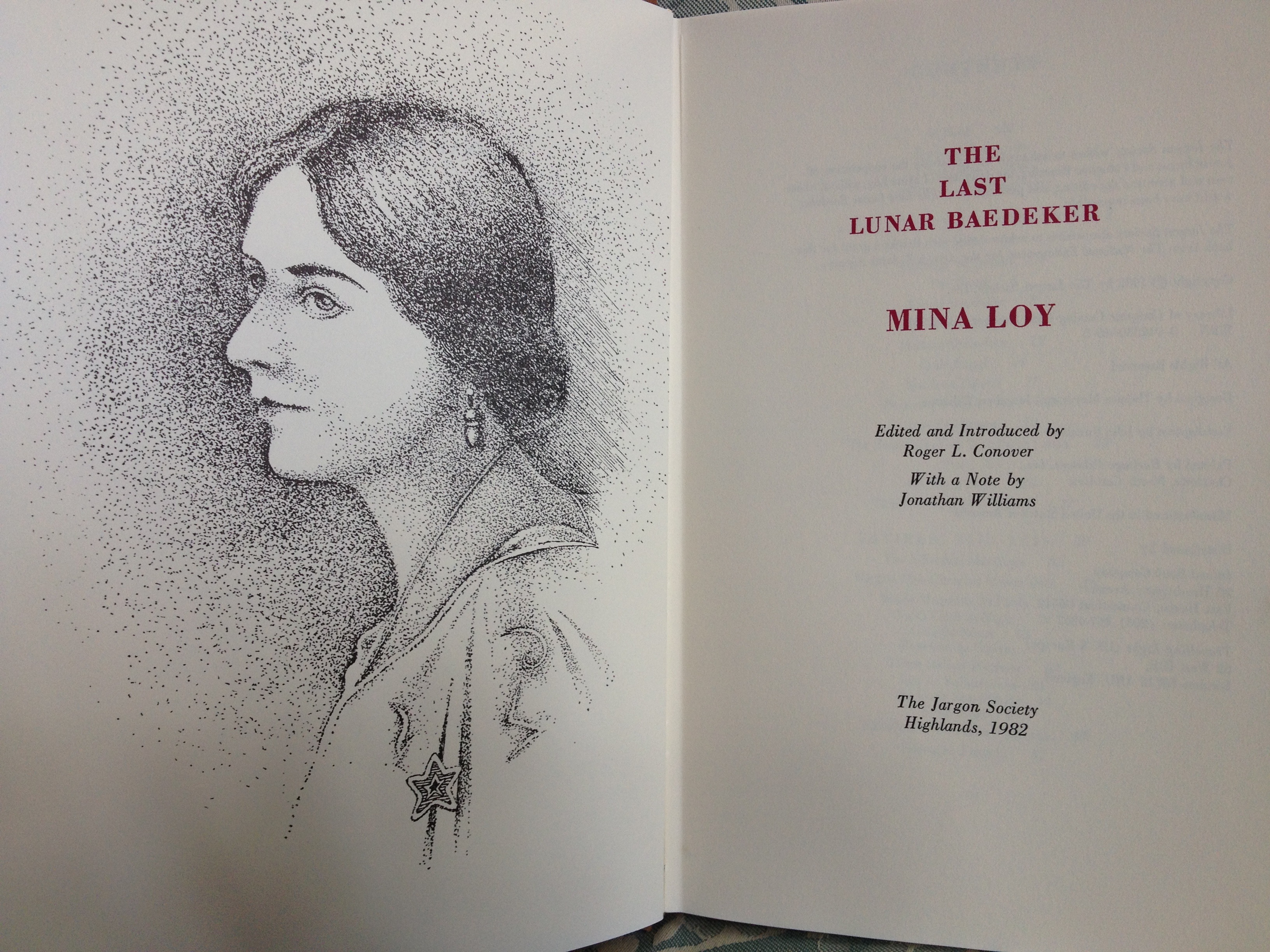
Pig Cupid, a small pamphlet of poems in response to Mina Loy’s ‘Songs to Johannes’, was where I first became aware of this neglected modernist poet.  That was in 2000; later, when Lawrence Rainey’s Modernism anthology came out (2005), I read her for the first time, and was amazed by ‘Parturition’ in particular, for the way it connected intense physical experience with philosophical abstractions. Rainey’s selection led me to what remains the most readily obtainable selection her poetry, and undoubtedly the best place to start, The Lost Lunar Baedeker, ed. Roger Conover (Farrar, Straus & Giroux, 1996; later published by Carcanet).  But tantalisingly, what Conover wasn’t able to include in that selection, given that he wished to include annotations and an introduction, was Loy’s autobiographical poem ‘Anglo-Mongrels and the Rose’.  He had included it in an earlier collection of her work, The Last Lunar Baedeker (Jargon Society, 1982), a beautifully made and hefty book that now re-sells for equally hefty prices.

Loy_LastLunar

You can get a good feel for Loy’s poetry without reading ‘Anglo-Mongrels’, but nevertheless, it attempts something quite different: an autobiography.  And it’s an autobiography that explores where personhood comes from, so rather than beginning with Loy’s childhood, it begins with her parents: her Hungarian-born Jewish father, Sigmund Felix Lowy, and her English mother, Julia Bryan. And her presentation of them isn’t straightforward: Sigmund becomes ‘Exodus’, and Julia is initially named ‘English Rose’, later to become ‘Ada’. In consequence, we see them as types rather than individuals, she ‘simperiing in her / ideological pink’, and he something of  Jewish stereotype, ‘loaded with Mosaic / passions that amass / like money.’  Mina Loy herself is born twenty pages into the poem (it’s about sixty pages long in total) and is referred to as ‘Ova’; her later lover Arthur Cravan is presented at the moment of his birth as ‘the male fruit / of a Celtic couple’, and is named ‘Colossus’.  The narrative doesn’t carry the main characters far beyond their early childhoods and formative impressions.  While ‘Anglo-Mongrels and the Rose’ is by no means perfect as autobiographical poetry, it’s a singular and striking experiment that deserves to be more widely read.