Category Archives: Books

#bookadayUK (16): Can’t believe more people haven’t read

Obscene, obscure, and over-long: from that sort of account of James Joyce’s Ulysses, I can understand why it’s not read more widely, but I’m still surprised by how many people mention it as the work they pretend to have read.  Reading it is so much more fun than pretending.

I first heard of Ulysses as one of the classic texts of high modernism.  At that point I was familiar with modernism almost entirely through T. S. Eliot, so I assumed that Ulysses would be an extended account of the decay of Western civilisation with the usual Eliot scenery of fog, smoke, canals, rats, and general urban debris, and an equivalent level of quotation from obscure texts in languages I didn’t understand.  Nevertheless, brave teenager that I was, I looked forward to reading it.

No-one had told me it was funny: raucously, mockingly, obscenely funny; wittily funny, childishly funny, exasperatingly funny. Mr Joyce’s emporium stocks every variety of funny.

And no-one had told me it was beautiful: not because of the world it depicts, which is only rarely beautiful, but in the shaping of the prose.

Stately, plump Buck Mulligan came from the stairhead, bearing a bowl of lather on which a mirror and a razor lay crossed. A yellow dressinggown, ungirdled, was sustained gently behind him by the mild morning air.

What captivating opening sentences.  Never mind that it’s hard to visualise how you might cross a razor and a mirror (even an old-fashioned cutthroat razor); never mind that the first thing anyone says is in Latin.  The cadence is enough to reassure that Joyce is utterly in control of his materials, and that he’s worth persevering with.  And the parody of the Mass that Mulligan is performing sounds the note of mocking scepticism that runs throughout.

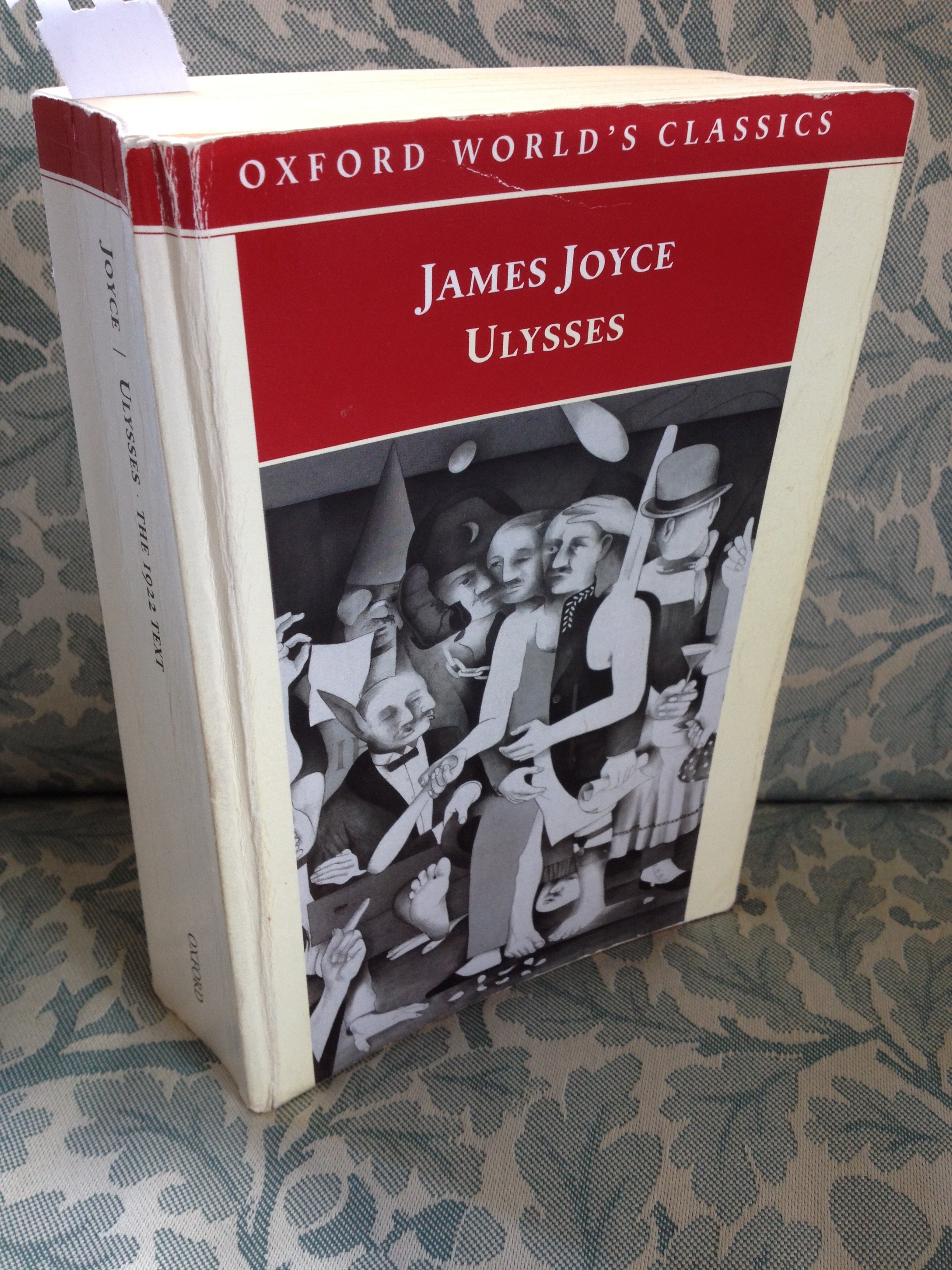
Ulysses (OWC)


It’s true that it’s a different reading experience from even the biggest Victorian novels. The length isn’t really the issue. You have to learn to live with a degree of confusion; some things only fall into place on a second or a third reading.  The Ithaca episode (the penultimate) is where we learn the most factual information about the characters, but by then it’s too late to be of use; in any case, much of the information is deliberately in excess of usefulness. You have to learn when to follow something up and when to let it lie, but a well annotated edition will enable you to do that easily.  Jeri Johnson’s edition for Oxford World’s Classics has over 200 pages of notes.  I wish this had been available when I first read Ulysses; the best that was available was Harry Blamires’s The Bloomsday Book, which on reflection probably had too much paraphrase but too little annotated.  You have to hold things in your head and connect them across long distances, but not in a detective-story mentality: plenty of connections can escape you and you’ll still gain a lot from the experience.

The first version I read, the Penguin edition of Hans Walter Gabler’s ‘corrected’ text, came with a reassuring Introduction by Richard Ellmann which said (though I paraphrase), Joyce’s theme was simple; he used the most elaborate methods to present it.  The theme, on Ellmann’s account, is love.  Leopold Bloom’s love for Molly; his love for his lost son and for the daughter who’s just moved away from home; the love of family and the love of nation and place. I don’t much care for claims about ‘universality’, and it’s a novel about a predominantly male world, but it’s still a novel with a wide reach.

#bookadayUK (15): Favourite Fictional Father

An unpaid nurse and a political assassin: that’s my favourite fictional father.  I must admit it took about ten days of pondering this topic to realise that it was timed to coincide with Father’s Day, and it took me almost as long to think of a fictional father who I felt sufficiently excited about to. For a while I’d planned to subvert the topic and go with my favourite fictional mother, Mrs Ramsay in To the Lighthouse, but Elizabeth Gaskell deserves some space.

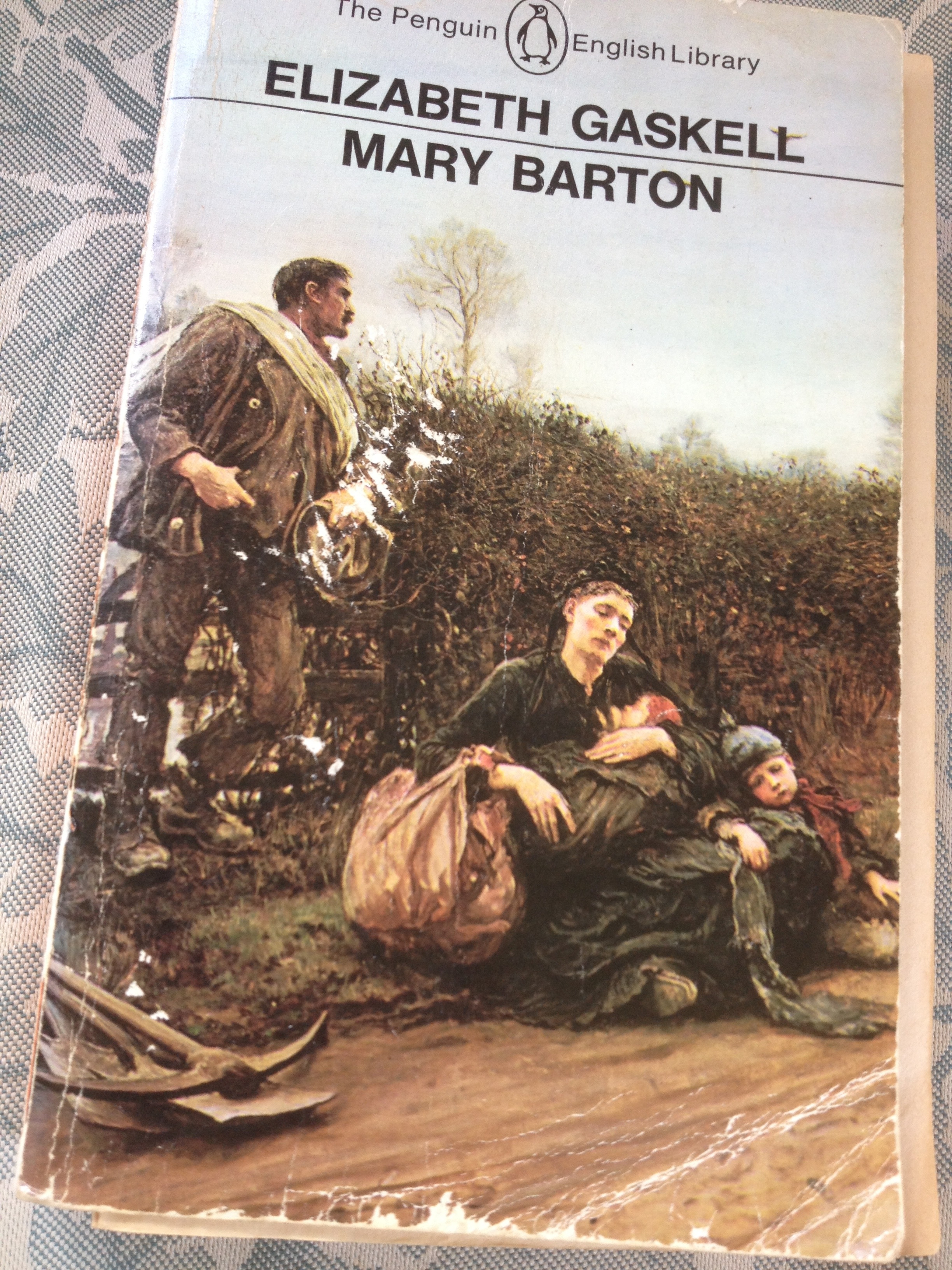
Gaskell_MaryBarton

My copy, 1970 Penguin English Library, ed. Stephen Gill, bought secondhand in June 1986.

When we first meet John Barton, in Gaskell’s Mary Barton (1848), he’s ‘a thorough specimen of a Manchester man’, his features marked by ‘a sort of latent, stern, enthusiasm’.  He and his wife are in fields outside the city with their friends the Wilsons. Jem Wilson is already carrying one of his twins in his arms, and John offers to take the other from his wife; a small gesture, but one that it signals a kind of tenderness in the man.  Later, when his workmate Ben Davenport is ill with a kind of typhoid in his squalid cellar home, John goes in search of medicines, nursing him, though to no avail; Ben dies. A succession of deaths interwoven with domestic details makes the opening ten or so chapters among the most powerful in Victorian fiction.  Part of that comes from Gaskell’s attempts to transcribe the Manchester pronunciation of the time, and to honour the dialect usages. As with all dialect writing, that places some obstacles in our way, and it sets the northerners apart from the standard English of the narrator; but it gives their speech a kind of independence too, which is an independence from their being narrated. The dignity accorded to the workers isn’t incompatible with their being able to make an analysis of their situation, even if Gaskell’s narrator sometimes anxiously disavows their point of view.  John knows the basics of Marxism avant la lettre: ‘How comes it they’re rich, and we’re poor’, Jem Wilson asks, during a period of downturn in the cotton industry; responds John, ‘You’ll say … they’n getten capital an’ we’n getten none. I say, our labour’s our capital and we ought to draw interest on that. They get interest on their capital somehow a’ this time, while ourn is lying idle, else how could they all live as they do?’

Dejected by the continual hardships and the succession of deaths, John turns to opium, and Gaskell becomes less sympathetic towards him.  She had originally intended to call the novel ‘John Barton’, but it was never going to be acceptable to Victorian readers to have a murderer as hero.  John also turns to trade-union membership, which Gaskell treats as if it were as bad as opium.  Mary comes to dread the sights of his fellow union-members coming to visit:

there were not seldom seen sights which haunted her in her dreams. Strange faces of pale men, with dark glaring eyes, peered into the inner darkness, and seemed desirous to ascertain if her father were at home.  Or a hand and arm (the body hidden) was put within the door, and beckoned him away.  He always went.

It’s like a first draft of the scene in Heart of Darkness where Conrad presents the Africans as little more than a jumble of limbs and eyes in the foliage at the side of the river. Some chapters later, furious at a caricature drawn of them by a mill-owner’s son, Harry Carson, and by the refusal of the ‘masters’ to hear their demands, the unionists decide to murder Harry Carson, and they draw lots to decide who should do it. John Barton becomes the murderer.  Even at this stage in the plot, Gaskell still shows us his tenderness: on his way to assassinate Carson, Barton comes to the aid of a small boy who has lost his way, and leads him home; but his destiny is determined for him. After the murder, John almost disappears from the narrative, and its construction becomes more melodramatic. Mary’s lover Jem is wrongly suspected of the murder, and Mary must prove his alibi. The novel becomes a page-turner in a more conventional mode, but sacrifices the patient, slow-paced examination of domestic lives that makes the opening chapters so powerful.


#bookaday (14): An old favourite

The occupational hazard of being a lecturer is that some literary favourites are also on the reading list, and so they become encrusted with layers of pedagogical questions, and it’s hard to return to the moment when they were genuinely new and personal.  Sometimes that’s great: you re-read the text and it now contains memories not of your own personal reactions, or not only, but of conversations you’ve had and people you’ve known; passages connect back to insightful commentaries in student essays.   But sometimes it can prevent you having a personal relationship to the text, and then it’s a relief that not everything is teaching fodder.

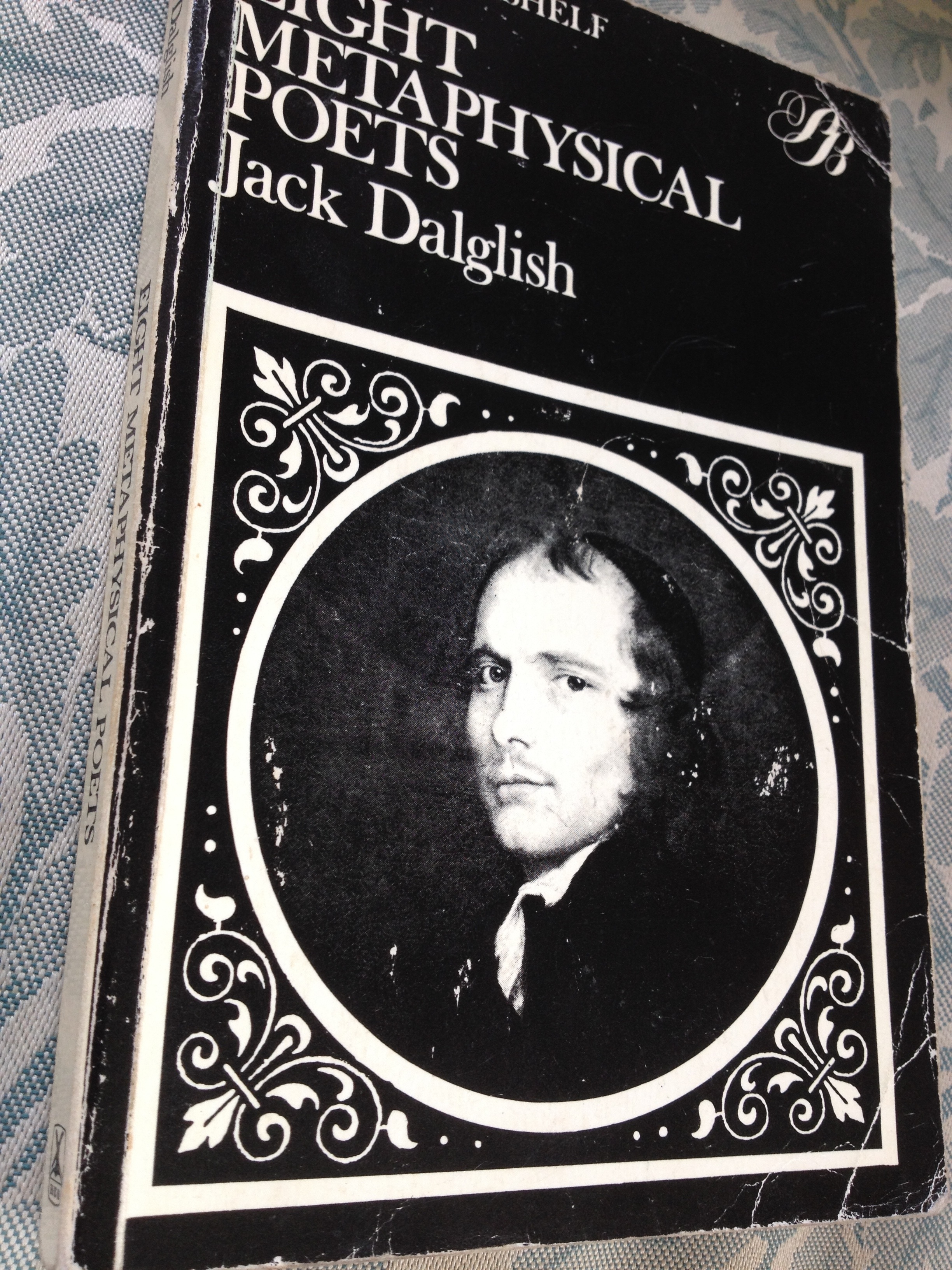
The texts that are least encrusted are the ones that I read between the start of my A-levels and the end of my BA degree, and which I’ve never or scarcely ever taught. I was first introduced to the Metaphysical Poets at sixth-form college, King James’s College, Henley-on-Thames.  At that date Oxford had an entrance exam for English Literature, and those of us thinking of applying were advised to do additional reading beyond the syllabus and prepare for the exam.  The Metaphysicals were considered ideal Oxford-exam material, and it appears that in May 1985 I bought Jack Dalglish’s 1961 edition of them in preparation for the exam that November.

Eight_Metaphys

That the Metaphysicals were considered suitable suggests that T. S. Eliot still exerted considerable influence over ideas of what was considered erudite.  (Though a student in the year above me who had successfully applied to St Hugh’s reported that her interviewer interrupted one response by saying ‘I don’t want to know what T. S. Eliot said; what do you think?’)  Scarcely two and a half pages into Dalglish’s Introduction he has quoted Eliot’s 1921 ‘The Metaphysical Poets’ (‘A thought to Donne was an experience ….’), and by the end of the third page, there he is again (‘the intellect was at the tip of his sense.’)  Over the page, we encounter the inevitable example, the famous pair of compasses from ‘A Valediction, forbidding mourning’.  Oxford tutors marking the entrance exam must have been heartily sick of compasses.

But although my critical judgements were probably neither well informed nor refined, I’m glad to have had that early introduction to the Metaphysicals and above all to John Donne.  It was in Dalglish’s anthology that I first encountered ‘A nocturnal upon S. Lucies day’ and its end-of-year melancholy, and Holy Sonnet xiv, ‘Batter my heart, three person’d God’, which I loved for its breaking of regularities (‘knock, breathe, shine, and seek to mend’).  He’s brilliant at coming up with dramatic opening lines that draw you into the poem, though to my surprise I see Dalglish’s anthology doesn’t include ‘Mark but this flea, and mark in this..’.  There’s an amazing range of tones and voices in Donne’s poetry, even in Dalglish’s selection. There’s also  a great deal of what looks like adolescent angst: ideal material for a seventeen-year old.

Dalglish’s notes I don’t remember, though I’m sure I must have used them: if we got any additional tuition for the Oxford exam, it was no more than a class or two. Dalglish seems very concerned to assert the masculinity of the poems (‘vigorous’ comes up a lot, and there’s at least one ‘sinewy’) and keen to remind us of their connection to normal speech.  Here the ghost of F. R. Leavis also haunts the text: Dalglish studied under Leavis at Downing College, Cambridge, from 1946-48. I think it was already clear that this was an ancient and foreign critical idiom; I seriously hope I never commended anything for being  vigorous, sinewy, or tough. The edition itself I remember fondly, for all that the cover looks austerely pedagogic: it was printed on good paper, and the margins allowed plenty of space for annotation.

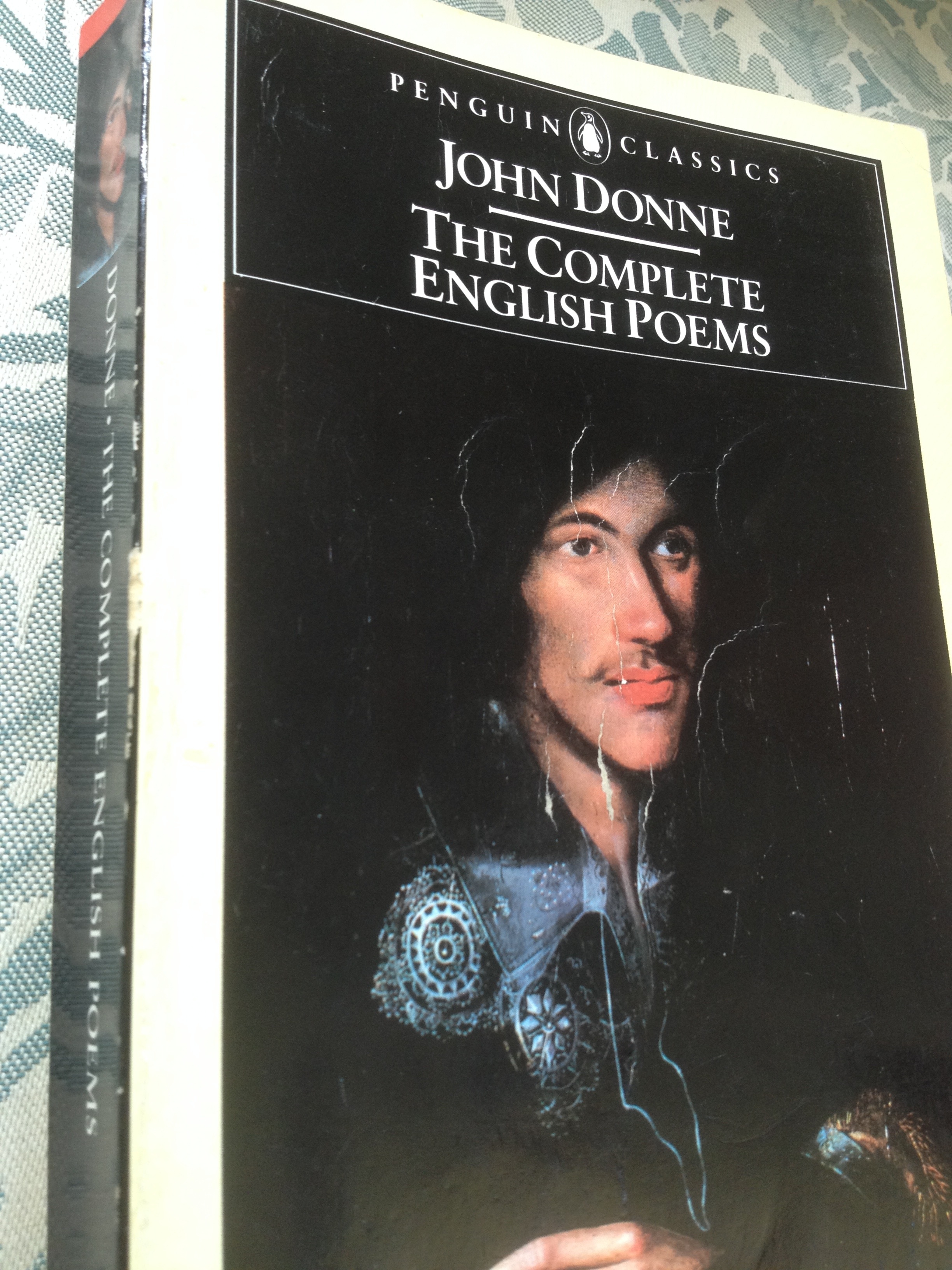
Donne_Complete

This early encounter gave me a good foundation: I went back to Donne in the second-year of my degree, now armed with the Penguin Complete English Poems and a Penguin selection of the sermons, and wrote an essay that was positively New Critical in its fascination with imagery of circles, loops, and spheres.  I taught Donne a little when I was first at Bangor in seminars on the first-year Jacobean literature module; just enough to revive my interest and not so much as to taint him.  And insofar as I’m planning to write a book on the neo-metaphysicals of the 1920s and 1930s (Herbert Read, Michael Roberts, William Empson, and others), they’re still with me, ‘vigorous’ as ever.


#bookadayUK (17): Future Classic

‘It is only by hindsight’ that a classic may be known, wrote T. S. Eliot: if we adhered to that position, the idea of a ‘future classic’ would be a meaningless one.  It’s certainly a difficult question, and not only because it’s always risky to make such predictions. Notoriously, in 1932 in New Bearings in English Poetry, F. R. Leavis notoriously announced that the poet Ronald Bottrall would be one of the greats; in a revised edition in 1950 in the face of Bottrall’s almost complete disappearance, Leavis retracted the prediction. It’s difficult for me to choose a future classic, because part of my interest in the question of ‘the classic’ derives from an interest in book history, and the book-historical perspective tends to emphasise the extrinsic factors in the making of classics: are they put on syllabuses?  do they have powerful promoters in academia and in the world of publishing?  From the book-historical perspective, the classic is denoted by a style of paratext, best known in the UK in the forms used by Penguin Classics and Oxford World’s Classics. Such observations in themselves don’t help predict what will become classics, though they point to relevant factors: if part of the raison d’être of a classic edition is to provide notes, then for a text to become a classic, a kind of linguistic or cultural change must have intervened that justifies annotation. That doesn’t mean that any text that requires annotation has the potential to become a classic.  The status of Ulysses as classic is jeopardised by its needing more annotation than can be contained in a single volume, and by the editor’s choice of what to annotate risking the appearance of arbitrariness.  After editing Ulysses for World’s Classics, Jeri Johnson gave a lecture entitled ‘Editing Ulysses: The Nightmare from which I am trying to awake.’

Ankhi Mukherjee’s essay ‘”What is a Classic?: International Literary Criticism and the Classic Question’ (PMLA [2010]) doesn’t remove ‘the classic’ from extrinsic factors, but clarifies some issues in ways that book-historical approaches don’t.  While those texts chosen to go into editions of ‘classics’ look very much like part of the canon, Mukherjee reminds us that the classic might have qualities which make it sit uneasily in the canon.  Certainly if we conceive the canon as presupposing an interconnected tradition,  one in which relationships of inheritance and indebtedness predominate, then the classic might be admitted despite its failure to fit in.  In Harold Bloom’s definition of the classic, it has qualities of ‘strangeness’, ‘a mode of originality that either cannot be assimilated, or that so assimilates us that we cease to see it as strange’.  I’m cautious about the second clause and the assumptions about community that are rolled into ‘us’, but the idea that the classic is singular and resistant to assimilation is one that I’m happy to work with.  Another way of putting this is that it’s like Michel Foucault’s idea of the ‘founders of discursivity’ (in ‘What is an Author? [1968]).  Writers like Freud or Marx ‘are unique in that they are not just the authors of their own works.  They have produced something else: the possibilities and rules for the formation of other texts.’  However, when Foucault tests this concept against a literary example — Ann Radcliffe, as founder of the Gothic novel — he finds her wanting, not because her example wasn’t enormously generative, but because the real founders of discursivity also enable ‘a certain number of divergences’ from their example. Likewise, Bloom’s non-assimilable author generates not just developments of her mode, but texts that work in opposition to it. It’s much easier to demonstrate the fact of opposition when one is working in fields of theoretical propositions, like psychoanalysis or linguistics, and much harder in a field where, if there is a rationale at all, it is buried in the practice.

Mukherjee also proposes that the classic exists in a relation of co-dependence with literary criticism: ‘the classic is that which survives critical questioning, and it in fact defines itself by that surviving’ (Mukherjee, p.1028). This raises a question of how narrowly or widely we should define ‘critical questioning’: does it mean only academic writing, or only prose writing operating within a recognised critical idiom, or could it be extended to include the kind of critical questioning undertaken by creative rewriting of earlier works?  A robust definition of the classic would have to envisage the survival of the concept even in a world where academic literary criticism had never existed or had ceased to be.

An older humanist mode of literary criticism would have spoken of classics as embodying timeless and universal human values.  That sort of answer doesn’t seem viable any more: definitions of the timelessly placelessly human have all too often embodied the culturally specific outlooks of the definer.  It’s one thing to hope for united humanity; it’s another to define its essential characteristics.  Moreover, defining classics in terms of human values tends to favour lyric poems speaking in a recognisable human voice, or realist narratives depicting recognisable human situations. Those are enormously interesting kinds of writing, with great internal variety, but there’s more to literature than they can encompass. Shakespeare’s plays and the Canterbury Tales are readily absorbed, but its harder to justify fantastic works like The House of Fame or Paradise Lost.

Tom MacCarthy’s Remainder (2005) struck me as one possible future classic, because it feels very fresh and original and yet also familiar, as Beckett had written without existential angst and in a recognisable modern south London setting; but thinking about the distinction between the classic and the canonical, I wonder whether Remainder, because of the suggestion of Beckett, might not be canonical rather than classic. It’s impossible to anticipate what critical questioning it might face, and whether it might survive it, and part of the problem here is of not knowing where MacCarthy’s career might take him. (The novel that followed it, C (2010), was highly acclaimed, but I haven’t yet found the time to read it; there’s another novel now complete in manuscript.)  If we’re thinking about extrinsic factors, MacCarthy seems to have influential backers, and Zadie Smith’s widely cited ‘Two Paths for the Novel‘ argues for his direction being the one with a future.

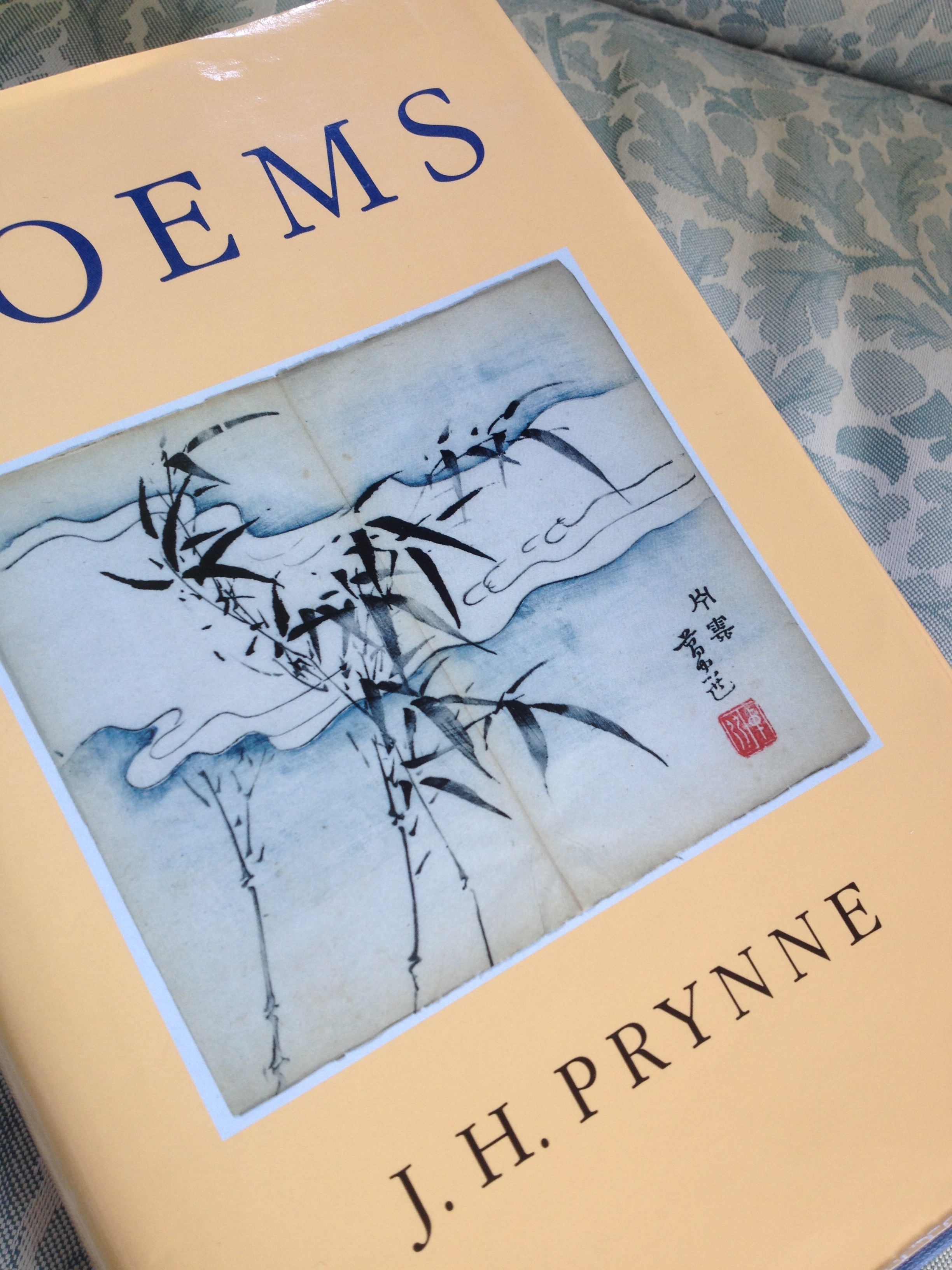
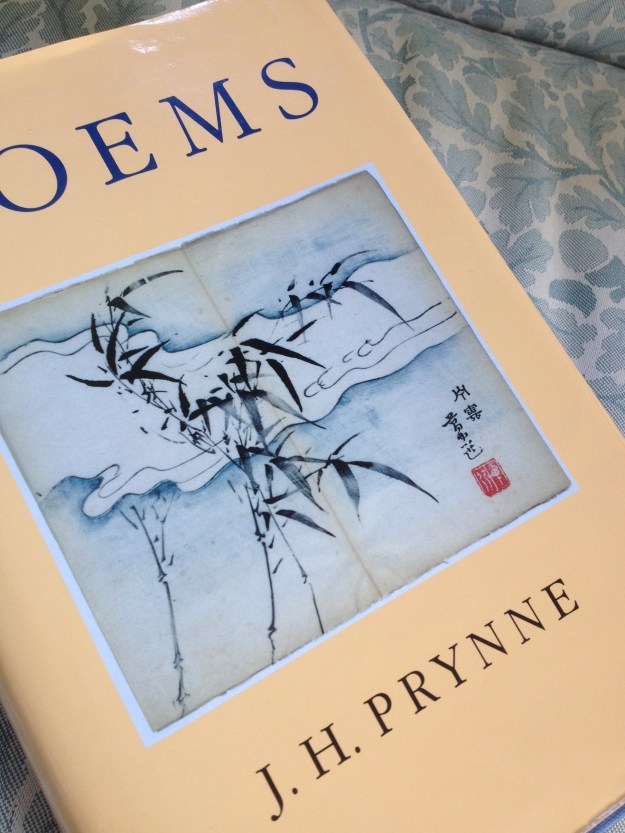
I’m more comfortable making predictions in the field of poetry, so, with some reluctance about the exercise, and the ghosts of Leavis and Bottrall looking down on me, I’d suggest that J. H. Prynne’s poetry has the necessary qualities to survive.  For all that he’s indebted to Charles Olson and Edward Dorn, Prynne has consistently invented new ways of writing poetry that go far beyond the production of poems that are in themselves inventive and constantly surprising. Put alongside Foucault’s demanding comparison of Ann Radcliffe with Freud, Prynne’s inventiveness might place him equal only to Radcliffe, but to an imaginary Radcliffe who invented not just Gothic but the marriage plot novel, the condition-of-England novel, and the sensation novel. And as I say, with literary discourses, it’s much harder to determine whether a later writer is working within the terms established by their predecessor.  As well as being some sort of a founder of discursivity, Prynne has also written works that startle in their range of reference and in their juxtapositions. Whether it will survive critical questioning is harder to predict because we don’t know what questions critics might pose, and in the short term will be less important than whether later poets wish to follow his example. And it’s clear that his example has been enormously important to several generations of poets.

I’ve found the earlier volumes (Kitchen Poems, Day Light Songs, The White Stones, Brass, Wound Response, which date from c.1968-1974) the more rewarding to read, though The Oval Window (1983) is magical.  In reading Prynne I’ve benefitted from the guidance of N. H. Reeve and Richard Kerridge’s Nearly Too Much: The Poetry of J. H. Prynne (1995), and it may be that their extended treatment of The Oval Window is why it works for me; there’s no comparable guide to the later volumes, and it’s notable how many critical accounts of his work treat the late 1960s work as if it were typical of the whole; in the later work syntax becomes increasingly compressed and unreliable as a guide.
Prynne_Poems

Ten years ago John Carey expressed outrage that Randall Stevenson had declared Prynne rather than Philip Larkin to be the most important English poet of the late twentieth century (in Stevenson’s The Last of England? (2004), his volume in the Oxford English Literary History; I’ve forgotten the exact terms in which Carey framed the comparison).  It’s hard (consulting the index of the volume) to find Stevenson making the comparison quite as starkly as this, though it’s true to the broad drift of his account. Carey’s preference is entirely consistent with the populist and anti-modernist line he took in The Intellectuals and the Masses (1992), in which accessibility outweighs other considerations. My guess is that Carey’s future classics would speak to universal human values and would do so in a register not far removed from everyday English speech.  I’d argue that literature can do more than speak everyday English, and that Prynne’s poetry has shown us several ways of doing it.

#bookadayUK (28): Bought at favourite independent bookshop

If I could identify a book that I  bought at Tyler’s, Bangor, about ten or twelve years ago, then that would be my favourite.  Tyler’s Academic Books had begun as a rather utilitarian, science-oriented bookshop elsewhere on the High Street, and in my first few years in Bangor I didn’t pay it much attention.  But then around the time that I moved to Lon Pobty it moved to a great location at the junction of Lon Pobty and Stryd Fawr, so I walked past it twice a day.  And a little bit later a former Bangor English student, Daniel J., took it over.  Though it didn’t carry a huge stock, Dan was very efficient at ordering books, and so, when things went well, I could order a book one day, and collect it the next; when everything was going really smoothly, I’d be walking past the shop and a wave from Dan would indicate that there was something waiting. It was far more efficient than Amazon, and he gave discounts to regular customers.  And there were poetry readings, though the one I remember best was fraught by cultural tensions between the English-language poets and the Welsh-language ones, and by Dan ejecting a member of the audience for unruly behaviour only to realise that he was actually one of the poets on the bill. I’ve no photo of the bookshop itself, sadly, but do have an old photo of the location in (supposedly) 1911, when it was the City Hotel:

LonPobty1911

Around the time I moved away from Bangor, in 2005, Tyler’s ceased trading, and when I was last there in 2006, the location was occupied by a clothes shop.

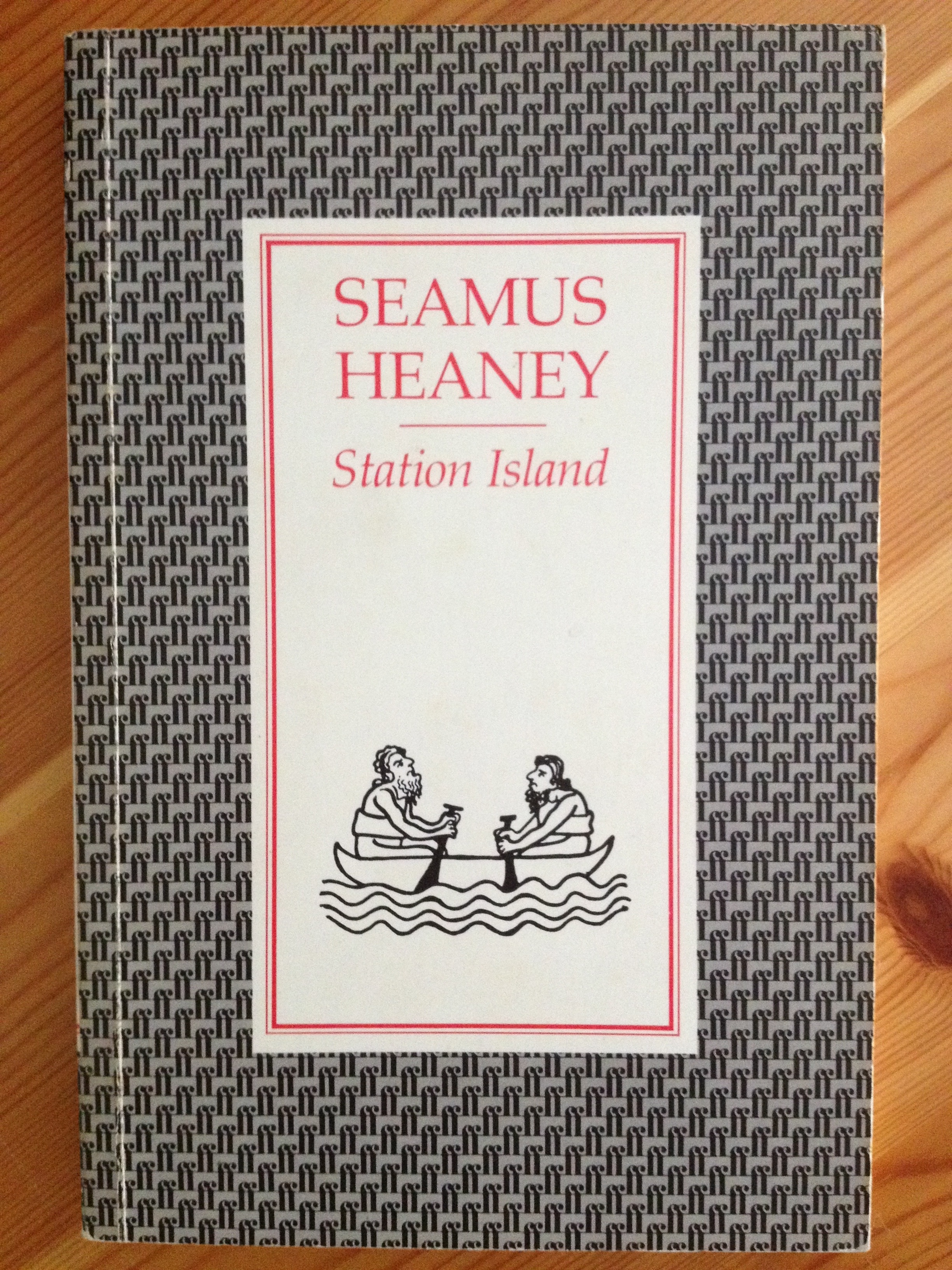
In the absence of an identifiable candidate from Tyler’s, here’s one I bought from The Bell Bookshop, Henley-on-Thames, in March 1986.  When I’d been younger, a trip to the Bell Bookshop was a special treat: it had an excellent range of children’s books, and lovely red-and-white bookmarks decorated with its bell logo.  Seamus Heaney’s Station Island might well be the first book I ever bought there with my own money, and even more probably is the last I ever bought there. Like the T. S. Eliot Collected Poems I’d bought at the beginning of my time at sixth-form, my acquisition of this felt like some sort of rite of passage: physically, this kind of book was unfamiliar, as my parents had little interest in poetry (though plenty of interest in books), and what poetry books they did have were typically Penguin anthologies.  Even more so than Eliot’s Collected Poems, and even as a paperback, Station Island felt physically luxurious, printed on thicker, more expensive paper than books I was used to.  And even the Pentagram design was a relative novelty, and didn’t feel oppressively corporate at that time.

We’d been studying some of Heaney’s earlier poems in George MacBeth’s Poetry 1900 to 1975 (Longman, 2nd edition, 1979); from what I can recall, it was the usual anthology pieces from Death of a Naturalist and Door into the Dark: ‘Blackberry Picking’, etc.  So far as I recall, MacBeth didn’t include any of the bog people poems. So, coming to this volume, I’d leaped over several stages of Heaney’s development, and hadn’t been altogether properly equipped to deal with it; and there’s at least one poem in the ‘Station Island’ sequence itself that presupposes knowledge of earlier work, ‘The Strand at Lough Beg’ from Field Work, and the Sweeney poems in the third section also presuppose greater cultural knowledge than I had. But I liked the spareness of the poems compared to the over-rich earlier work. It’s not my favourite volume by Heaney — that would probably be Wintering Out — but the memory of buying it is a happy one. And so far as I know, unlike Tyler’s, The Bell Bookshop is still thriving.

Heaney_Station Island

My copy, bought March 1986


#bookaday (13): Makes me laugh

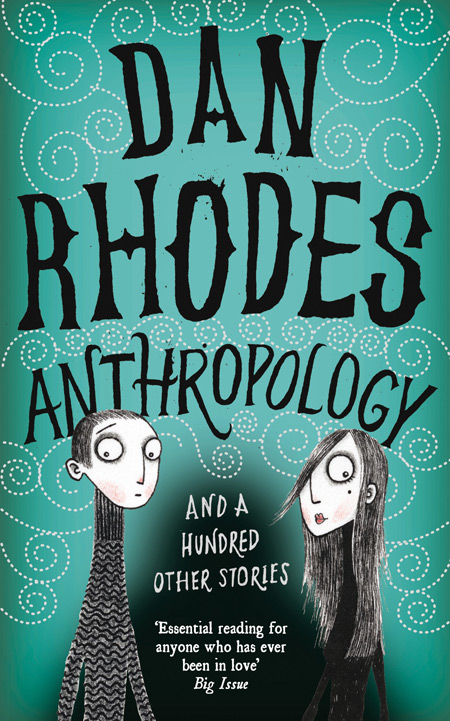
Dan Rhodes’s Anthropology. Never mind the Oulipean formal constraints (one hundred and one stories, each one hundred and one words), what really makes these stories of unhappy love affairs and bereavement hilarious is the deadpan tone with which Rhodes delivers bizarre scenarios. The girlfriend of the titular story ends up dressed as a 1970s Village-People-style gay man while tending goats in Mongolia. ‘Innocence’ ends with a parrot spouting obscenities at a wedding. Every girlfriend has a new name, but the narrator scarcely distinguishes one from another, and he understands them in the most superficial way; ‘pretty’ and ‘lovely’ are the most telling epithets he can summon. Celestia, Tabitha, Lulula, Paris, Foxglove, Zazie: the names change, but the scenarios repeat themselves. Two consecutive stories begin ‘My girlfriend left me’; many times his girlfriend dies. Each story is self-contained, and the narrator never acknowledges the repetitions, ever notices the absurdity of it all, and never learns.

There’s an underlying sadness about them too, one that’s always just hidden behind the deadpan, and, these being highly compressed pieces, the tone can turn in an instance. No sooner have you laughed at the parrot’s obscenity than you reach the final phrase, ‘I knew that the marriage was over.’ And there’s a strange pathos in the narrator’s impercipience and cheerful persistence.

Rhodes_anthropology

#bookaday (12): I pretend to have read it

I’m sorry to be so irritatingly honest, but I can’t think of any book that I pretend to have read; as a tutor I don’t want to be living in fear of being found out by bright and widely read students.  Occasionally they ask to do tutorials on novels I haven’t read, and I let them know that: (i) I’ll try to read as much as I can by next week, and, (ii) they need to realise that I might not manage it.  I know a lot about the first quarters of novels.  The important thing about an Oxford tutorial is that the student drives the process by researching and writing an essay before it; the tutorial refines their knowledge through discussion.  (R., discussing this, suggests that in tutorials I probably mention other works in general terms and leave the students with the impression that I have read them, but there’s no intention to deceive.  It’s also possible that students think I’ve read all the books on my shelves.)

As a tutor the real peril is not being able to remember the detail of novels that you have read.  It’s surprising how quickly you can reawaken memories by reading just a few pages from various parts of a long novel; and the student’s essay itself will do more.  Long poems are a problem too, and In Memoriam in particular resolutely refuses to stay in place: it’s very long, the stanza form doesn’t vary (though Tennyson is a genius for creating variety within its formal constraints), and though there’s a broad-scale movement from bereavement to consolation, it’s not especially linear or logical.  So let’s say In Memoriam.  I’ve read it, but I probably come across like someone who’s pretending.

Tennyson Selected


#bookaday (11): Secondhand bookshop gem

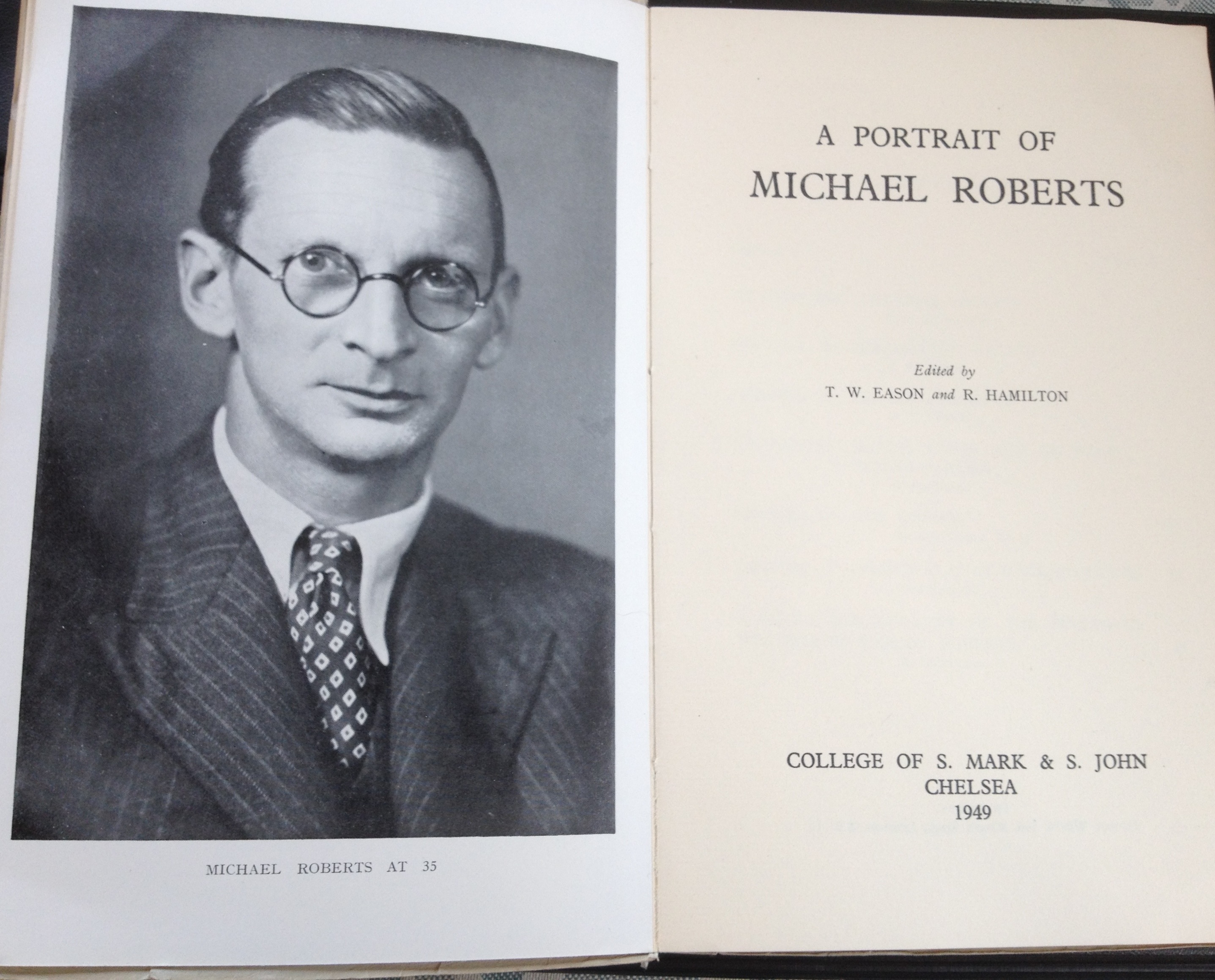
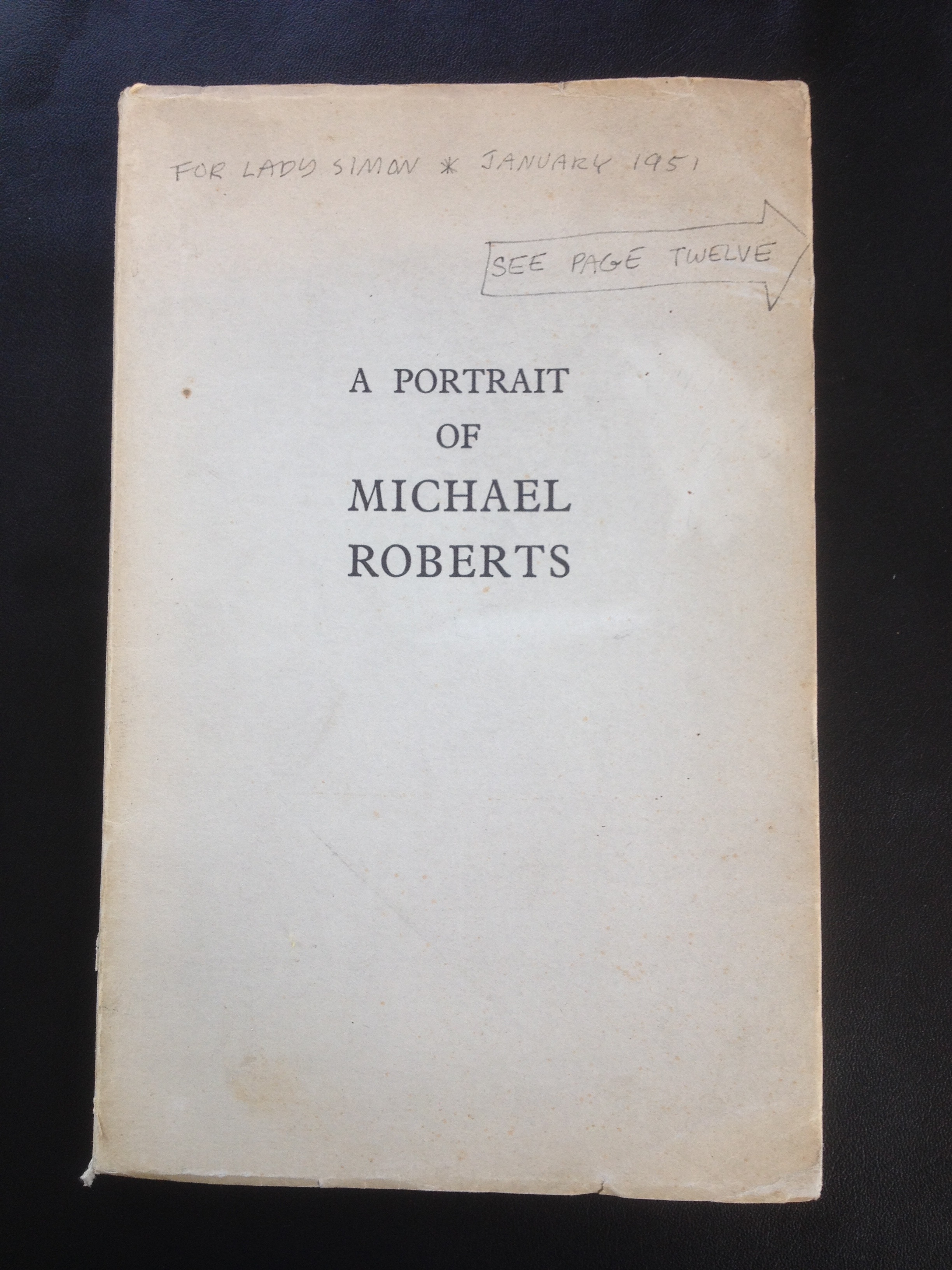
If there was a golden age of secondhand bookshop browsing, for me it fell between 1995 and 2000, though the afterglow lasted through to 2005.  The book I’ve chosen is far from being a gem in physical appearance, but it marks the moment of transition.  I picked up A Portrait of Michael Roberts (1949) for thirty-five Canadian dollars while I was in Victoria, British Columbia, in May 2000; I was there for three weeks working with Herbert Read’s papers in the University of Victoria. While I was there, one of the archive assistants mentioned a new online website that catalogued the holdings of antiquarian booksellers around the world, and which coincidentally was based in Victoria: abebooks.com.

MR_Portrait2

Until then secondhand bookbuying had been serendipitous and speculative.  My golden age began in January 1995 because that’s when I started my first properly paid and full-time post as a lecturer, at the University of Wales Bangor. I paid quite a few visits to my friends A— and A–, who had recently moved to Hereford, and Hereford put me in reach of Hay-on-Wye; sometimes as a day trip from their house, sometimes as a detour on the way.  Book-browsing at Hay was a full sensory experience: not just the sight of books, but the chill of basement rooms, the creaking of old doors, and the smell of slightly mildewed pages.  I came back with all sorts of wonders. They were mostly, I now realise, belated acquisitions of books I had focused on when doing my doctorate.  (Moving to Bangor deprived me of the resources of the Bodleian, so I was trying to compensate).  But some others were speculative purchases of works for future reading and study.

The coming of ABE made it far easier to find obscure titles and to be sure that you weren’t spending over the odds for a given book, but it removed the excitement of serendipity and foraging, and it removed the sensory engagement in the quest.  The element of speculative thinking about what you might need has been displaced by the instrumentalised search for what you do need in the present moment.

MR_Portrait1

A Portrait of Michael Roberts was published by the College of St Mark and St John, then an Anglican teacher-training college in Chelsea; it later relocated to Plymouth, and became the present-day University of St Mark and St John, popularly ‘Marjon.’ Roberts had become its Principal in 1944, but his career was cut short by his being diagnosed with leukaemia; he died in December 1948.

The book I found in Victoria came with a mysterious inscription on the front over “FOR LADY SIMON * JANUARY 1951” and a big arrow saying “SEE PAGE TWELVE.”  The arrow refers to the start of M. F. Cunliffe’s chapter about Roberts’s time as a teacher at the Newcastle Royal Grammar School, but whether Cunliffe was the presenter of the volume I’ve no way of knowing. When I bought the book I’d not heard of Lady Simon, but have since found out she was the Manchester-based politician and educational reformer Shena Simon, Lady Simon of Wythenshawe (1883-1972); how her copy of the Portrait found its way to Canada is also something of a mystery.  I came to hear of her again because my partner studied for her A-levels at the now-defunct Shena Simon College in central Manchester.  My copy of the book isn’t a gem in any conventional sense, but it knots together several important threads.

#bookaday (10): Reminds me of someone I love

SnailandWhale

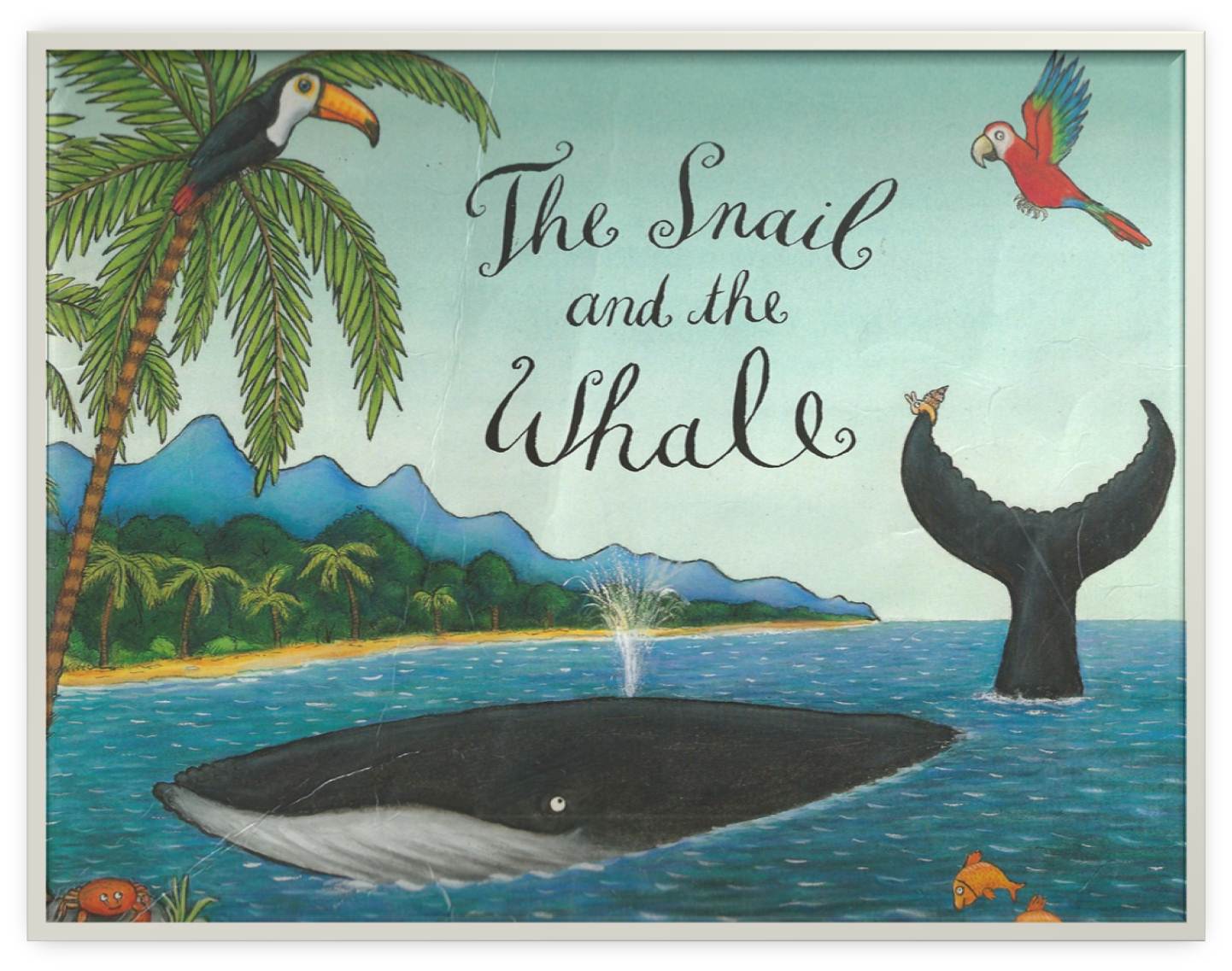
‘Reminds me of someone I love’ suggests long-term separation: you love them, but they’re not around and you need a reminder.  Fortunately that’s not the case for me. Or only in the special sense that when you have a small child, they’re developing so quickly that every week or at least every month, something of their old self is being left behind and a new one coming to replace it.  As the new one is mostly more articulate and more adept, better at understanding temporal relations and better at remembering what it did yesterday, better at using a toilet rather than nappies, that change is very much welcome; but there’s still a slight undercurrent of sadness. In theory that ought to be true for adults, but in practice it’s only small children who change with such speed.  As a neighbour who was a GP said with doctorly sententiousness (she herself had small children), ‘The days go slowly but the years go quickly.’

So, Julia Donaldson’s The Snail and the Whale.   I wish I could remember when we first started reading this to my son at bedtime. We’d started with The Gruffalo, which I was soon able to recite from memory, and we soon had A Squash and a Squeeze, which R. didn’t like very much.  I like reading verse stories at bedtime: I like reading something rhythmical, with all the possibilities for intonational melodies over the phrases.  I even enjoyed Dr Seuss’s Scrambled Eggs Super, though I read it every night for about six months in the middle of last year, and though the narrative is an episodic structure in which any episode could be swapped with any other.

The Snail and the Whale came some time before that; we have it as a board book, so maybe we bought it when our son was one.  As verse, Julia Donaldson’s books are very inconsistent. Several of them began as children’s songs, and so when they’re read as verse they scan unevenly and need a degree of rehearsal; but The Snail and the Whale is lyrical and smooth.  It isn’t my favourite Julia Donaldson: that might be Cave Baby, both for its celebration of creativity and for Emily Gravett’s beautiful illustrations, or it might be The Gruffalo, for its astonishing economy and inevitability. But The Snail and the Whale reduced me to tears several times when I first read it. Not just because of sleep deprivation: the story is very evocative of the world being huge and wonderful, and the narrative depends on the idea that the small and powerless creature might save the life of the big one.  Perhaps the idea of adventuring far and wide is particularly poignant when you have a small child; some people do travel, but we stayed firmly within Oxfordshire for the first 20 months.  And the idea that the large powerful creature might one day need to depend on the wit of the small and vulnerable creature is a moving one.  And the verse brings something to it as well, in its lyricism, and in the way the verses sometimes close up into the formulation ‘The tiny snail / On the tail / Of the whale.’  Our son is now four and a half, and evening story-time is a mixture of Spiderman stories and Roald Dahl, but The Snail and the Whale will always remind me of that earlier time.


#bookaday (9): Film or TV tie-in

Like every other reader I know, I try to avoid adaptations of novels that I’ve not yet read, and I’m wary of adaptations of things I know well.  It hardly needs spelling out: it’s supremely annoying to have your own visualisation of a character or a locale displaced by the director’s; you can never return to the text without those embodiments in mind.

I’ve recently had a new manifestation of the problem, reading Graham Greene’s The Quiet American: I’ve never seen the 2002 film with Michael Caine and Brendan Fraser, but I must have seen a clip of it, because early on Fowler’s terse narratorial voice kept realising itself in my head in a Michael Caine accent.

QuietAmericanFilm

But in thinking about this blog entry, I’ve recognised a related tendency in my book-buying which smacks of petty snobbishness: if there’s a choice between buying the film tie-in edition of a text and the regular edition, I always opt for the regular one, even if the text inside is identical. I might have got into this habit because I didn’t want the visualisations on the front cover to influence my visualisation of the characters, but I suspect the real motivation is lower: I didn’t want people to think the only reason I was reading the book was that I’d seen the film. Or at least that I was uncomfortable with the unbridled commercialism of film tie-ins. (What that attitude forgets is that publishing is a commercial business: film tie-in covers are no more ‘commercial’ than regular ones, only differently so.)

And so the only film tie-in I can find anywhere among my books is Elizabeth Bowen’s The Last September (still on the to-be-read pile), bought secondhand through the post, so I hadn’t realised what the cover would look like.  The text inside is the standard Vintage edition; but it has a film tie-in front cover, and was apparently a freebie with Woman and Home magazine.  I wonder now why I haven’t yet read it, and wonder whether in some way the film tie-in cover is deterring me.

 LastSeptember