‘Disliked’ is probably too strong for it, but ‘Old Snakey’ on Illuminate wasn’t one of my favourite tracks when the album came out. It has a kind of B-movie narrative scenario of an Egyptologist haunted by the spirit inside a purloined statuette, and probably by the spirits inside his liver, and while it’s not as conspicuously as comedy song as some of the early Jazz Butcher material, it’s one of the lighter-hearted pieces. That would be fine, but in the chorus the vocal melody and everything else falls heavily on the beat (‘SOME-thing THAT old SNA-key FOUND a THOU-sand YEARS a-GO…’) in a way that seems intended to accentuate the comedy. Madness used to do this sometimes when they weren’t doing up-beat ska numbers, and it wasn’t funny then.
In February 1999, after Sumosonic had called it a day, Pat and Max were joined by Owen Jones on drums and Pat Beirne on harmonica for a gig in Hamburg with a laid-back, acoustic feel to it. A recording came out in January 2000, Glorious and Idiotic, and it’s well worth a listen. It’s heavily weighted towards the pre-1986 Jazz Butcher material, but the version of ‘Old Snakey’ fits in very nicely; in this version it’s light and it’s spacious and suddenly it makes sense — musical sense, that is, not lyrical.
There’s no version on YouTube at present, but if one turns up I’ll update the blog.
By the time of Illuminate, it was no secret that Pat Fish wanted to leave behind the ‘Jazz Butcher’ name: invented for a one-off joke gig, it had always seemed misleading, and even for listeners who had got used to the idea of there being no ‘jazz’ content in the music, it had become associated with guitar-based indie music. The Black Eg side-project, which had put out an album in 1991, gave a hint as to where Pat wanted to go, though it was released to so little fanfare that it was years before I heard about it, and even longer before I heard it. Keyboards; drum machines; samples. 21 December 1995 saw a gig billed as The Last Jazz Butcher Gig Ever, though soon afterwards, to some embarrassment, the band found that their agent had booked them for a summer festival in 1996.
What came after the Jazz Butcher was for a while to have been called Audio Aquatic, but eventually saw the light of day as Sumosonic. Their debut single was ‘Come, Friendly Spacemen’, released by Creation (CRESCD 242 on 5 December 1996. Here’s a demo version:
Shortly before this came out, NASA had been asking — no doubt pleading for their continuing relevance — how earthlings could communicate their benign intentions to approaching alien lifeforms, and I think the lyric glances at this, as well as being a wry observation on the loved-up atmosphere of the ecstasy era, and a gentle complaint about the greedy, degraded state of the world. It’s insanely catchy, the lyrics are sharp, and there’s some beautiful detail, especially the melodic guitar line towards the end, over the lyrics ‘And if the world’s all broken down / Watch the skies above your town.’
It was a surprisingly long time — just over a year — before the debut album came out in January 1998. It too has some unmissable Pat Fish gems: ‘Cat’s Life’, ‘God’s Green Earth’, ‘Sputnik’ (a successor, in a way, to ‘Land’ on Illuminate), and ‘Fern, Schnell, Gut.’ But Creation didn’t get behind it — as the late release suggests — and they dropped Sumosonic a few months later. They continued gigging through 1998, but if the lists at sumosonic.com are to be trusted, they called it a day in September 1998.
I thought it would be easy to find a self-reflexive song in the Jazz Butcher corpus, but it hasn’t been. In the early songs there’s a lot of self-referencing (most explicitly in ‘The Jazz Butcher Meets Count Dracula’ and ‘JB vs. PM’), and calling out names of the band members (‘me and Max and Dave and Jones …’); in ‘Conspiracy’ there’s a self-mocking account of their willingness to engage with the Big Questions, like the Egg-Potato Phenomenon; but whereas in most twentieth-century poets’ volumes you’d find the poem about poetry, I can’t think of a song about songwriting. ‘Scarlett’, from the Illuminate album, qualifies by virtue of a brilliant moment when the camera pulls back, so to speak, and we see the band in the act of recording the song. What had been, in the first chorus, ‘We put all our faith in constructs’, and ‘We put all our faith in strangers’ in the second becomes, in the third, ‘We put all our faith in magnetic tape.’
But never mind if it doesn’t really fit the criteria: there’s a lot else to like here. (And there’s not a version of it on YouTube at the moment, so you’ll have to take my word for it.) At the start there’s a lovely contrast between the coarse sound and boxy echo of the rhythm guitar and the liquid drops of melody from the other guitar; the rhythm section aren’t obtrusive in this song, but they give it a subtle groove. And Pat’s vocal performance is a good one: I like the hint of a stoned Bob Dylan in the phrase ‘And a silver haze descends’ and even (is it?) the hint of Elvis in ‘Don’t you wanna come down’? There’s a rich, warm, reassuring sound to the song, as befits a song about reassuring someone who’s lost their self-confidence; but the reassurance never becomes cloying or saccharine, as befits a song that reminds us that we put our faith in insubstantial and impermanent things.
Another song made from found phrases, ‘When Eno Sings’ isn’t especially coherent in its lyrics, but with music and a performance as persuasive as this, that doesn’t matter. Though Eno is a less obvious influence on the Jazz Butcher sound than (say) The Velvets, he’s clearly important to Pat, not for his ambient works or for the music of his songs — though the lyrics to ‘Groovin in the Bus Lane’ (on Big Questions) acknowledge its musical similarity to Eno’s ‘Blank Frank’ — but for his dadaist willingness to toy with lyrical nonsense.
Someone has put together a curious video for it: no insult meant to the Jazz Butcher, but the crowds pictured therein are a better turnout than at the gigs I’ve been to; I can only guess that this is an act of wish fulfilment on the part of another die-hard fan.
Though I’ve selected this one for its ending (the whole final minute or so of ‘It’s a love thing’), it captivates from the beginning, the bass and the echoing guitar line locking in perfectly, and the subtle daring of beginning a song that’s so musically joyous with the lyric ‘Sometimes I cry / When the feeling fails to come …’. Thanks to what’s quoted from his song titles, Eno emerges in this song as a kind of fantasy figure, a minor deity, ever present but always out of reach: he’s on a faraway beach, he’s at the chinese opera, he’s in a tiny craft. As for that concluding vocal line, it’s a development of the 1960s soul / Velvet Underground choric mode (think ‘Na nana nana na’ from ‘Rain’, or ‘Radio On’ from ‘Roadrunner’), but the hard dry sound of those earlier songs has gone, and the vocal style is warmer. The brilliant twist is the repeat that leaves out the adjective:
It’s a love thing, it’s a feel thing
It’s a drug thing, it’s a ______ thing
Answers on a postcard please, to Mr B. Eno, c/o Opal Productions, Somewhere in Deepest Oxfordshire.
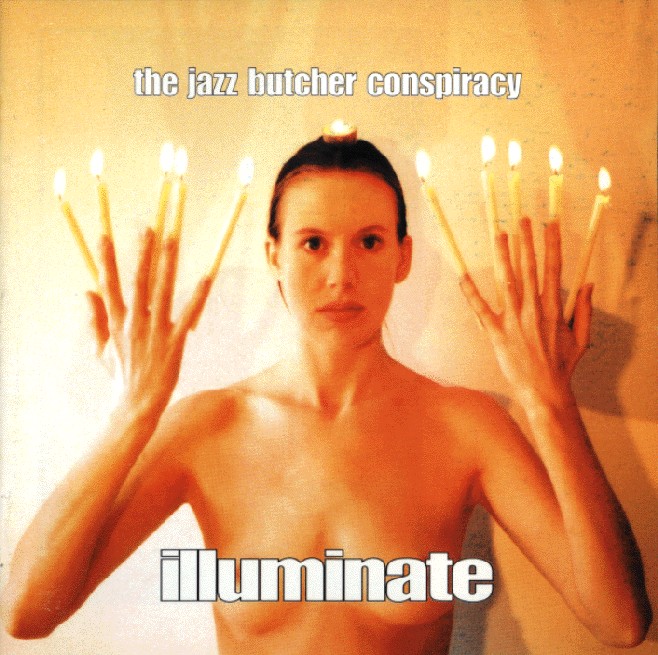
1995’s album Illuminate was a return to form after the disappointment of Love Bus. I’d started a new job at the University of Wales, Bangor, and ordered the single, ‘Sixteen Years’, at the late lamented Cob Records; when I came to collect it, the guy at the counter gave me an advance white-label copy of the album. It’s got something in common with Cult of the Basement in its eclecticism, and in the way that short instrumental pieces (‘A Great Visitation of Elephants’, ‘Beetle George’) fill the gaps in the jigsaw. It’s got some silliness, but it’s also got sublime songs like ‘Blues for Dead Dean Read’, ‘Scarlett’, ‘When Eno Sings’, and ‘Land’; and the one with the best intro of any Jazz Butcher song. It feels a bit like Pat’s response to Gerard Langley’s ‘Pick a card, any card … wrong!’ on ‘Jacket Hangs’: ‘Cigarettes! Tickets! Beer! Money! What could possibly go wrong?’ Sadly there’s no YouTube bootleg of it, so you’ll just have to take my word.
Great not only for its introduction, ‘Lulu’s Nightmare’ is another of those touring songs that manage to break through into common experience: the indignities of long-distance travel (or even short distance if you commute to London) set against some shimmering oasis of relaxation and self-indulgence at the end of it.
The Blue Aeroplanes: Whatever Happened to our Golden Birds
A busy touring schedule and a fairly high turnover of band members have meant that the Jazz Butcher Conspiracy are fairly well networked with other bands from the 1980s and 1990s. Let’s not get into Rock Family Trees or any of that, but members of the band have also been in Bauhaus, Love and Rockets, The Woodentops, The Wolfhounds, Levitation, and Primal Scream. There’s been a particularly frequent shuttle service between The Blue Aeroplanes and the JBC: Alex Lee, Paul Mulreany, and Joe Allen have all played in both. Pat Fish was particularly heavily involved in the Rough Music album (1995), and ‘Whatever Happened to our Golden Birds’ is credited to Langley/Fish. (This video, by the way, wins no prizes for dynamism.)
The guitar melody that opens the song and runs throughout is instantly identifiable as Pat’s contribution: he’s always been fond of non-European scales and keys. This one feels like the sinister twin to the Basement Theme from Cult of the Basement. That said, Gerard’s unique delivery, and the contribution of the rest of the band means that it doesn’t sound like a Jazz Butcher song that strayed on to someone else’s album: it’s also a Blue Aeroplanes track.
Condition Blue had been the right album for me at the right time, even if that meant it encouraged me to wallow in morose sentiments in late 1991. By the time of its successor, Waiting for the Love Bus, in 1993, I was in need of music and lyrics that would make sense of the horrendous post-Thatcher years, and the album didn’t deliver. I think I wanted more of the loud and raucous sound of Condition Blue, but with an eye directed to the outer world; Love Bus sounded too clean. The Western Family live album had reassured me that Pete Crouch could play loud and dirty as well as clean and precise, but that aspect of the live performances didn’t come through in the studio. Although I wasn’t a grunge fan, guitars in the early 1990s had got a lot dirtier. Added to that, I’d been playing bass in a band through 1992, and we’d sounded increasingly distorted and dirty, partly through choice, partly though lack of a good amps.
Love Bus has some great songs on it. I like the groove of ‘Penguins’, and I like ‘Whaddya’, but the album doesn’t hold together. ‘Ben’ does address the cultural-political scene, but there the anger is restrained, musically. However, there’s one really standout track that everyone should hear: the first one, ‘Rosemary Davis World of Sound’:
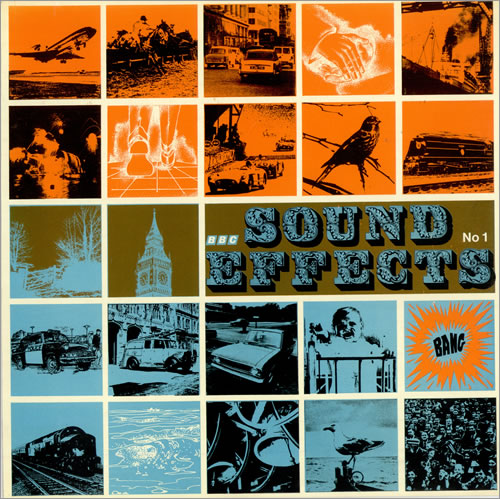
Rosemary Davis (b.1926) was the BBC person who did field recordings for use in BBC radio drama, later released from 1969 onwards as a series of LPs, ‘Sound Effects.’ Here’s the cover of the first (RED 47M); The Jam later paid tribute with the cover art for their Sound Affects (1980)
The track listings don’t look like the most promising material for a songwriter:
But, with some selectivity and splicing together of different elements, it becomes an evocative collection of phrases. (You can do the Googling yourself, but it seems that Pat takes phrases from several of the Sound Effects LPs). There were hints of this method on ‘Harlan’ from Condition Blue, which incorporates the titles of several of Harlan Ellison’s stories, but here it’s done much more rigorously.
Stylistically, the music draws on the psychedelic drones and analogue echoes of the Spacemen 3: Pat had been a big supporter of the band from its early days, and Sonic Boom has contributed to several Jazz Butcher albums. One might take the implication to be that being lost in Rosemary Davis’s world of sound is some kind of trip, but Pat’s own account of the appeal of the field recordings is that today ‘these sounds, assiduously recorded in the early sixties, seem to come from another world.’*
Chris F., who introduced me to the Jazz Butcher’s music when I was at sixth-form college, also introduced another friend, Pete Crouch. Around this time Pete was primarily into Mark Knopfler and J. J. Cale, and Max Eider’s guitar work grabbed his attention very quickly. For a brief while he had a covers band, called with seeming arbitrariness Peter’s Walnut Whirls, and they did a set of cover versions that was half Dire Straits, half Jazz Butcher, with ‘Roadrunner’ thrown in. Pete went off to University somewhere to do American Studies, but continued to follow the Jazz Butcher around. This led to Pete doing some guitar and a guest solo on Pat’s 1991 album, Condition Blue, and becoming the main guitarist on the tour that followed (documented in soggy low-fidelity awfulness on the live album Western Family — something went wrong with the master tapes), and on the next studio album, Waiting for the Love Bus.
Condition Blue is one of the great Jazz Butcher albums,though it divides fans: those that like the more whimsical and gentler side of Pat’s writing aren’t so fond. It came out of the breakdown of Pat’s marriage and apparently some kind of breakdown. The lyrics are generally more abstract and oblique than usual; witty, but with less of an obvious point to make. The music is louder, and more exuberant, and several of the songs have extended play outs where it’s clear that every one is having a lot of fun. If I’d allowed myself more songs for this blog I’d certainly want to be writing about the tribute to Harlan Ellison (and crazy people who stand at junctions shouting at the traffic), ‘Harlan’; ‘Honey’, ‘Shirley Maclaine’, and ‘Racheland’. And the track ‘Vodka Girls’ belongs to this session.
‘Girls Say Yes’, along with ‘Still and All’, is one of the gentler tunes.
From the very beginning, the sound is rich and seductive: from the female ‘has’ (presumably courtesy of Sumishta Brahm), and in the rich chorus of vocals around ‘don’t try, don’t try’. Pete’s guitar solo bears the fruit of those years listening to Knopfler and Eider. There’s a pair of triplets somewhere in the middle of it that are straight out of Knopfler (at about 2:55), but the great thing about this solo is that it doesn’t sound like an alien imposition, or an imitation; it has its own identity, and it belongs perfectly to the song; it lifts the song in just the right way, and doesn’t feel like it’s in competition.
Whoever thought of this cue was probably anticipating songs that evoke magnificent scenerylike beaches at sunset, and they reckoned without my painfully literal imagination. (I once did a word-association test, as a preliminary to being a subject in some other psychological experiment. They said ‘Doctor’. An image of a doctor in a white lab coat flashed into my mind’s eye; I hesitated, and responded with ‘Doctor.’)
‘Daycare Nation’ makes mention of Royal Oak Station, in west central London. I can’t listen to it without thinking of Royal Oak Station, though beyond that, it also evokes the backs of houses that you see from the train as it slows down coming into Paddington. It’s another song from Cult of the Basement, but as there’s no YouTube version of the album recording, here’s Pat performing it at the 12-Bar in 2007:
On the album it fades in over the noise of underground trains; the bass line comes in with the mechanical simplicity of a musical box or a nursery rhyme, and the saxophone breathes gently and seductively. It’s a night-time song. We’re potentially in classic singer-songwriter territory (bedsits, eccentrics, and a patronising display of pity), but ‘Daycare Nation’ is impersonal and non-narrative, and that takes it somewhere different.
You’re living in your own home
You’re living in your own world
You’re living in a waking dream
You’re living in the best of all possible worlds
The smell of contagion
In the hall of your apartment
And a soft little scratching
On the wall of the room next to yours
The way the second stanza undercuts the first is brilliant; there’s nothing in the music to signal the difference. The ‘soft little scratching’ lands perfectly between being specific and leaving us to imagine what might be living next door, or in the wall cavity. The thousands of ‘Mr Odds’ cross references another song on the album, more upbeat and comical: when there was just one Mr Odd he might be a figure of fun (though also of pathos); when multiplied, the pathos comes to the fore.
They’re not real
They’re there by accident
They’re not real
It’s just an accident of birth
The closing lines are the most troubling: the song has made it quite clear that they are real, living in a specific place and time; these lines register either what the government would have you believe (this was the era of ‘care in the community’), or they register the appalled response of someone who can’t quite take in the magnitude of it. What’s great about this song is the way that it records direct acquaintance with dilapidated bedsit-land (smells, sounds) and at the same time the perspective from far off, the perspective of the intercity commuter coming into Paddington and wondering about all the lives going on behind all those windows.
By the time of recording the third Creation Records album, Cult of the Basement, in January 1990, the Jazz Butcher Conspiracy line-up had reached a degree of stability. The rhythm section of Paul Mulreany and Laurence O’Keefe had been in the band for two years, and although Kizzy O’Callaghan had retired from touring due to ill-health, I had the impression seeing the band, and even listening to the recordings, that they understood each other as musicians. Cult of the Basement is one of the great Jazz Butcher albums. It makes a virtue of its musical diversity with odd short tracks (The Basement, Fertiliser, After the Great Euphrates) and samples. Only one of the songs (‘My Zeppelin’) seems throwaway, its comedy country-and-western stylings a glance back at the Glass-era band.
Whether having a stable band is a prerequisite for creating a great groove only musicians can say; perhaps complete strangers could have done it.
It’s not really a reggae bass-line, but it has a reggae feel to it, and the song is reggae-like in that everything coheres around the bass. I especially like the way it starts with an unpromising stop-start drum beat, and then everything suddenly springs into life. The guitar lines are wonderful too, but they’re leaves and flowers on the branches; the lyrics are minimal and relatively obscure, but the delivery is delicate and fits around everything else.




 Michael Whitworth