Category Archives: Music Blog

Murmur, by J. Niimi

 Murmur (2005), by J. Niimi
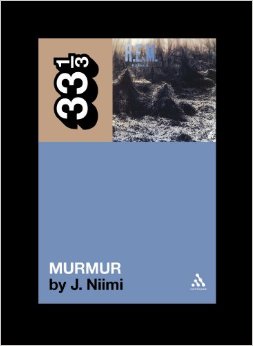
Niimi Murmur

Carefully researched and attentive to small, significant details, J. Niimi’s 33 1/3 book on R.E.M.’s Murmur is one of the best I’ve read so far in this series; and if the four parts of the book aren’t quite integrated, that’s because there are genuine difficulties in trying to account for (i) the history of the band and their cultural context, (ii) the recording of the album, (iii) the album artwork and what it tells us about the record, and (iv) the lyrics.

The jacket of the book tells us that Niimi has worked as a studio engineer, producer, and engineer, and his LinkedIn page adds some detail, saying that he is drummer, songwriter, multi-instrumentalist, engineer, producer, etc., for Ashtray Boy.  I’m sorry to admit I’ve never heard of this band and their nine albums, but it’s clear that Niimi knows whereof he speaks.  The second chapter, the song-by-song analysis, is particularly impressive for its knowledge of recording techniques; in writing it Niimi has had the benefit of interviewing producer Mitch Easter.  So we find out, for example, that the acoustic guitar in ‘Laughing’ was achieved by having Peter Buck, Mitch Easter and Don Dixon all playing a guitar into a single mike, then recording another track with the tape speed tweaked minutely.  Or we learn that Bill Berry produced a particular pssh-pssh sound using some old oak flooring run through an over-modulated compressor. Niimi assumes that his readership is happy with some talk of ‘resolution back to the tonic chord’ and that sort of basic musicological vocabulary.

If there’s a concomitant problem in this chapter its that Niimi hasn’t at this point presented a strong thesis about the album, and so there’s a danger that we can’t see the wood for the trees, the oak flooring, and the Rotosound drum heads.  In this chapter of the book Niimi doesn’t aim to evoke the experience of listening to the album: I listened to it a lot at one time, but haven’t given it a spin for ten years or so; I found as he talked me through the tracks that I could recall some of the details, but less than was the case elsewhere in the book when he did allow himself a more impressionistic and evocative language.

Niimi begins the book with a narrative account of the coming-together of the band, their early gigs, and their recording of the Chronic Town EP: there’s a particular concentration on different recording studios and what they were able to offer, but not at the high magnification of the second chapter.

After the track-by-track analysis, the third chapter pulls back, considering in some detail the album’s cover image of the invasive plant kudzu.  There’s some (to my mind) digressive material (pp.55-61) on the cassette tape as a medium for the distribution of music (a wholly inadequate one when it comes to cover art), but kudzu takes Niimi to some interesting places: it opens up the question of the ‘southernness’ (in the American sense) of the album, and how far we can understand Murmur as ‘Gothic’.  There’s also a really interesting section (pp.74-8) on the phenomenology of reverb and the imaginary sound spaces that studios can produce, and a citation of an intriguing-sounding essay, David Rothenberg’s ‘The Phenomenology of Reverb’.  (Sadly the book has no Works Cited, but it seems as if the essay in question was first published in 2001, and has only ever existed on the internet; the version I’ve found post-dates Niimi’s book.)  Niimi’s technical knowledge comes into play here, but there’s a larger thesis at work, which instantly recalled the non-naturalistic spaces of Murmur and their unsettling effect on the listener.

The final chapter, on lyrics and interpretation, offers what might be the book’s standout contribution (if we were assessing it on scholarly grounds), in that Niimi identifies and summarises an essay that Stipe had read while a student, Walker Percy’s ‘Metaphor as Mistake’, The Sewanee Review, 66, no. 1 (Winter, 1958).  Unfortunately for anyone working in English Lit, the essay as summarised doesn’t say anything very distinctive: in short, there is a shaky if not arbitrary relation between signifier and signified, and this means that the reader will always be required to bring something to interpretation.  While this might have been a brave thing for Percy to write in the context of the New Criticism and the ‘affective fallacy’, by the era of post-structuralism, it was a familiar theme.  (I should, I admit, go and read Percy’s essay for myself.)

The chapter gets much better when it examines the lyrics themselves.  In particular, it makes some illuminating observations about the absence of the first-person singular and, in other ways, the impersonality of Stipe’s lyrics.  There’s an illuminating contrast with Gary Numan’s characteristic pose of impersonality and alienation — a dramatisation of alienation, or a thematisation of it — against Stipe’s more genuinely peculiar approach: ‘On Murmur there are words and there is singing, but there is no singer’ (p.100). This is insightful stuff, and I’m only sorry that by this point, Stipe and the words have become the almost exclusive focus: I’d have like the book more if Niimi had found a structure that enabled him to talk about the music and the singing and the words at the same time.  Perhaps longer track-by-track analyses might have allowed for a more holistic approach, though this difficulty with that form would have been that most of the main issues would have to be dispatched in the analysis of the first track, leaving the later analyses looking thin, or artificially looking for difference where none really exists.
Thirty-one songs: Pat Fish (The Jazz Butcher)

In July I set myself a challenge of writing a short post every day about songs by Pat Fish, who has mostly recorded as The Jazz Butcher / The Jazz Butcher Conspiracy, but who has also recorded with the bands Wilson and Sumosonic, and contributed to records by the Spacemen 3 and The Blue Aeroplanes. Like the #bookadayUK writing I’d been doing in June, it was a way of trying out an approach that’s different from the scholarly writing that I do as a lecturer: freer, more impressionistic, more autobiographical, and more evaluative, though hopefully still imbued with a desire to get the facts right.  It was also a way of finding out how to write about popular music.  And it was an excuse to listen to some great music.

With the exception of the first and last,  the posts are arranged chronologically by the date of release of the song, so this sequence also forms a kind of fragmentary history of the band to date.

1: The first song I ever heard by them: ‘Southern Mark Smith’

2: Best guitar solo: ‘Partytime’

3: A song that makes you laugh out loud: ‘Bigfoot Motel’

4: Best cover version: ‘Roadrunner’

5: Sang the wrong lyrics: ‘Girlfriend’

6: A song about the weather: ‘Rain’

7: A song with a day of the week in the title: ‘Big Saturday’

8: A song that reminds you of a certain event: ‘What’s the Matter, Boy?’

9: Title alludes to a film: ‘The Human Jungle’

10: Makes you feel like you’re in a film: ‘City of Night’

11: A political song: ‘Olof Palme’

12: A song that should have been a hit: ‘Angels’

13: One you want to listen to in the car: ‘Next Move Sideways’

14: A song with a number in the title
: ‘Looking for Lot 49’

15: Best closer on an album: ‘Keeping the Curtains Closed’

16: Song you liked at first but liked less over time: ‘New Invention’

17: A song about travelling: ‘Hysteria’

18: Best bassline: ‘Pineapple Tuesday’

19: Reminds you of somewhere: ‘Daycare Nation’

20: Song you used to put on a mixtape: ‘Girls Say Yes’

21: Favourite song from least favourite album: ‘Rosemary Davies World of Sound’

22: Best Guest Appearance: ‘Whatever Happened to Our Golden Birds’

23: Best Intro: ‘Lulu’s Nightmare’

24: Best ending: ‘When Eno Sings’

25: A song about music: ‘Scarlett’

26: A song about other worlds: ‘Come, Friendly Spacemen’

27: A song you disliked at first (but came to like): ‘Old Snakey’

28: Song about death: ‘Sleepwalking’

29: Reminds you of a great night out: ‘Quality People’

30: A song with a name in the title: ‘Shakey’

31: If I could choose just one: ‘Sister Death’

Some of the cues I took from the ‘Thirty Day Song Challenge’ and a later similar one; others I invented for myself.  Thanks too to Paul and Rachel for their suggestions; to David Whittemore, whose Jazz Butcher website was an invaluable resource for fact-checking; and to Pat, who stumbled across the blog and kindly expressed his appreciation.

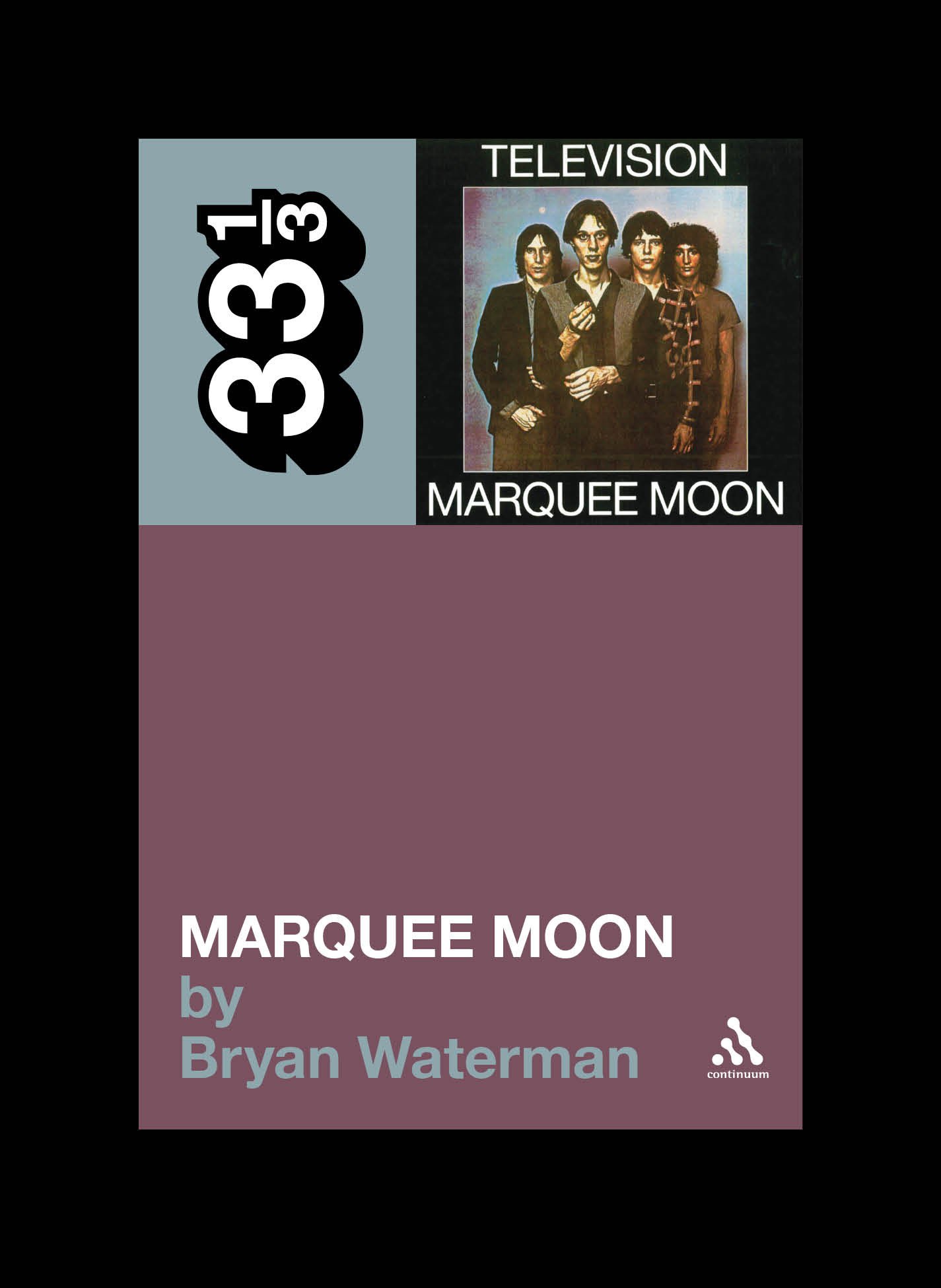
Marquee Moon, by Bryan Waterman

Waterman MarqueeMoon

I’ve enjoyed reading Bryan Waterman’s Marquee Moon (2011), his account of Television’s 1977 debut album, but it doesn’t have the qualities of the best in the 33 1/3 series.  Waterman’s prose is sharp and to the point, and his scepticism about the band’s creation myth absolutely necessary in relation to an era and a musical movement where the modernist tropes of a break with the past were being recycled. What I’m not so sure about it is the amount of detail he goes into in relation to the early 70s New York music scene, and the networks that Tom Verlaine and Richard Hell worked their way into.  His knowledge of the different sub-scenes is admirable, as is his tracking of venues, musical styles and fashion statements, and he presents this information with admirable clarity, never allowing the detail to obscure the basic narrative of the band’s emergence.  But for all those virtues, I felt frustrated, waiting for a discussion of the music itself to come along.  It takes until p.156 (in a book with pp.211 of text) for the band to enter the studio to record Marquee Moon, and the track-by-track analysis doesn’t begin until p.163.  What we get is insightful, but only rarely do Waterman’s insights into the music and lyrics themselves seem to justify the detailed contextualisation that has come in the first five chapters.  What I wanted more of were moments like the one where Waterman finds a trace of New-York-Dolls-style campiness in the chorus to ‘See No Evil’, or when in relation to ‘Venus’ he notes the New York trend of name-dropping one’s contemporaries.  Although Waterman is alive to the ways the music and lyrics might reference other musicians and other genres, the range of  reference he finds in Marquee Moon suggests that the New-York-focused contexualization might have been too narrow: it’s not all the Dolls and the Velvets and Patti Smith; instead there are references to the Robert Johnson, The Yardbirds, and Richard Thompson.

Perhaps I’m being too harsh.  I’ve greatly enjoyed finding out about CBGBs and the New York scene in the early and the mid 1970s; if Waterman were to write another 33 1/3 book I would — depending on the subject — be interested to read it; but the book is a reminder of the gulf that separates contextual knowledge and formal analysis, and the difficulty of making the two connect.

#31songs: 31: If I could choose just one

The Jazz Butcher — a desert-island disc

At the outset of this project I was grateful to Dr H. when she pointed out that there were 31 days in July, not 30, and that I might use one of them for the Desert Island Disc option; but now I’ve got to the end it’s proving tricky.  There are certainly other songs that I’d like to write about. Thinking about the relation of Pat’s songs to 1960s soul music has been interesting; and recalling that he did a cover of ‘Stand By Me’ at the first Jazz Butcher gig I went to, in March 1987, has made me hear ‘Swell’ (from Fishcotheque, recorded later that year) quite differently.  But ‘Swell’, lovely though it is, wouldn’t be my desert island disc.  As soon as I’d started blogging this series, Dr D. of London mentioned ‘She’s On Drugs’, and I instantly regretted not keeping the cue ‘Song about drugs’.  I also wish I’d had the categories ‘A Song about Eccentrics / Eccentricity’ (that would be ‘Mr Odd’ sorted), ‘A Song about a Town’ (that would be ‘Chickentown’), ‘A Song about Separation’ (several, including ‘Swell’ and ‘Racheland’), ‘A Song about Animals’ (many, many songs, from ‘Girls Who Keep Goldfish’ on the first album down to ‘Animals’ on the most recent).  I worried, starting this project, that I might find myself coming to dislike aspects of Pat’s songwriting when forced to describe them, but I’ve actually developed renewed respect for the sharpness of his ironies and their awareness of limits, and for the performances by all the players, including Pat’s vocal performances.  I’ve also realised that even an allowance as generous as 31 songs doesn’t do justice to his output.

In any case, the idea of being trapped on a desert island with just one song to listen to is terrifying, and reminds me of a story from the days when cars first had auto-reverse tape players: someone crashed his car while listening to Wham!, and found himself trapped in it for hours, upside down, with the first Wham! album on auto-repeat; ‘It was terrible’, he said, somewhat ambiguously, ‘I thought I was going to die.’

But, if I were selecting just one song from the ones I’ve already written about, I suppose I would opt for ‘Pineapple Tuesday’, in that months on a desert island would allow me to devise a strange dance to go with it; or ‘Girls Say Yes’ for the guitar solo alone; or ‘When Eno Sings’ because it would lead to the image of Brian Eno in his tiny craft coming to the rescue, or because it would lift my spirits.  Or alternatively, with the Wham! anecdote in mind, I could choose this one, which must be one of the few indie-rock songs to take its inspiration from the dying words of a saint:


#31songs: 30: A song with a name in the title

The Jazz Butcher: Shakey

It seems amazing to me that twelve years elapsed between Rotten Soul and Last of the Gentleman Adventurers, the crowd-funded album that Pat and Max put out in 2012, but it’s true.  The interim saw live action from Wilson, of course, and a couple of compilations, Cake City (2001) and The Jazz Butcher’s Free Lunch (2003), and also Pat continued gigging fairly frequently,  often solo, sometimes with pre-recorded backing tracks, in Northampton, Oxford, and London.  He had been performing some of the songs on Gentleman Adventurers since around 2005 (‘Shame About You’ and ‘Shakey’), so it was clear that he hadn’t gone away.

While parts of Rotten Soul (‘Mister Siberia’ and ‘Tough Priest’ especially) had sounded like Wilson tunes, Gentleman Adventurers forges a more coherent sound, outlook, and aesthetic, while being as musically wide ranging as any previous Jazz Butcher album.  It’s an album full of contempt for a risk-averse culture; as the sepia tinted cover might suggest, it’s an album of tobacco stains and wine stains.  I hesitate to say ‘maturity’, because that word has come to suggest a kind of easy-listening a-dolt-orientated-rawk; perhaps it’s better to say this is the Jazz Butcher’s ‘late style.’  The sound is fittingly acoustic, but avoids the clichés of the ‘unplugged’ era, and allows effects and electric guitars their place.

‘Shakey’ doesn’t, strictly speaking, have someone’s name in the title, but for my purposes today, nicknames are allowable:

‘Shakey’ takes Brian Wilson as its emblem of a life lived to the full, or indeed to overflowing, but it begins with a glance at Neil Young’s ‘Helpless’: ‘There is a town in north Ontario’ is a direct lift, and the chords are similar. I’m not sure quite how much we’re supposed to bring Young’s song into play; for me the reference to north Ontario links into ‘You wouldn’t last an hour out there’, to suggest a brutally cold world as the frame for everything else that happens. That’s not how Young’s song sees the town, which is an idyllic place he returns to in memory and imagination. Is ‘Shakey’ stripping the romantic gloss from Young’s song, and finding an altogether more brutal and degraded world: ‘a father battering on his son’, and chopping out his Class As on the kitchen floor.  What’s great about this lyric is the way it plays off our expectations about the magic things that Brian Wilson did musically against his distinctly un-magical and disorderly private life.  Do the magic things come at a cost?  A cost of being considered scum by someone?  A cost of personal loss.  ‘Walk away, you can’t afford it.’

#31songs: 29: Reminds you of a great night out

Wilson: Quality People

After the return to the Jazz Butcher that came with Glorious and Idiotic and Rotten Soul, Pat divided his time between solo performances (sometimes accompanied by a range of musicians from Northampton), and a new project, in some ways a development of Sumosonic, called Wilson. Pat started with the idea of making music solo at home, but Wilson ended up being a six-piece band (and sometimes larger), with drummer, percussionist, bassist, two guitarists, and a vocalist.  Their sound was heavier and harder-hitting than Sumosonic, built around the rhythm and the bass and samples.  They made their live debut in March 2001, and played their final gig in August 2009, though there was a one-off reformation in 2012 for the launch of a DVD of the 2009 gig.  Here’s ‘Quality People’:

I saw them four times in 2006, a couple of times in Oxford, and a couple of times in Northampton. All of these gigs were special in different ways (one in Northampton was at the Balloon Festival, and the other was as the support act for the Woodentops in their first gig in 14 years. But the first and most memorable was very late at the Exeter Hall, way down the Cowley Road, on a ridiculously hot in June 2006: everyone’s shirts stuck to them; Stevie’s amp died the death; there was dancing, and a long walk home.

169517931_b04ad7ad59_m 169517973_85d7daf9a8_m 169518043_d9baf1f274_m

#31songs: 28: Song about death

The Jazz Butcher Conspiracy: Sleepwalking

Late in 1999, Pat and Max convened in Peter Crouch’s home studio in London to record an album of new material. Released the following year, Rotten Soul (Vinyl Japan, 2000) contains some of the best Jazz Butcher songs ever recorded, but the restrictive studio environment means they’re not always the best imaginable versions.  In particular, the drum machine, though expertly and subtly programmed, is still a drum machine, and lacks the variation in accent and timing that live drums would have allowed.  It works best on the songs where its appearance is minimal, and on those (like ‘Mister Siberia’ and ‘Tough Priest’) conceived as glacial and impersonal; it also works pretty well on ‘Come On, Marie’, a song where  it becomes more obvious than ever how much Pat has learned from Motown, and where a fairly  strict, mechanical rhythm is entirely suitable.  It’s least good on ‘Niagara’, a great song, but one that needs a more live feel.

‘Sleepwalking’ is apparently a song that Pat had written some years previously: his notebook from around the time of Illuminate mentions it, with a big note saying ‘Rejected for the third album running’; so it may date back to 1991 and Condition Blue.  That it’s a song about death, and about someone dying slowly and painfully, is only an interpretation — it may be a song about deep depression, or being trapped in a relationship and not having the strength to let go — and I guess my seeing it this way is influenced by the same album having Max Eider’s song ‘Diamorphine’ on it. (And if that’s not a song about palliative care, I don’t know what is.)

Musically it starts in an understated way: a drum pattern, a rhythm guitar, a bass guitar, the vocals, and Pat Beirne’s harmonica embellishments; but it builds slowly and unostentatiously; there’s a continual building up of pressure which the guitar solo only partly releases.  In the choruses the ‘on and on and on and on’ builds it, while the ‘sleepwalking’ releases it; Pat’s vocals are nuanced in tone, especially in the choruses.  This could be, reading the lyrics, a terribly bleak song, but it’s given warmth and humanity by the vocals, the harmonica, and Max’s guitar parts (when they come in, from 1.20 onwards). It doesn’t build to the volume or the levels of distortion that some of the songs on Condition Blue did, but the feeling of restraint throughout makes it all the more powerful.


#31songs: 27: A song you disliked at first (but came to like)

The Jazz Butcher Conspiracy: Old Snakey

‘Disliked’ is probably too strong for it, but ‘Old Snakey’ on Illuminate wasn’t one of my favourite tracks when the album came out.  It has a kind of B-movie narrative scenario of an Egyptologist haunted by the spirit inside a purloined statuette, and probably by the spirits inside his liver, and while it’s not as conspicuously as comedy song as some of the early Jazz Butcher material, it’s one of the lighter-hearted pieces.  That would be fine, but in the chorus the vocal melody and everything else falls heavily on the beat (‘SOME-thing THAT old SNA-key FOUND a THOU-sand YEARS a-GO…’) in a way that seems intended to accentuate the comedy. Madness used to do this sometimes when they weren’t doing up-beat ska numbers, and it wasn’t funny then.

In February 1999, after Sumosonic had called it a day, Pat and Max were joined by Owen Jones on drums and Pat Beirne on harmonica for a gig in Hamburg with a laid-back, acoustic feel to it.  A recording came out in January 2000, Glorious and Idiotic, and it’s well worth a listen.  It’s heavily weighted towards the pre-1986 Jazz Butcher material, but the version of ‘Old Snakey’ fits in very nicely; in this version it’s light and it’s spacious and suddenly it makes sense — musical sense, that is, not lyrical.

There’s no version on YouTube at present, but if one turns up I’ll update the blog.

JBC_glorious_front

#31songs: 26: A song about other worlds

Sumosonic: Come, Friendly Spacemen

By the time of Illuminate, it was no secret that Pat Fish wanted to leave behind the ‘Jazz Butcher’ name: invented for a one-off joke gig, it had always seemed misleading, and even for listeners who had got used to the idea of there being no ‘jazz’ content in the music, it had become associated with guitar-based indie music.  The Black Eg side-project, which had put out an album in 1991, gave a hint as to where Pat wanted to go, though it was released to so little fanfare that it was years before I heard about it, and even longer before I heard it.  Keyboards; drum machines; samples.    21 December 1995 saw a gig billed as The Last Jazz Butcher Gig Ever, though soon afterwards, to some embarrassment, the band found that their agent had booked them for a summer festival in 1996.

What came after the Jazz Butcher was for a while to have been called Audio Aquatic, but eventually saw the light of day as Sumosonic.  Their debut single was ‘Come, Friendly Spacemen’, released by Creation (CRESCD 242 on 5 December 1996. Here’s a demo version:

Sumosonic_ComeFriendly

Shortly before this came out, NASA had been asking — no doubt pleading for their continuing relevance —  how earthlings could communicate their benign intentions to approaching alien lifeforms, and I think the lyric glances at this, as well as being a wry observation on the loved-up atmosphere of the ecstasy era, and a gentle complaint about the greedy, degraded state of the world.  It’s insanely catchy, the lyrics are sharp, and there’s some beautiful detail, especially the melodic guitar line towards the end, over the lyrics ‘And if the world’s all broken down / Watch the skies above your town.’

It was a surprisingly long time — just over a year — before the debut album came out in January 1998.  It too has some unmissable Pat Fish gems: ‘Cat’s Life’, ‘God’s Green Earth’, ‘Sputnik’ (a successor, in a way, to ‘Land’ on Illuminate), and ‘Fern, Schnell, Gut.’ But Creation didn’t get behind it — as the late release suggests — and they dropped Sumosonic a few months later. They continued gigging through 1998, but if the lists at sumosonic.com are to be trusted, they called it a day in September 1998.

#31songs: 25: A song about music

The Jazz Butcher Conspiracy: Scarlett

I thought it would be easy to find a self-reflexive song in the Jazz Butcher corpus, but it hasn’t been.  In the early songs there’s a lot of self-referencing (most explicitly in ‘The Jazz Butcher Meets Count Dracula’ and ‘JB vs. PM’), and calling out names of the band members (‘me and Max and Dave and Jones …’); in ‘Conspiracy’ there’s a self-mocking account of their willingness to engage with the Big Questions, like the Egg-Potato Phenomenon; but whereas in most twentieth-century poets’ volumes you’d find the poem about poetry, I can’t think of a song about songwriting. ‘Scarlett’, from the Illuminate album, qualifies by virtue of a brilliant moment when the camera pulls back, so to speak, and we see the band in the act of recording the song.  What had been, in the first chorus, ‘We put all our faith in constructs’, and ‘We put all our faith in strangers’ in the second becomes, in the third, ‘We put all our faith in magnetic tape.’

But never mind if it doesn’t really fit the criteria: there’s a lot else to like here. (And there’s not a version of it on YouTube at the moment, so you’ll have to take my word for it.)  At the start there’s a lovely contrast between the coarse sound and boxy echo of the rhythm guitar and the liquid drops of melody from the other guitar; the rhythm section aren’t obtrusive in this song, but they give it a subtle groove. And Pat’s vocal performance is a good one: I like the hint of a stoned Bob Dylan in the phrase ‘And a silver haze descends’ and even (is it?) the hint of Elvis in ‘Don’t you wanna come down’?  There’s a rich, warm, reassuring sound to the song, as befits a song about reassuring someone who’s lost their self-confidence; but the reassurance never becomes cloying or saccharine, as befits a song that reminds us that we put our faith in insubstantial and impermanent things.