Author Archives: michaelwhitworth

#31Songs (4): 20th Century Composites, by Art Objects

#31Songs (4): A Song About Music

20th Century Composites, by Art Objects, from Bagpipe Music (1981)

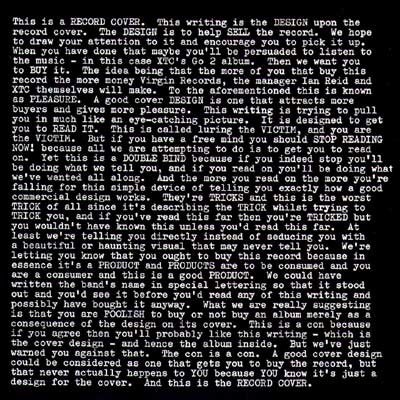
In late 1970s and early 80s New Wave there’s a distinct and distinctive strand of self-conscious deconstruction of the conventions of pop and rock, usually done in a comical spirit. Hipgnosis’s cover for XTC’s Go 2 (1978) was one of the most conspicuous demonstrations:

XTC_Go_2

Wilson Neate’s 33 1/3 book on Wire’s Pink Flag (1977) sees Wire as implementing such critiques in their song writing: their song structures self-consciously dismantle conventional pop music structures; they lengthen or shorten introductions, and in other ways play with the frames.

Much later, on Harvester, the Blue Aeroplanes covered Wire’s ‘Outdoor Miner’, so that band were clearly on their radar, but what the Art Objects do in ’20th Century Composites’ is closer in spirit to XTC’s album cover: Art Objects no more abolish the catchy pop song than XTC get rid of the outer sleeve of their record; they continue in the tradition while drawing attention to its weaknesses and exhaustion.

https://play.spotify.com/track/5NZEbnuWkJDsLgbOUTU5oc

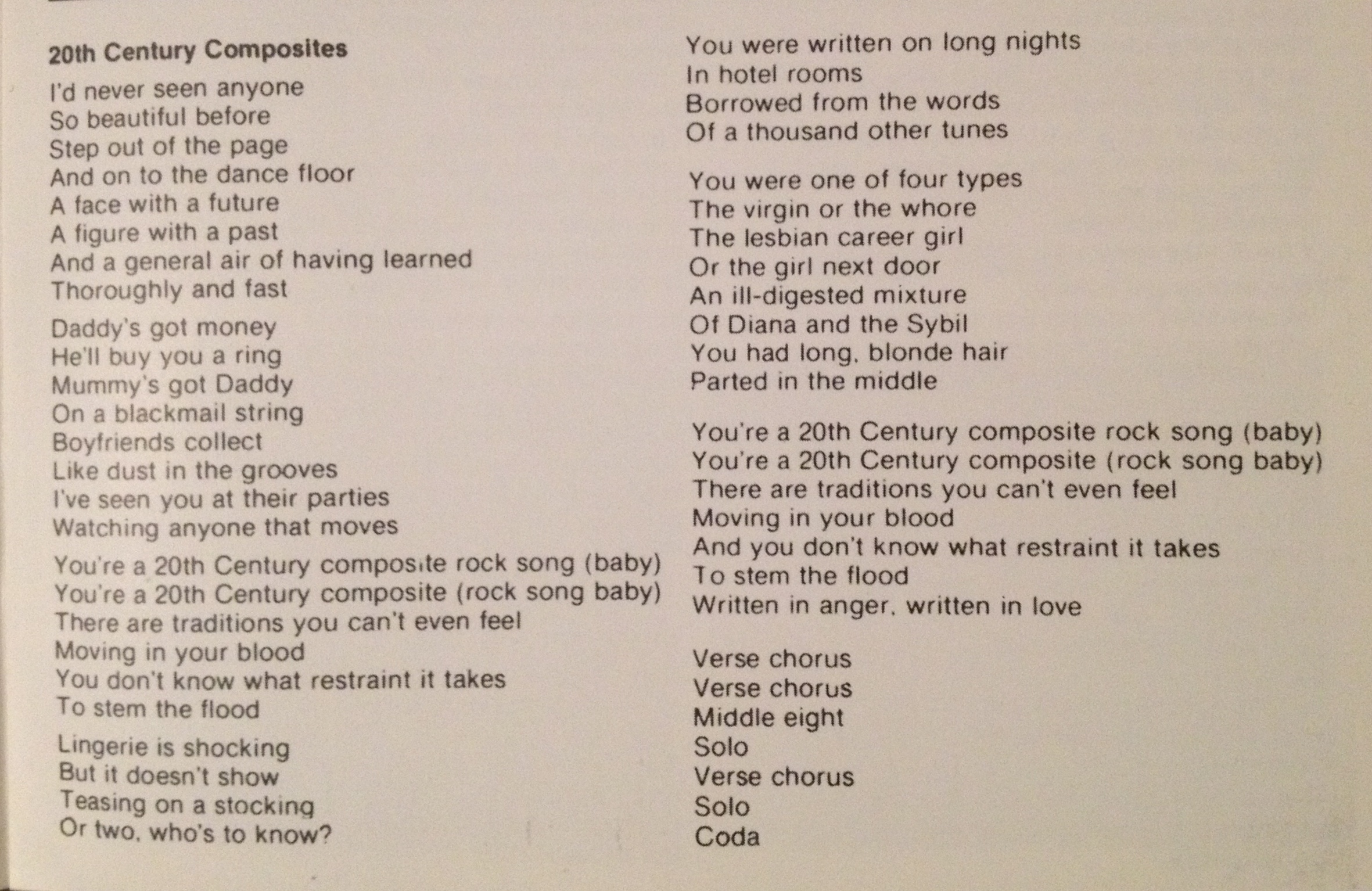
The acoustic guitar riff may have taken only seconds to compose, but it’s brilliant: it’s catchy, but  it derives from twelve-bar boogie; played on an electric and it could sit quite happily at the start of a Status Quo song.  But there, after the first few iterations, you’d expect the chord to shift up; Art Objects stick with the same two chords, like a stuck record, and at the end of the first verse there’s an sudden silence.  Then were back into the riff again for another verse, before the sound fills out slightly for the chorus, with a catchy but angular keyboard riff coming in.  The backing vocals in the chorus are a neat touch: ‘Ba-by’, sung with a slur between the two notes, and recorded with little or no reverb: compared to some of the band’s chorus additions, it’s minimal and it’s almost mechanical in its delivery. It’s more the evacuated sign of a chorus rather than the thing itself. The long drum roll after the second chorus (slightly phased) also feels like a deliberately performed cliche, though like all these things, one that lets the band have their cake and eat it.  The coup de grace comes with the lyrics on the play out: ‘Verse chorus / Verse chorus / Middle eight / Solo’: a standard rock-song structure that, in their more experimental pieces, Art Objects were working to go beyond, as were  The Blue Aeroplanes after them.

It’s hilarious and catchy. Where the lyric goes slightly wrong is more an ideological matter: it conflates the artificial and formally cliched art work with the artificial woman.  It might mean that it’s about the artificial depictions of women in cliched works of art (she has stepped ‘out of the page’), but it falls a bit too easily into a misogynist tradition of rejecting women for their artificiality.  (See Jonathan Swift, for example).  Particularly problematic is the denial of self-reflection in ‘There are traditions you can’t even feel / Moving in your blood’: the speaker sets himself up as the one who knows, the one who can pass judgement on the artificial construct.


LYRICS (from the liner notes)

photo 2

#31Songs (3): Batpoem, by Art Objects

#31Songs (3): Title Alludes to a Film

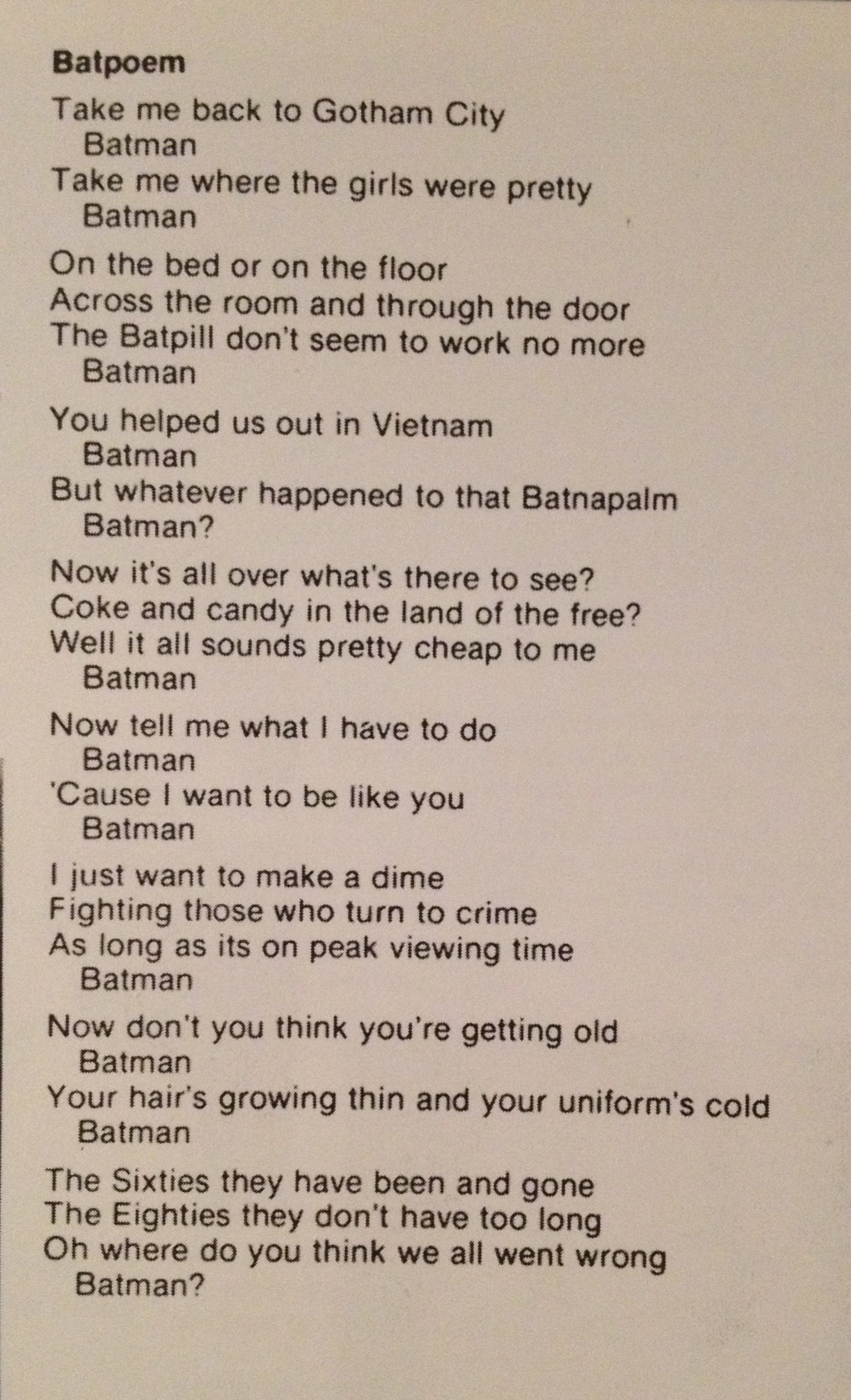
‘Batpoem’, by Art Objects, from Bagpipe Music (1981)

‘Batpoem’ doesn’t only allude to a film, but to the whole pop-cultural myth of the superhero.  Moreover, as the original liner notes indicate, it updates a number done by Adrian Henri as part of the The Liverpool Scene on their album The Amazing Adventures of the Liverpool Scene, which apparently appeared in 1968 or 1969 (sources differ).  Here’s the Liverpool Scene’s version on YouTube:

https://www.youtube.com/watch?v=gfYZANvhM48

I can’t find a YouTube version of the Art Objects song, but there is one on Spotify:

https://play.spotify.com/track/6EimmfA0LQi67VexNQflFh

Gerard Langley’s notes add: ‘That was the 60’s.  It’s the 80’s now and Batman’s in the White House’.  While Henri’s lyrics had been sarcastic about a culture hung-up on superhero interventions, Langley’s Reagan-era account turns the screw even tighter.

photo 1

I think Henri’s lyrics about ‘damsels in distress’ in various states of undress was a criticism of patriarchal attitudes and of the imaginary irresistible attractiveness produced by  ‘Batpill’ (or the fantasy of rape implied); Langley’s ‘The Batpill don’t seem to work no more’ doesn’t allow any space for thinking otherwise.

As a performance the Art Objects’ version exposes the Liverpool Scene one as a fairly pale and lame late-evening joke.  This is the punkiest and most savage performance I can think of from Art Objects or the Blue Aeroplanes: the drums are solid, the guitars fuzzy and crudely reverbed, and Gerard’s delivery is hoarse and vitriolic.


#31Songs (2): Hard Objects, by Art Objects

#31Songs (2): A Political Song

Hard Objects, by Art Objects

https://www.youtube.com/watch?v=KteB7M4GE7s

The origins of The Blue Aeroplanes lie in a band called Art Objects, and in the light of the many changes of personnel in the Aeroplanes, and the minimal difference between Art Objects and their successor, it makes sense to start here. Art Objects played their first gig at Aston Court festival in the summer of 1978, at which point they consisted of Gerard Langley on vocals, Wojtek Dmochowski as a dancer, and J. J. Key on guitar and other noises. (My account comes from a piece by Bill Stair, who joined the following year as a bassist.)  It’s clear that from the outset the band had no intention of being a standard rock unit, and though the following year they added a drummer, another guitarist, and the aforementioned bassist, their approach was experimental. That said, as is clear from one listen to ‘Hard Objects’, they were perfectly capable of writing catchy tunes.  ‘Hard Objects’ was recorded early in 1980 and released on newly formed Bristol label Fried Egg Records.

Many elements of the Aeroplanes’ sound are in place: Gerard doesn’t sing, and so the usual melodic focal point of popular song is denied us; but the backing vocals compensate by twisting a vocal melody around his declaimed lyrics; there are melodic elements in the guitars and in the bass, but there are also more experimental, guitar-derived shriekings and groanings.  The style of the ending anticipates the end of ‘And Stones’ from the Swagger album, with the climax of the music coinciding with the end of the lyrics; and the delay-pedal guitars also anticipate that song.

Lyrically, though, it’s much more direct and message-oriented than Gerard Langley’s other material: it’s a protest song, and one can imagine it working well in a scene of CND and other leftish gigs.  The opening line is pure blues, of course, but I like to think of it as being derived indirectly, via W. H. Auden’s blues-poems from the 1930s, of which ‘Funeral Blues’ is now by far the best known.  The delivery is punchy and direct. Something that I can’t quite put my finger on goes wrong in the conclusion (‘The nuclear bomb …’ onwards): I don’t think it’s so much that the lyrics spell things out too obviously and are a little overwrought, but rather that the sneering tone in the delivery is over-emphatic: the sneer is intended for those in power, for sure, but the implication is that we as listeners won’t get the point of the lyrics without it; and given that the lyrics are very direct at this point, that seems to be a failure of nerve or lack of faith in the audience.


LYRICS (my transcription)

I woke up this morning I walked to the wall (HARD OBJECTS)
The size of their guns did not worry me at all (HARD OBJECTS)
The beauty of the morning was a wound still ahead (HARD OBJECTS)
The gaunt stab of weapons and things better left unsaid.

Living in the shadow of — HARD OBJECTS
Carving at a road with — HARD OBJECTS
Another cut or two with — HARD OBJECTS

I was living at the heart of one room space
With a badly twisted body and infected face
The hole in the ribs had exposed a [? giant lung]
Oh what it is to me, young

I’m threatened day and night by — HARD OBJECTS
Suffering death by — HARD OBJECTS
Hung about and weighted with — HARD OBJECTS

Well the front page is full till the flags have been raised
A captive beast staggering bloody and crazed
It’s a myth, an old myth of cruelty that we shared
That you can die as you live or bring pressure to bear.

Without listening for the sound of — HARD OBJECTS
Looking for the prying of — HARD OBJECTS
The ticking and the clicking of — HARD OBJECTS
The whirring and the grinding of — HARD OBJECTS
The spokes and wheels and ratchets of — HARD OBJECTS
I hate the uses made of — HARD OBJECTS
The authority invested in — HARD OBJECTS
Beaten in the face by . . .

HARD OBJECTS

The nuclear bomb is a blunt instrument in the hands of disturbed children playing […] marbles.
The law is a blunt instrument for the use, as they so wish, of those in a position of authority.
The mass media is a blunt instrument in the hands of men whose sole desire it is to rob a bank.
The economy is a blunt instrument with which the politically wealthy can have the poor or subservient systematically beaten to ensure the minimum resistance.
Desire and affection are blunt instruments effectively employed by professional […] whose hands are permanently stained with hypocrisy and printer’s ink.
Education is a two-edged weapon which after a certain point those in power would like to keep for their exclusive use.
And the voice of protest and dissent is the only weapon possessed by the majority of victims and it’s lying unused at the feet of people too busy living and dying to bother to pick it up.

#31Songs (1): Tolerance, by The Blue Aeroplanes

In July I enjoyed writing a blog a day about The Jazz Butcher’s songs. This is the first in a series about The Blue Aeroplanes, using mostly the same cues, though I don’t think I can sustain the rate of a blog-per-day.  Like the Jazz Butcher series, after the first entry this will be arranged in approximately chronological order by the date the record was released.

#31Songs (1): The First One I Ever Heard

‘Tolerance’ by The Blue Aeroplanes

I first heard The Blue Aeroplanes on a cheap and cheerful compilation album I bought on vinyl around 1987 or 1988, the Beechwood Indie Top 20, vol.2.

indietop20_volume2

The song on the album was ‘Tolerance’: this exists in at least three versions, and I’m not sure from memory which the compilers used, though I think it’s the one found on The Blue Aeroplanes’ Tolerance LP or the one on their Friendloverplane compilation.  The Tolerance version begins with a melodic bass-line, and is sustained throughout by it, while the Friendloverplane version begins with delicate chiming guitars, and in the verses is altogether wispier than its Tolerance counterpart:

https://www.youtube.com/watch?v=eLoPuV2NLMI

There’s another later version with a more emphatic drum beat which turns up on the Warhol’s 15 compilation:

https://www.youtube.com/watch?v=Tbb2z6ICYvM

‘Tolerance’ really stood out on the Indie Top 20 compilation.  The Brilliant Corners’ ‘Brian Rix’ was funny but disposable; Michelle Shocked’s ‘If Love Was a Train’ had a bit more substance, and led me to her debut album (the proper debut rather than the Texas Campfire Tapes); but something about ‘Tolerance’ stayed with me: Gerard Langley’s spoken vocals; the contrasting, passionate, Johnny-Rottenish vocal on the chorus, which at the time I believed mistakenly to be Langley; the suggestion, within the dense and difficult lyric, that the singer was siding with the female protagonist (‘She should go out more and he should show some tolerance’); no vocal melody in the verses, of course, but all sorts of melodic suggestions in the guitars and in the bassline. All these were completely new to me.  It stayed with me, but for some reason — lack of information in those pre-internet days, combined with a limited record-buying budget? — I didn’t follow it up and buy anything more by them.

On 5 December 1990 I bought the Friendloverplane compilation at the Our Price in the Westgate in Oxford —  I tucked the receipt into the booklet, £11.99, and it’s still there — and learned that the chorus vocals were actually a guest appearance by Jedzrej Dmochowski, brother of Wojtek, the band’s dancer. I think by that stage I’d bought Swagger, which had come out in February 1990, and which I remember being heavily advertised on flyposters on hoardings outside Somerville.  ‘Tolerance’ still stood out on Friendloverplane, but the compilation also gave an indication of the sheer range of their output in their first seven years: they’d first performed as The Blue Aeroplanes in 1981 (or so it says on Wikipedia); the compilation had come out in 1988.  ‘Veils of Colour’ had some similar horn sounds, though more melancholy; ‘Severn Beach’ highlighted their skill at crafting a catchy chorus; ‘Etiquette’, had the same sceptical attitude as ‘Tolerance’ towards conventional gender relations, and a funkyish new wave feel to it; ‘Days of 49’ had Rodney Allen on vocals and showed off their folk side. There were samples, there was social protest, there were lyrics of baffling obliquity, there was a Bob Dylan cover.  But I’m getting ahead of myself.

‘Tolerance’ isn’t an easy lyric to understand: we have glimpses and fragments of a narrative scenario, some or all of it seen in recollection, a time (‘that time’) in the past that the speaker is trying to measure and come to terms with.  The splitting of the lyric between Gerard and Jedzrej adds a further interpretative problem: are we to understand this as some sort of duet, with Jedzrej replying to to Gerard’s lines, or is Jedzrej simply voicing a more passionate outburst on Gerard’s behalf?  It has more characters than most love songs: there’s a woman at the centre of it, there’s a first person who is presumably, like the singers, male; there’s a him; and there’s a ‘you’ of uncertain gender who ‘said she looked older’ (an insult, a compliment, or a neutral comparison?), who gave her shelter, who cried on her shoulder, and who got lost and found.  Heterosexual love-song convention would have ‘you’ be female, but it’s clear this is no conventional love song.

It could be a story of infidelities: that would be why she concealed him with her quick arms, and one way of thinking about the lamp being the mark of ‘something new’ is to picture it occurring late at night, the lovers suddenly illuminated by a streetlight, a new and unwelcome revelation.  (There’s a scene like that in Virginia Woolf’s Jacob’s Room, and this song is every bit as cubist as Woolf’s novel).  There’s a lot about light (punningly in ‘old flames’), and a line about wintry air: it’s a song of dark evenings and distrust.  It’s also a song with hints of regrets: ‘it was me / Who said you should go there / And she should come along’.  What were the consequences of the speaker’s saying ‘you’ should go there (where?) and her coming along?  Did the ‘you’ and ‘she’ start a relationship in consequence?

In so far as it’s reflecting on that past history, it also asks what keeps people together: the need for shelter?  something as abstract as ‘her intent’?  And it asks at what point that becomes oppressively controlling: she should go out more? He should show more tolerance, the lyric says, though tolerance itself is still a controlling attitude.

And is it also weighing up relationships alongside the other things people fill their time with? Painting and art for example?  Pass-times and ambitions?  Are the ‘absentee notes’ lovers’ apologies, sardonically spoken of as it they were letters to one’s manager?  And is the ‘X’ a signing-off kiss, or the manager’s dismissive cross?

‘And here we are again’, says Gerard with more than his usual weariness before the final chorus,  and this seems both an admission that such situations repeat themselves (‘how we repeat these patterns’, as he says in another, later, song), but also a wry gesture towards the form of popular song in verses and choruses. An earlier song, ’20th Century Composites’, by an earlier incarnation of the band, Art Objects, had ended with the band singing ‘Verse chorus / Verse chorus / Middle eight / Solo’, so they have form in this regard.  One of the oddities of ‘Tolerance’ is that the opening line seems to cast the events into a remembered past, but the present tense of other lines suggests that the situation is present: past and present can’t be kept so easily apart.  The narrator would like ‘that time’ to be in the past, but like a chorus it keeps on coming round again. And these kinds of puzzle in the lyrics keep me coming back to it.


LYRICS

(Adapted from what I found at lyrics.wikia.com. I hear ‘flames’ where they have ‘flings’, and ‘pubs’ where they have ‘poems’.)

You could measure the effects of that time in light
A lamp could be the mark of something new
There were plants and frames and paintings invisible structure
She did conceal him with her quick arms
And her intent was the only thing that kept him there

And it was you
Who said she looked older
While it was me
Who stood by the door
But it was you
Who gave her the shelter
That she looked to him for

A worthwhile pass-time but a sad ambition
Absentee notes in the next room with X
She should go out more and he should show some tolerance
Ah, big ridicule such little thing
Such grip on everything we have

On everything we have

And it was you
Who cried on her shoulder
And it was you
Who got lost and found
And it was me
Who said you should go there
And she should come along

Our coat tails drag marks
Old flames don’t hold a candle
When the lights go out
at that civilised time

What do we have?
More pubs
The emptier the better
And events in the future
Like a state of undress

Through that wintry air
Kiss news down the line
And here we are again

And it was you
Who cried on her shoulder
And it was you
Who got lost and found
And it was me
Who said you should go there
But it was you who gave her the shelter

Love of ruins: Detroit and Ohio

When I first saw photos from The Ruins of Detroit (2010),  by Yves Marchand and Romain Meffre, I was amazed and shocked. How can such magnificent buildings and the entire social structure that sustained them and depended on them collapse into ruin in such a short space of time?  They seem to be photos mesmerised by the volatility of capitalism, its ability to build up cities in a short space of time and the abandon them to the elements just as quickly.  Their mesmerisation by the spectacle of decay means they don’t, as photos, allow much space for human activity, or human despair or optimism, though I imagine that there’s a great deal of those things, and more, going on just beyond the frame.

Today The Guardian has a brief photo feature concerning ruined houses in Ohio, which I guess will be a glossy magazine feature on Saturday. These are a different kind of building from the Detroit ones — domestic spaces rather than public ones — but as images they’re very similar.  And that’s where it becomes a bit troubling: it feels as if a distinct genre has emerged, and the genre is becoming codified in terms of choice of subjects and the kind of lighting that is appropriate. Moreover, judging by the captions to the Ohio photos, its codified in terms of the kind of emotional response that’s anticipated. In between the Detroit photos and the Ohio ones I’ve also seen photos of abandoned hospitals and asylums, and Seph Lawless’s photos of abandoned shopping malls. The Ohio ones, being domestic, inevitably push us a little more towards thinking about the people who once lived in these places, but the basic feelings of sublime wonder about the prospect of an entire civilisation sinking into the ground are still the same. Let’s call it the Ozymandias-emotion: ‘Look on my works, ye mighty, and despair.’

What I found particularly frustrating about the Ohio photos was that there was no explanation of why these houses were abandoned.  At least in the case of Detroit there’s a partial explanation in terms of the decline of employment in its car factories (though one can still ask why those factories and not those in other cities), but in the case of Ohio the feature didn’t offer any clues. That leaves us to think that it’s somehow a natural process, like the forces of nature laying waste the Ramsays’ home in Woolf’s To the Lighthouse (1927), but in the case of entire communities, I think we deserve a better answer.

I’m dimly aware that there’s a growing critical discourse surrounding modernity and ruin, and the kind of ideological games that we play on ourselves when admiring the spectacle of a collapsing railway station, opera house, or country mansion, and that there’s much more to be said.

Murmur, by J. Niimi

 Murmur (2005), by J. Niimi

Niimi Murmur

Carefully researched and attentive to small, significant details, J. Niimi’s 33 1/3 book on R.E.M.’s Murmur is one of the best I’ve read so far in this series; and if the four parts of the book aren’t quite integrated, that’s because there are genuine difficulties in trying to account for (i) the history of the band and their cultural context, (ii) the recording of the album, (iii) the album artwork and what it tells us about the record, and (iv) the lyrics.

The jacket of the book tells us that Niimi has worked as a studio engineer, producer, and engineer, and his LinkedIn page adds some detail, saying that he is drummer, songwriter, multi-instrumentalist, engineer, producer, etc., for Ashtray Boy.  I’m sorry to admit I’ve never heard of this band and their nine albums, but it’s clear that Niimi knows whereof he speaks.  The second chapter, the song-by-song analysis, is particularly impressive for its knowledge of recording techniques; in writing it Niimi has had the benefit of interviewing producer Mitch Easter.  So we find out, for example, that the acoustic guitar in ‘Laughing’ was achieved by having Peter Buck, Mitch Easter and Don Dixon all playing a guitar into a single mike, then recording another track with the tape speed tweaked minutely.  Or we learn that Bill Berry produced a particular pssh-pssh sound using some old oak flooring run through an over-modulated compressor. Niimi assumes that his readership is happy with some talk of ‘resolution back to the tonic chord’ and that sort of basic musicological vocabulary.

If there’s a concomitant problem in this chapter its that Niimi hasn’t at this point presented a strong thesis about the album, and so there’s a danger that we can’t see the wood for the trees, the oak flooring, and the Rotosound drum heads.  In this chapter of the book Niimi doesn’t aim to evoke the experience of listening to the album: I listened to it a lot at one time, but haven’t given it a spin for ten years or so; I found as he talked me through the tracks that I could recall some of the details, but less than was the case elsewhere in the book when he did allow himself a more impressionistic and evocative language.

Niimi begins the book with a narrative account of the coming-together of the band, their early gigs, and their recording of the Chronic Town EP: there’s a particular concentration on different recording studios and what they were able to offer, but not at the high magnification of the second chapter.

After the track-by-track analysis, the third chapter pulls back, considering in some detail the album’s cover image of the invasive plant kudzu.  There’s some (to my mind) digressive material (pp.55-61) on the cassette tape as a medium for the distribution of music (a wholly inadequate one when it comes to cover art), but kudzu takes Niimi to some interesting places: it opens up the question of the ‘southernness’ (in the American sense) of the album, and how far we can understand Murmur as ‘Gothic’.  There’s also a really interesting section (pp.74-8) on the phenomenology of reverb and the imaginary sound spaces that studios can produce, and a citation of an intriguing-sounding essay, David Rothenberg’s ‘The Phenomenology of Reverb’.  (Sadly the book has no Works Cited, but it seems as if the essay in question was first published in 2001, and has only ever existed on the internet; the version I’ve found post-dates Niimi’s book.)  Niimi’s technical knowledge comes into play here, but there’s a larger thesis at work, which instantly recalled the non-naturalistic spaces of Murmur and their unsettling effect on the listener.

The final chapter, on lyrics and interpretation, offers what might be the book’s standout contribution (if we were assessing it on scholarly grounds), in that Niimi identifies and summarises an essay that Stipe had read while a student, Walker Percy’s ‘Metaphor as Mistake’, The Sewanee Review, 66, no. 1 (Winter, 1958).  Unfortunately for anyone working in English Lit, the essay as summarised doesn’t say anything very distinctive: in short, there is a shaky if not arbitrary relation between signifier and signified, and this means that the reader will always be required to bring something to interpretation.  While this might have been a brave thing for Percy to write in the context of the New Criticism and the ‘affective fallacy’, by the era of post-structuralism, it was a familiar theme.  (I should, I admit, go and read Percy’s essay for myself.)

The chapter gets much better when it examines the lyrics themselves.  In particular, it makes some illuminating observations about the absence of the first-person singular and, in other ways, the impersonality of Stipe’s lyrics.  There’s an illuminating contrast with Gary Numan’s characteristic pose of impersonality and alienation — a dramatisation of alienation, or a thematisation of it — against Stipe’s more genuinely peculiar approach: ‘On Murmur there are words and there is singing, but there is no singer’ (p.100). This is insightful stuff, and I’m only sorry that by this point, Stipe and the words have become the almost exclusive focus: I’d have like the book more if Niimi had found a structure that enabled him to talk about the music and the singing and the words at the same time.  Perhaps longer track-by-track analyses might have allowed for a more holistic approach, though this difficulty with that form would have been that most of the main issues would have to be dispatched in the analysis of the first track, leaving the later analyses looking thin, or artificially looking for difference where none really exists.

Thirty-one songs: Pat Fish (The Jazz Butcher)

In July I set myself a challenge of writing a short post every day about songs by Pat Fish, who has mostly recorded as The Jazz Butcher / The Jazz Butcher Conspiracy, but who has also recorded with the bands Wilson and Sumosonic, and contributed to records by the Spacemen 3 and The Blue Aeroplanes. Like the #bookadayUK writing I’d been doing in June, it was a way of trying out an approach that’s different from the scholarly writing that I do as a lecturer: freer, more impressionistic, more autobiographical, and more evaluative, though hopefully still imbued with a desire to get the facts right.  It was also a way of finding out how to write about popular music.  And it was an excuse to listen to some great music.

With the exception of the first and last,  the posts are arranged chronologically by the date of release of the song, so this sequence also forms a kind of fragmentary history of the band to date.

1: The first song I ever heard by them: ‘Southern Mark Smith’

2: Best guitar solo: ‘Partytime’

3: A song that makes you laugh out loud: ‘Bigfoot Motel’

4: Best cover version: ‘Roadrunner’

5: Sang the wrong lyrics: ‘Girlfriend’

6: A song about the weather: ‘Rain’

7: A song with a day of the week in the title: ‘Big Saturday’

8: A song that reminds you of a certain event: ‘What’s the Matter, Boy?’

9: Title alludes to a film: ‘The Human Jungle’

10: Makes you feel like you’re in a film: ‘City of Night’

11: A political song: ‘Olof Palme’

12: A song that should have been a hit: ‘Angels’

13: One you want to listen to in the car: ‘Next Move Sideways’

14: A song with a number in the title
: ‘Looking for Lot 49’

15: Best closer on an album: ‘Keeping the Curtains Closed’

16: Song you liked at first but liked less over time: ‘New Invention’

17: A song about travelling: ‘Hysteria’

18: Best bassline: ‘Pineapple Tuesday’

19: Reminds you of somewhere: ‘Daycare Nation’

20: Song you used to put on a mixtape: ‘Girls Say Yes’

21: Favourite song from least favourite album: ‘Rosemary Davies World of Sound’

22: Best Guest Appearance: ‘Whatever Happened to Our Golden Birds’

23: Best Intro: ‘Lulu’s Nightmare’

24: Best ending: ‘When Eno Sings’

25: A song about music: ‘Scarlett’

26: A song about other worlds: ‘Come, Friendly Spacemen’

27: A song you disliked at first (but came to like): ‘Old Snakey’

28: Song about death: ‘Sleepwalking’

29: Reminds you of a great night out: ‘Quality People’

30: A song with a name in the title: ‘Shakey’

31: If I could choose just one: ‘Sister Death’

Some of the cues I took from the ‘Thirty Day Song Challenge’ and a later similar one; others I invented for myself.  Thanks too to Paul and Rachel for their suggestions; to David Whittemore, whose Jazz Butcher website was an invaluable resource for fact-checking; and to Pat, who stumbled across the blog and kindly expressed his appreciation.

After I Left You, by Alison Mercer

I’ve recently enjoyed reading Alison Mercer’s After I Left You.  I’m not at all knowledgeable about contemporary genres of fiction, but in broad terms After I Left You is romantic fiction, its plot split between the narrator’s years at university (1991-94) and her almost-present day (2011-12) reconnecting with her contemporaries and the playing out of unresolved narratives from twenty years earlier.  I can’t remember where I heard about it, but I was intrigued because I’d enjoyed Elanor Dymott’s Every Contact Leaves a Trace (a sort of deconstructed murder-mystery that’s really about mourning) and when I heard about another fictional account of Oxford in the early 1990s in a different genre, I was intrigued. Dymott and Mercer were both undergraduates in Oxford in the early 1990s; I was an postgraduate at Oxford at the same time.

*NOTE: I’ve tried to avoid spoilers about the really large events, which has led to some avoidance of what really matters about the novel; and to discuss it at all involves at least hinting at some of the story.*

Mercer After cover

There’s an ease and classical simplicity about Mercer’s narration; she’s completely in control of her materials, knows exactly where she wants the novel to go, and there’s nothing superfluous.  (Unless you apply your criteria for superfluity with on some painfully austere basis.) At one point early on I was worried that the novel was going to be too simplified, too diagrammatic: the narrator, Anna Jones, runs into her old friend Meg Brierley, who had also been an undergraduate at (the fictional) St Bart’s College. Meg has recently separated from her partner; Anna suggests that she might start her own business:

‘Maybe I could, but to be honest, I’ve lost my confidence. I find it hard to believe that anyone would take me seriously.  I mean, who am I? I’m Jason Mortwell’s ex and the mother of his three children. Who’d invest in that?  At the end of the day, I’m just another middle-aged woman who’s been put back on the shelf?’

Anna’s self-consciousness about her status, and the last sentence in particular, have the effect of placing her at little too deliberately in what I assume are the typologies of present-day romantic fiction, as well as getting Meg to do exposition which could be left out altogether or left to the narrator.  However, the ability to draw on such typologies and recognisable narratives is probably inseparable from Mercer’s strengths (that classicism and sure-footedness); and the over-explicit placing of the character at this point is a minor blemish.

What Mercer’s particularly good at is evoking the uncertainty of self that’s part of arriving at and existing through university: the awareness of performativity in oneself and others, and the ease with which one is bedazzled by other people’s performances. Several of her characters are, as it happens, aspiring actors, but that’s not what I mean.  After they’ve been to see a production by one of their circle, Mercer nails it: ‘none of my friends were quite their usual selves that night.  Or rather, we were all trying to be ourselves, and were overshooting the mark.’

Mercer’s way with similes also gives the novel an additional dimension.  After Anna has questioned her friend Keith a little too intimately — Keith is one of the best secondary characters, an intriguing composite of types (the under-confident slacker, the outsider, the male confidant) who nevertheless becomes something more than the sum of those parts — she describes the instant change in their relations: ‘I followed him indoors and found him slumped on the sofa, staring not space, and I knew then that I’d broken something, some part of the mechanism of our friendship, and I had never before appreciated how delicate it was, or how precious.’  While the past tense here indicates a gap of a few moments, part of the emotional strength of the novel lies in its awareness of the ways that friendships at university are conducted by people who haven’t achieved complete emotional maturity, and who only achieve it through their mistakes, and who reach a fuller understanding of their situation only in retrospect. Without Mercer having to spell it out, we know that that moment of realisation reverberated for many years later.

The loss of Keith is handled lyrically and movingly.  In the 2012 scenes, as Anna attends the wedding of one of her university friends, she remembers him, thinks back to the circumstances of his death, and imagines how he might look had he been able to attend the wedding.

     That was when I heard him, as subtle and undeniable as a tap on the shoulder, or an echo, or a memory: I want you to be happy.

     The next minute he was gone, as if he’d been drawn back into the splendid quiet of the yew trees, or faded like the imprint of warm breath on a mirror.

Moments like that lift the novel above its plot.  The main drivers of the plot are several. From the very outset, the question of Anna’s parentage: her mother has separated from her biological father early on, and she wants to know who he was.  (The answer stares us in the face and we don’t see it.)  Cumulatively, and much less specifically, the question of what rupture occurred between Anna and her student-days boyfriend Victor, and what its ramifications were.  And (less subtly) about two thirds through, when someone recognises that Anna is repressing something she admits that ‘Something did happen […] a long time ago.  Three things.  Two of the people I loved the most betrayed me. I witnessed a crime. And someone died.’  There’s a sort of resolution of one plot aspect in the final wedding scene which satisfies a basic emotional need for justice, and which would work in a film or TV production, but which felt a little melodramatic and in excess of the quieter and subtler emotional qualities of the novel. Setting aside the plot, at some deeper level what drives the novel is a sense of loss and an awareness that our attempts to repair past damage never completely work.

Does the Oxford University setting matter?  I find this hard to judge, having been at Oxford myself as a student (albeit at a very different college), and the only other university I know in detail I know as a lectuer.  The novel certainly doesn’t labour its setting: such topographical scene-painting as Mercer provides is only what’s needed for the plot or the emotional state of Anna. St Bart’s is recognisably University College, and the north Oxford annexe recognisably that college’s Staverton Road buildings.  A peculiar thing happens when the students visit a small rural church with a well and an adjoining yard full of goats, which is based on St Margaret’s Church at Binsey, but which in the novel is relocated somewhere off a dual carriageway, presumably the A34.  I don’t say this as a criticism, but (a) because it’s like one of the those dreamlike moments in Inspector Morse where characters leave the front quad of one college and emerge into a completely different part of town, and (b) because it shows that Mercer isn’t rigidly tied to actual topography.

More importantly, could these characters work in a different university setting?  The glamourous Clarissa and her actress mother seem plausible in a received version of Oxford when they might not in a novel set elsewhere.  Initially Clarissa’s intimidating self-confidence is a mark of Anna’s feeling of not quite belonging.    If the same story were to be set in a different university, I wonder whether Clarissa wouldn’t seem more out of place.  (None of this is to do with the real Oxford: I don’t think I met any children of celebrities at Oxford, or if I did they kept quiet about it.) The things that struck me as distinctive about it — the intense pace of the eight-week terms, the potentially claustrophobic quality of college life — aren’t significant in the novel.  And the fact that Anna’s friends have drifted apart after graduating and that Anna herself has shown little interest in college reunions deflates the myth of mason-like networks being what Oxford graduates gain from their time at university. For the most part it’s a story that could be transposed elsewhere without loss, and that is very level-headed about its setting. It doesn’t trade on any Bridesheady glamour or mystique about Oxford.

(Having written this, I see that Mercer has written wittily on her blog about her Oxford setting and the pitfalls of writing an “Oxford novel”, and that she’s read far more examples of the beast than I have.)

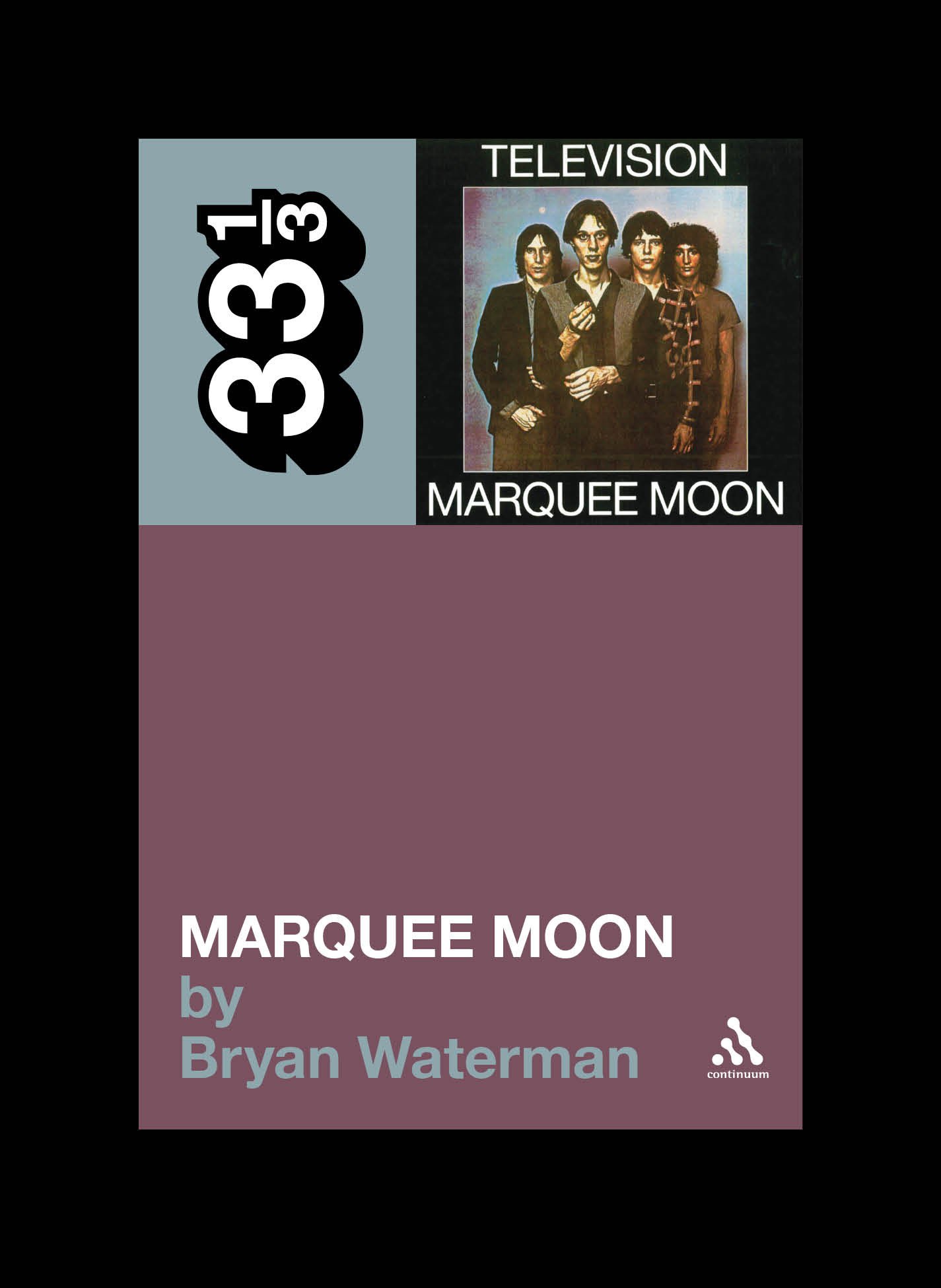
Marquee Moon, by Bryan Waterman

Waterman MarqueeMoon

I’ve enjoyed reading Bryan Waterman’s Marquee Moon (2011), his account of Television’s 1977 debut album, but it doesn’t have the qualities of the best in the 33 1/3 series.  Waterman’s prose is sharp and to the point, and his scepticism about the band’s creation myth absolutely necessary in relation to an era and a musical movement where the modernist tropes of a break with the past were being recycled. What I’m not so sure about it is the amount of detail he goes into in relation to the early 70s New York music scene, and the networks that Tom Verlaine and Richard Hell worked their way into.  His knowledge of the different sub-scenes is admirable, as is his tracking of venues, musical styles and fashion statements, and he presents this information with admirable clarity, never allowing the detail to obscure the basic narrative of the band’s emergence.  But for all those virtues, I felt frustrated, waiting for a discussion of the music itself to come along.  It takes until p.156 (in a book with pp.211 of text) for the band to enter the studio to record Marquee Moon, and the track-by-track analysis doesn’t begin until p.163.  What we get is insightful, but only rarely do Waterman’s insights into the music and lyrics themselves seem to justify the detailed contextualisation that has come in the first five chapters.  What I wanted more of were moments like the one where Waterman finds a trace of New-York-Dolls-style campiness in the chorus to ‘See No Evil’, or when in relation to ‘Venus’ he notes the New York trend of name-dropping one’s contemporaries.  Although Waterman is alive to the ways the music and lyrics might reference other musicians and other genres, the range of  reference he finds in Marquee Moon suggests that the New-York-focused contexualization might have been too narrow: it’s not all the Dolls and the Velvets and Patti Smith; instead there are references to the Robert Johnson, The Yardbirds, and Richard Thompson.

Perhaps I’m being too harsh.  I’ve greatly enjoyed finding out about CBGBs and the New York scene in the early and the mid 1970s; if Waterman were to write another 33 1/3 book I would — depending on the subject — be interested to read it; but the book is a reminder of the gulf that separates contextual knowledge and formal analysis, and the difficulty of making the two connect.